
Table of Contents
When you grip a metal tool, a precision knob, or a barbell, that cross-hatched, textured pattern you feel is called knurling. It seems simple, but achieving a clean, functional, and perfectly repeatable knurl is one of machining’s most misunderstood challenges.
While hand knurling tools exist, modern manufacturing relies on CNC knurling for precision, speed, and quality.
This guide explores the knurling process, from basic types to the high-tech advantages of CNC machining. We’ll cover the critical differences that separate a scrap-worthy part from a perfect one, and how our services ensure you get the latter, every time.
What is Knurling and Why Do We Use It?
Knurling is a manufacturing process, typically performed on a lathe, that creates a pattern of straight, angled, or crossed lines on a workpiece.
The purpose is usually one of three things:
- Functional Grip: This is the most common reason. The raised diamond or straight pattern provides a non-slip surface for hands or fingers (e.g., medical instruments, tool handles, electronic knobs).
- Press Fits: A straight (annular) knurl can increase the effective diameter of a part, creating a tight, secure interference fit when pressed into another component.
- Visual Aesthetics: A clean, crisp knurl simply looks professional and adds a “high-quality” feel to a product.
The Evolution: Hand Knurling vs. Lathe Knurling vs. CNC Knurling
To appreciate the precision of CNC, it helps to understand the alternatives.
- Hand Knurling Tools: These are simple, manually operated tools. They are suitable for hobbyists or one-off repairs, but offer zero control over pressure, depth, or consistency.
- Manual Lathe Knurling Tools: This is the traditional method, using a tool holder on a manual lathe. It relies entirely on the machinist’s skill to set the tool on center, apply the right pressure, and select the correct feeds. It’s prone to errors like “double tracking” (where the tool creates a second, overlapping pattern).
- CNC Knurling: This is the modern standard. Using a CNC lathe, the entire process is controlled by code. The feed rate is exact, the tool pressure is consistent, and the spindle speed is optimized for the material. This eliminates guesswork and ensures every single part in a 10,000-piece run is identical.
The Most Critical Choice: Form Knurling vs. Cut Knurling
This is where true machining expertise comes in, and it’s a topic most guides ignore. The “wheels” that create the knurl can work in two fundamentally different ways: Forming or Cutting.
1. Form Knurling (Material Displacement)
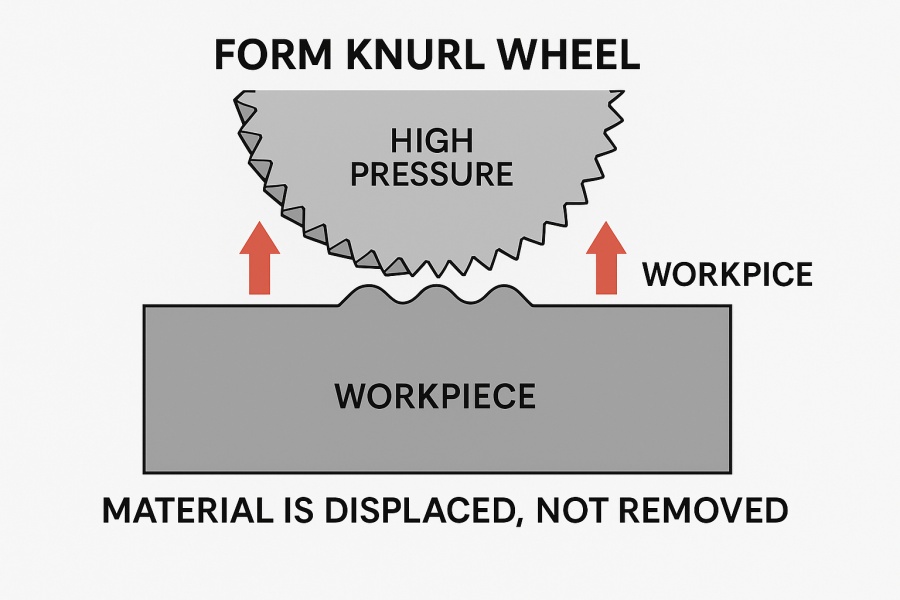
This is the most common method. The knurling wheels are forced into the material, displacing the metal to form the pattern’s peaks and valleys.
- Pros: Very fast, strong pattern.
- Cons:
- High Stress: Puts immense pressure on the part and the machine.
- Diameter Change: The material is displaced, so the part’s final diameter will be larger than the starting diameter. This must be calculated for.
- Material Limits: Does not work well on thin-walled tubes (they will collapse) or certain “gummy” materials. To understand more about the tooling involved in this process, you can refer to specialized Form Knurling tools from Dorian.
2. Cut Knurling (Material Removal)
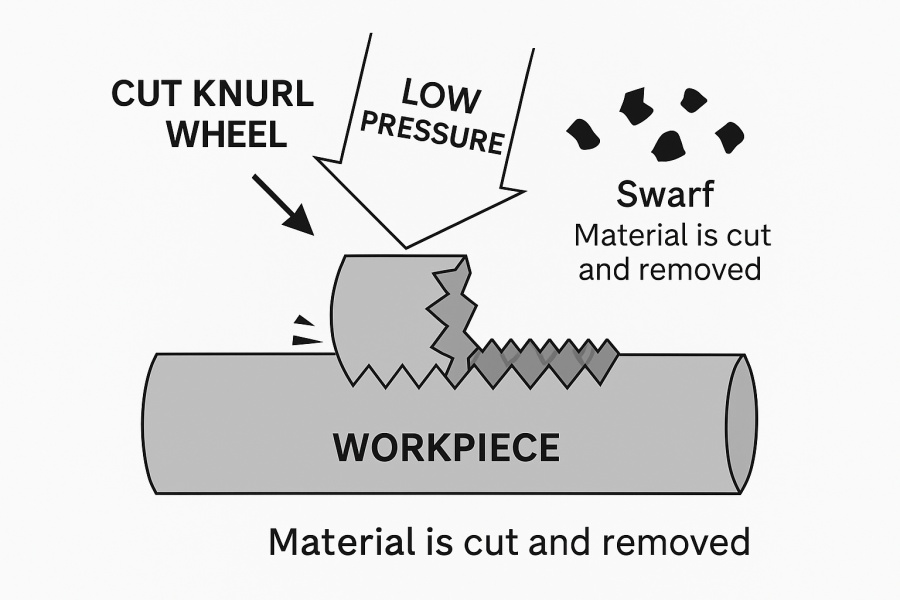
This is a more advanced technique, perfectly suited for CNC control. The knurling wheels have sharp, precisely ground teeth that cut the pattern into the material, removing tiny chips just like a threading tool.
- Pros:
- Low Stress: Puts very little pressure on the part. This is the only way to knurl thin-walled components.
- Precision: Creates a sharper, cleaner, more “perfect” pattern.
- No Diameter Change: The final diameter is the same as the starting diameter (or slightly less).
- Material Versatility: Works beautifully on difficult materials, including plastics, brass, and hardened steels, where form knurling would fail.
- Cons: Slower cycle time (requires more passes).
Our Expertise: At Dongguan Huade Precision Manufacturing Co., Ltd, our CNC programming and tooling capabilities allow us to use both methods. We analyze your part’s material, wall thickness, and functional requirements to select the correct knurling process—a choice that makes the difference between success and failure.
Common Types of Knurling Patterns
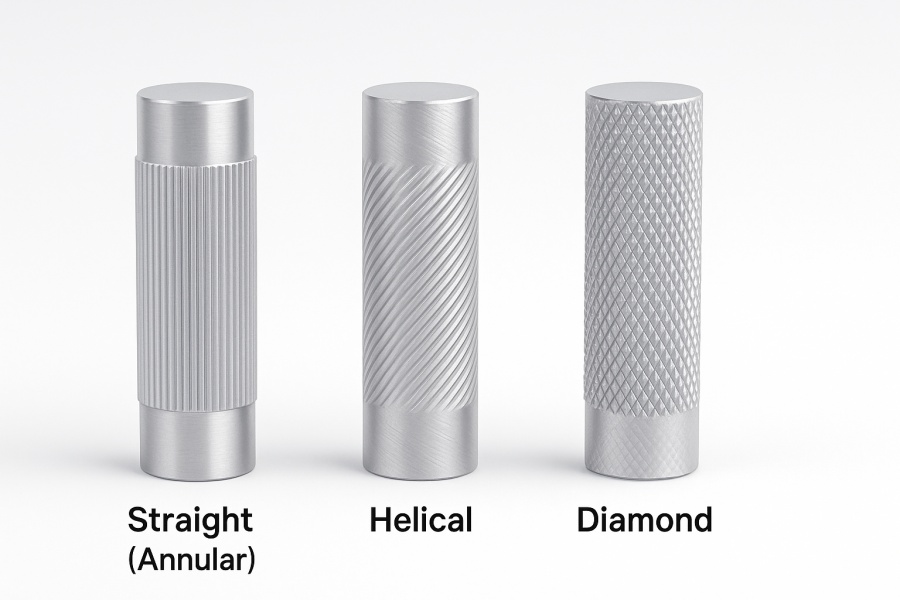
[Image: A clear, side-by-side photo showing a straight knurl, a helical knurl, and a diamond knurl on identical metal dowels.]
While patterns can be complex, they are based on three simple types:
| Pattern Type | Description | Common Uses |
| Straight (Annular) | A series of straight, parallel ridges. | Press fits, simple rotational grip. |
| Helical (Diagonal) | A series of ridges in a left-hand OR right-hand helix. | Grip, aesthetics. Often used in pairs to create a diamond. |
| Diamond | The classic. A combination of left and right-hand helical patterns. | Maximum grip, the “standard” look for knobs and handles. |
Common Knurling Problems That CNC Solves
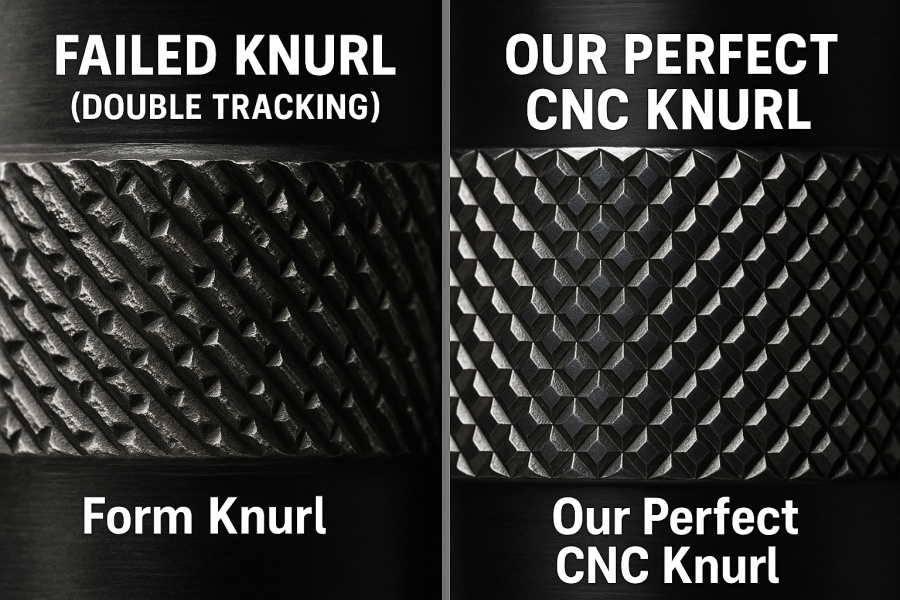
Knurling has a reputation for being tricky. Here are common failures and how our CNC process prevents them:
- The Problem: Double Tracking / Poor Pattern
- The Cause: The tool “skips” or fails to engage the workpiece correctly, creating a messy, overlapping, or uneven pattern. This is common in manual setups with incorrect feed rates.
- The CNC Solution: Our CNC lathes have synchronized feed rates. The tool’s movement is perfectly timed with the spindle’s rotation, forcing the knurl to track perfectly on every revolution.
- The Problem: Material Flaking or Tearing
- The Cause: Using the wrong tool, wrong speed, or (most likely) using a form knurl on a material that needs to be cut (like 6061 Aluminum or some plastics).
- The CNC Solution: We stock both cut and form knurling tools. Our process library dictates the exact speeds, feeds, and tool type for your specified material, ensuring a clean pattern with no flaking.
- The Problem: Inconsistent Depth and Diameter
- The Cause: On a manual lathe, it’s impossible for an operator to apply the exact same pressure for the exact same duration on 1,000 parts.
- The CNC Solution: CNC provides absolute repeatability. The tool’s X-axis depth is programmed to a tolerance of microns, and the Z-axis feed is constant. Every part is a perfect clone.
Your Partner for Precision CNC Knurling Parts
Knurling isn’t just an aesthetic add-on; it’s a critical functional feature. Don’t risk your project on guesswork or inconsistent manual processes.
At Dongguan Huade Precision Manufacturing Co., Ltd, we are experts in precision CNC machining services, and that includes perfect, repeatable knurling. Our advanced CNC turning capabilities allow us to handle everything from a 10-piece prototype run with a delicate cut knurl on a thin-walled aluminum tube, to a 50,000-piece production run of hardened steel knobs. We have the technology and expertise to deliver..
Stop worrying about knurling quality. Let our experts handle it.
Ready to get started? Upload your CAD file or drawing today for a free, no-obligation quote from our engineering team.
 English
 Deutsch
 Español
 Français
 Português do Brasil
 Italiano