
Modern unmanned aerial vehicles rely on highly optimized UAV parts to maintain structural stability, flight accuracy, and long-term reliability. In professional and industrial platforms, these components are no longer generic hardware. They are engineered elements designed around load paths, vibration behavior, and tight integration constraints within compact aircraft systems.
From an engineering perspective, the performance and service life of an aircraft are directly tied to how accurately the parts of a UAV are designed, manufactured, and assembled.
Structural and Mechanical Parts of UAV
A typical UAV platform consists of multiple mechanical subsystems operating under dynamic flight conditions. Core parts of UAV structures include the main airframe, arm interfaces, motor mounting zones, landing gear supports, and mechanical connection points where loads are transferred across the aircraft.
These UAV parts must balance strength, weight, and manufacturability. For this reason, professional manufacturers increasingly rely on CNC aircraft parts rather than cast or molded alternatives. CNC machining allows precise control of geometry at every interface, ensuring correct alignment between propulsion systems, arms, and payload modules.
In aircraft-level assemblies, aircraft CNC machining is especially important wherever coaxiality, flatness, and repeatability are required to prevent vibration amplification during flight.
CNC Machining in UAV Part Manufacturing
In advanced UAV production programs, cnc machining aircraft parts is selected for predictability rather than speed alone. Machined components offer consistent tolerances across repeated batches, stable surface quality at mechanical interfaces, and reduced fatigue risk caused by dimensional variation.
This approach is particularly critical for folding arms, articulated joints, and hinge-based structures that experience repeated motion during deployment and transport. Poor dimensional control in these areas often leads to accelerated wear, loss of stiffness, or long-term alignment issues.
By machining UAV parts from solid billet materials, engineers can remove unnecessary mass while preserving structural integrity in load-critical regions.
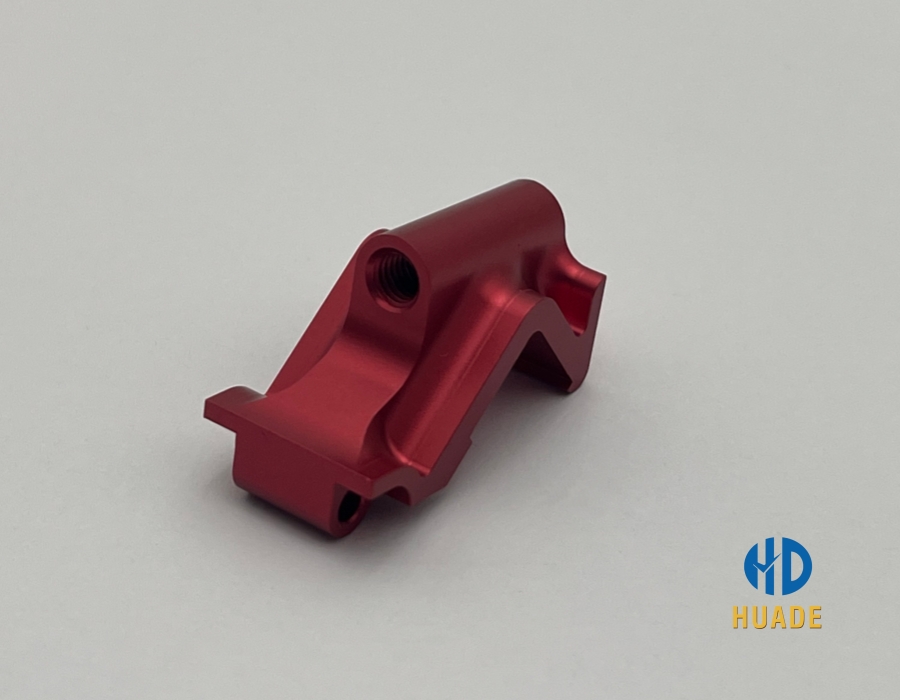
Typical CNC Aircraft Parts Used in UAV Platforms
Across industrial, agricultural, and inspection drone systems, commonly machined UAV parts include:
- Aluminum structural frames and arm connectors
- Motor mounting plates and reinforcement blocks
- Landing gear brackets and impact interfaces
- Payload and gimbal mounting structures
- Precision hinge and articulation components
Each of these parts of UAV contributes directly to flight stability. CNC processes enable tight dimensional control, allowing complex aircraft structures to be assembled without manual fitting or post-adjustment.
Engineering Background from UAV Development Programs
During the development of a long-range inspection UAV for a Southeast Asian engineering team, Daniel Wong, Lead Mechanical Engineer at AeroVision Dynamics Pte. Ltd. (Singapore), reported excessive torsional flex at the arm-to-frame interface during extended cruise flights. The issue became noticeable after repeated vibration testing and long-duration flight trials.
After reviewing the structural layout, Huade’s engineering team worked closely with AeroVision Dynamics to analyze load paths and interface geometry. The investigation identified inconsistent tolerances in the original connection blocks, which amplified vibration transfer from the propulsion system into the main airframe.
To address this, Huade Precision redesigned the interface geometry and manufactured new CNC aircraft parts from solid 7075 aluminum. Following implementation, the updated UAV parts achieved significantly higher stiffness while reducing overall structural weight. Assembly consistency also improved, as repeatable CNC tolerances eliminated the need for manual shimming during installation.
In a separate agricultural UAV platform operating in chemically aggressive environments, Michael Turner, Engineering Manager at GreenDrone Technologies Pty Ltd. (Australia), encountered gradual deformation of standard aluminum arms after several hundred flight hours. Continuous exposure to fertilizers and vibration accelerated material fatigue, leading to alignment drift.
Working together with Huade Precision’s manufacturing and process engineers, the team evaluated material behavior and surface treatment options. Huade produced CNC machining aircraft parts using anodized 6061 aluminum, combined with reinforced arm joints and sealed mechanical interfaces. After deployment, the revised parts of UAV demonstrated stable structural performance with no deformation observed during extended field operation across multiple growing seasons.
Materials Used in High-Performance UAV Parts
Material selection is closely tied to the mechanical role of each UAV component. Structural UAV parts are commonly machined from aluminum alloys for their strength-to-weight ratio, while stainless steel is reserved for wear-prone or high-stress interfaces such as pins and hinge shafts.
Below is a concise engineering-oriented overview of commonly used materials and their typical applications in UAV systems.
Materials × Applications (Lightweight Engineering Reference)
| Material | Typical UAV Application | Key Reason |
|---|---|---|
| 7075 Aluminum | Primary frames, arm connectors | High strength-to-weight ratio |
| 6061 Aluminum | Mounts, brackets, housings | Good machinability and corrosion resistance |
| Stainless Steel | Pins, hinge shafts, wear interfaces | High wear resistance and durability |
| Brass / Specialty Alloys | EMI-sensitive enclosures | Non-magnetic, RF compatibility |
Through aircraft CNC machining, each material can be applied precisely where its mechanical or functional properties provide the most benefit, rather than relying on uniform material choices across the entire aircraft.
Integration and Assembly Considerations for UAV Parts
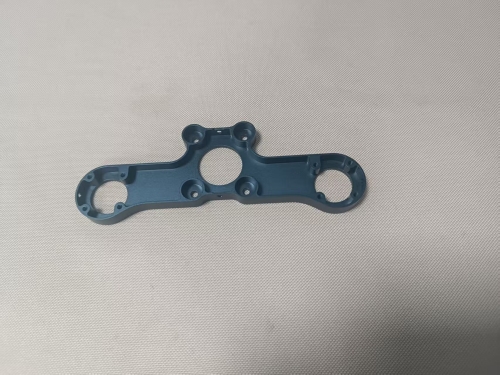
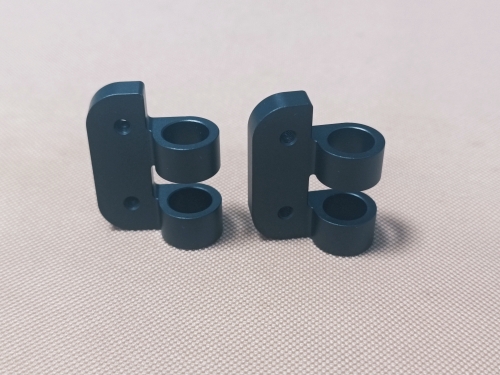
Well-designed parts of UAV must integrate seamlessly across the entire aircraft system. CNC machining ensures repeatable geometry, allowing frames, arms, and moving joints to align without introducing residual stress during assembly.
For manufacturers targeting professional UAV markets, CNC-produced aircraft components provide a scalable path from functional prototyping to low-volume production while maintaining consistent mechanical performance.
CNC Machined UAV Parts from Huade Precision
At Dongguan Huade Precision Manufacturing Co., Ltd., we specialize in UAV parts and CNC aircraft parts for aerospace and drone-related applications. Our machining capabilities support tight tolerances, low-MOQ production, and fast prototyping for structural and mechanical aircraft components.
By combining engineering collaboration with advanced cnc machining aircraft parts processes, we support UAV developers from early-stage design through production-ready platforms.
 English
 Deutsch
 Español
 Français
 Português do Brasil
 Italiano