
Analysis of China’s CNC Machining Price Trends in 2026
CNC machining prices remain one of the most variable costs in manufacturing. Unlike stamping or injection molding, where per-part costs stabilize after tooling investment, CNC machining pricing fluctuates based on geometry complexity, material selection, tolerance requirements, and—most significantly—part size and machine occupancy time.
This guide explains how CNC machining prices are calculated, how to estimate CNC machining cost per hour, and how pricing differs between small precision components and large-scale machining services. Whether you’re sourcing a batch of aluminum brackets or heavy machining services for 500 kg aerospace frames, understanding these pricing mechanics will help you negotiate better and plan budgets accurately.
The Fundamental Cost Structure of CNC Machining
Before diving into part-specific pricing, it’s important to understand that CNC machining price is not simply “hourly rate × time.” A typical machining quote comprises:
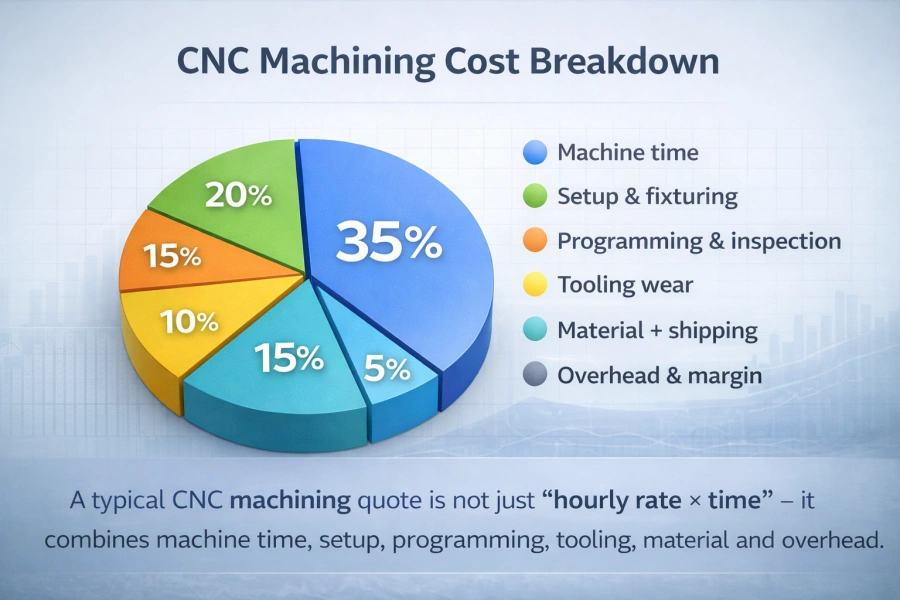
Direct Machine Time Costs: This is the actual spindle-on time multiplied by the machine hourly rate. In China, a 3-axis vertical mill might cost $15–$35/hour, while a 5-axis horizontal machining center runs $20–$80/hour. Large scale machining on heavy-duty gantry mills can reach $200–$300/hour due to equipment capital costs and power consumption.
Of course, the above pricing applies only when you work directly with a CNC machining factory. If you use online sourcing platforms or trading companies instead, the cost may increase by an additional 15–30% on top of this price range.
Setup and Fixturing Costs: Every job requires work-holding design, tool selection, and program verification. For small runs (1–50 parts), setup can represent 30–60% of total project cost. Complex fixtures for machining large parts may require dedicated soft jaws, tombstones, or modular clamps costing $500–$2,000 per setup.
Tool Wear and Replacement: Cutting tools degrade predictably based on material and chip load. Machining aluminum might consume $5–$15 in tooling per part, while hardened stainless steel or Inconel can exceed $80 per part in carbide inserts and specialized endmills.
Programming and Inspection Time: CAM programming for simple geometries takes 2–4 hours; complex 5-axis parts can require 15–30 hours. First-article inspection with CMM verification adds 1–4 hours depending on tolerance requirements.
Material and Shipping Overhead: Raw stock typically adds 20–40% markup over market price. For heavy machining services, shipping 200+ kg parts requires freight considerations that can add $150–$600 per pallet.
Small Part CNC Machining Pricing: The High-Mix, Low-Volume Model
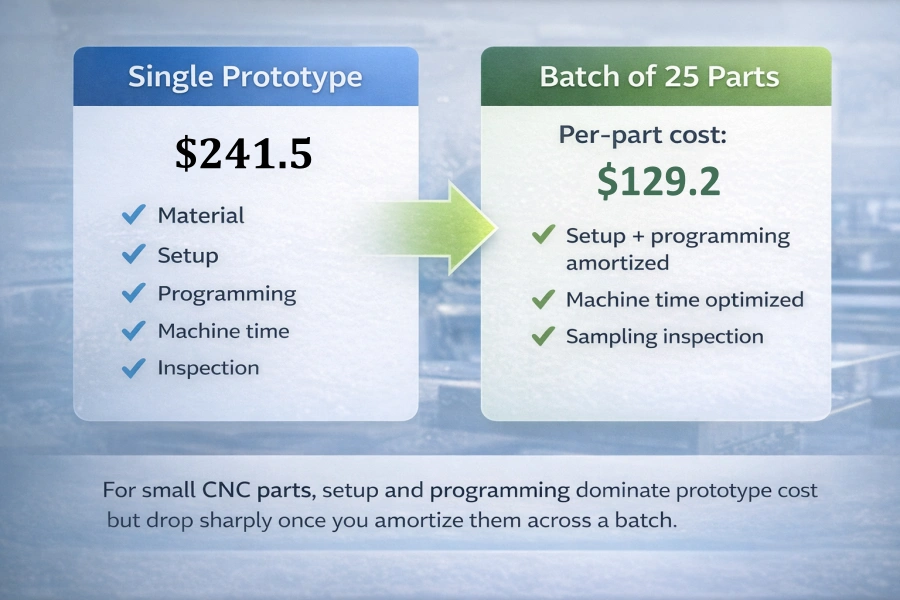
Prototype machining costs drop significantly when setup and programming are amortized over batch quantities.
Small CNC parts (under 10 kg, fitting in 400 mm cube envelope) dominate prototype and low-volume production. These parts benefit from shorter cycle times but carry proportionally higher setup costs.
Typical Small Part Cost Breakdown
A precision aluminum manifold (150 mm × 100 mm × 50 mm) with ±0.01 mm tolerance might quote as follows:
- Material cost: $10 (aluminum 6061-T6 plate)
- Setup time: 2.5 hours @ $18/hour = $45
- Machining time: 4.2 hours @ $20/hour = $84
- Tool consumption: $20
- Programming: 3 hours @ $20/hour = $60
- Inspection: 1.5 hours @ $15/hour = $22.5
- Total for first part: $241.5
For a batch of 25 parts, setup and programming are amortized:
- Setup/programming: $105 ÷ 25 = $4.2 per part
- Machine time: $84 per part (reduced to $80 with optimized batch nesting)
- Material + tooling: $30 per part
- Inspection: $15 per part (sampling inspection)
- Total per part in batch of 25: $129.2
This illustrates the dramatic economies of scale in CNC machining: the first prototype costs $241.5, but the 25th part costs $129.2—a 53% reduction.
Large Part CNC Machining Pricing: Equipment Access and Material Handling
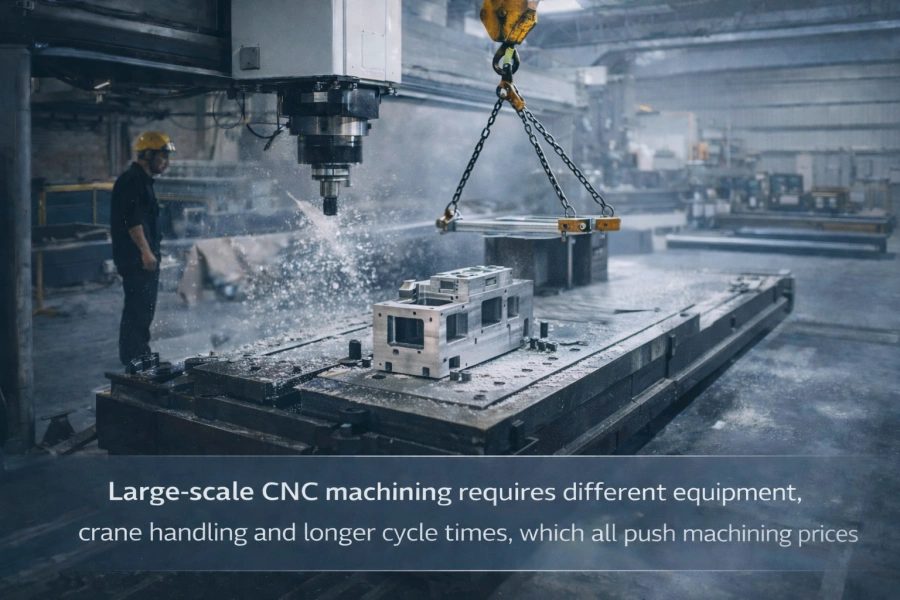
Heavy CNC components require crane handling, special fixtures, and longer machining cycles.
Machining large parts introduces cost multipliers absent in small-part production. A component measuring 1,200 mm × 800 mm × 300 mm and weighing 180 kg requires fundamentally different infrastructure.
Cost Drivers Unique to Heavy Machining Services
Machine Availability Premium: Only 15–20% of machine shops can accommodate parts exceeding 1,000 mm. This scarcity creates a 20–35% premium on cnc machining price for large components.
Crane and Handling Time: Loading a 180 kg workpiece requires overhead crane operation, alignment fixtures, and often two operators. Budget 0.5–1.5 hours per setup at blended labor rates of $90–$120/hour.
Extended Cycle Times: Large parts require conservative feeds and speeds to prevent chatter and maintain surface finish. A small part might rough at 8,000 RPM with 2,500 mm/min feed; large scale machining often runs 1,200 RPM at 800 mm/min, tripling cycle time per cubic centimeter removed.
Chip Evacuation and Coolant Management: Removing 40–60 kg of chips from a large cavity requires high-pressure coolant systems and frequent tool clearing. This adds 15–25% to active machining time.
Inspection Complexity: CMM measuring a 1,200 mm part takes 3–6 hours versus 45 minutes for a 150 mm part. Portable arm CMMs or laser trackers may be required, adding $200–$400 to inspection costs.
Real-World Large Part Pricing Example
Consider a 1,000 mm × 600 mm × 200 mm aluminum plate (80 kg finished weight) with integrated ribs and mounting bosses:
- Material cost: $640 (aluminum 7075 plate, 120 kg rough stock)
- Setup time: 4 hours @ $110/hour = $440
- Machining time: 18 hours @ $80/hour (5-axis horizontal mill) = $1,440
- Tool consumption: $285
- Programming: 12 hours @ $50/hour = $600
- Inspection: 4.5 hours @ $30/hour = $135
- Handling/crane time: 2 hours @ $50/hour = $100
- Total for first part: $3,640
For a batch of 10 parts:
- Amortized setup/programming: $104 per part
- Machine time: $1,350 per part (10% efficiency gain)
- Material + tooling: $925 per part
- Inspection: $135 per part (sampling)
- Handling: $80 per part
- Total per part in batch of 10: $2,594
Machining Cost Calculation Formula
While quotes vary by shop capability and overhead, this formula provides a baseline for machining quote process estimation:
Total Part Cost = (Setup Cost / Batch Qty) + (Machine Rate × Cycle Time) + (Material Cost × 1.3) + (Tool Wear × Passes) + (Programming Hours × Eng Rate) + (Inspection Time × QC Rate) + Handling
Where:
- Setup Cost = fixture build + first-article setup time
- Machine Rate = shop hourly rate for specific machine class
- Cycle Time = roughing + finishing + tool changes + repositioning
- Material Cost × 1.3 = raw stock plus 30% handling markup
- Tool Wear = predictable consumption based on material hardness
- Programming Hours = CAM time + simulation + post-processing
- Inspection Time = CMM or manual verification against drawing
- Handling = material receiving + crane time + packaging/shipping
Comparative Pricing Table: Small vs Large CNC Parts

| Factor | Small Parts (<10 kg) | Large Parts (80–300 kg) |
|---|---|---|
| Machine Rate | $15–$80/hour | $150–$250/hour |
| Setup Amortization | Break-even at 15–25 parts | Break-even at 5–10 parts |
| Typical Lead Time | 2–5 days | 7–15 days |
| Tooling Cost/Part | $8–$100 | $80–$350 |
| Material Markup | 25–35% | 30–45% |
| Inspection Time | 0.5–2 hours | 3–8 hours |
| Handling Overhead | Negligible | $75–$250 per part |
| Prototype Cost Range | $200–$1,200 | $3,500–$15,000 |
| Production Cost (qty 50) | $120–$480/part | $2,200–$8,500/part |
Tolerance Requirements and Their Impact on CNC Machining Cost Per Hour
Tolerance specification is the single largest pricing variable after part size, and one of the biggest drivers of CNC machining cost per hour. Standard commercial tolerances (±0.127 mm / ±0.005″) require no premium. However, precision tolerances trigger multiple cost multipliers:
±0.05 mm tolerance: Adds 15–25% to machining time due to reduced feeds, additional spring passes, and in-process measurement.
±0.01 mm tolerance (as offered by Dongguan Huade Precision Manufacturing): Requires climate-controlled environment, tool presetting, mid-cycle probing, and 100% CMM verification. Expect 40–60% cost increase over standard tolerance, significantly affecting your CNC machining cost per hour.
±0.005 mm (sub-micron) tolerance: Mandates grinding or EDM finishing operations, premium measurement equipment, and often sub-contracted specialized processes. Can double or triple base on CNC machining pricing.
For large scale machining, tight tolerances compound exponentially. Holding ±0.02 mm across a 1,200 mm dimension requires thermal compensation algorithms, coolant temperature stabilization, and multi-point verification—capabilities available in fewer than 5% of machine shops.
Additionally, part geometry has a major impact on CNC machining price and can significantly influence your CNC machining cost per hour. A simple parallel plate can sometimes cost up to ten times less to machine compared to a part with complex or multi-surface geometries.
Material Selection and Its Impact on CNC Machining Pricing
Material choice drives both cycle time and tool consumption. Using the Machinability Index (with 1018 steel = 100%), common materials rank:
- Aluminum 6061: Index 200–300 | Low tool wear | High speeds possible
- Brass: Index 150–200 | Excellent surface finish | Moderate cost
- Steel 1018: Index 100 (baseline) | Standard tooling | Reference point
- Stainless 304: Index 40–50 | High tool wear | 2.5× cycle time vs aluminum
- Titanium Ti-6Al-4V: Index 15–20 | Extreme tool wear | 6× cycle time vs aluminum
- Inconel 718: Index 8–12 | Requires carbide/ceramic tools | 10× cycle time vs aluminum
When requesting a machining quote process, specify material early. Switching from aluminum to stainless steel mid-design can increase part cost by 120–180% on identical geometry.
The Hidden Costs Behind CNC Machining Price
CNC machining rarely delivers finished parts. Secondary operations add measurable costs:
- Deburring: $2–$6 per part (manual), $0.8–$2 (vibratory finishing)
- Anodizing (aluminum): $1.50–$3.50 per square decimeter
- Passivation (stainless): $25–$60 per batch
- Powder coating: $6–$15 per part for small components
- Engraving/marking: $1–$3.5 per part
- Heat treatment: $6–$25 per part depending on process
For machining large parts, finishing costs scale disproportionately. Anodizing a 1,200 mm aluminum frame might cost $55 versus $3.5 for a small bracket.
Rapid Prototyping vs Production Runs: When CNC Machining Prices Shift

Example of small-batch CNC machined aluminum and brass components produced by Dongguan Huade Precision Manufacturing, illustrating real-world CNC machining prices.
Prototype machining emphasizes speed over efficiency. Shops prioritize 2–3 day rapid prototyping by:
- Using manual programming instead of optimized CAM (faster setup, slower cycle)
- Running single parts with generous tool paths (less risk, more time)
- Skipping custom fixtures in favor of standard vises (faster setup, limited geometry access)
This approach works for quantities of 1–10 parts. Beyond 15–20 parts, production-optimized processes become cost-effective:
- Custom fixture development: $800–$2,500 one-time cost, saves 30–50% per-part cycle time
- Pallet systems: Allow lights-out machining, reducing labor allocation
- Optimized tool paths: CAM refinement can reduce cycle time 20–35%
- Dedicated inspection fixtures: CMM programs and go/no-go gauges speed verification
The crossover point typically occurs at quantities of 12–25 parts for small components, 6–12 parts for heavy machining services.
Geographic Factors That Influence CNC Machining Price
In 2026, global sourcing trends show that CNC machining price varies 35–55% depending on region, certification level, and material type.
US-based machining shops charge $55–$140/hour for 3-axis work, $110–$220/hour for 5-axis. Asian manufacturers like Dongguan Huade Precision Manufacturing Co., Ltd. offer comparable quality at $15–$35/hour for 3-axis, $20–$80/hour for 5-axis.
However, international sourcing introduces:
- Shipping lead time: 15–30 days ocean freight vs 2–5 days domestic
- Freight costs: $450–$1,200 per pallet for ocean shipping
- Communication cycles: Time zone differences add 1–2 days per revision
- Import duties: 0–7.5% for machined metal parts under current tariffs
For prototypes and low quantities (1–50 parts), domestic sourcing often proves cost-competitive when accounting for total landed cost and iteration speed. For production runs (1000+ parts), international CNC machining prices typically deliver 35–55% savings even after shipping and duties.
How to Request an Accurate CNC Machining Price Quote
To obtain competitive quotes without multiple revision cycles:
- Provide CAD models (STEP or IGES format) rather than just 2D drawings
- Specify tolerances explicitly—only call out tight tolerances where functionally required
- Indicate production volume and timeline—shops price prototypes differently than production
- Clarify material and finish requirements upfront
- Note inspection requirements—first article report, material certs, CMM data
- Ask about design-for-manufacturability feedback—experienced shops can suggest cost-saving geometry modifications
Shops with robust machining quote processes will return detailed breakdowns showing setup, machine time, material, and tooling separately. Beware of quotes showing only a total price—this limits your ability to negotiate or understand cost drivers.
Optimizing Your Design to Reduce CNC Machining Prices
Engineering decisions made during design freeze have 10× more cost impact than vendor selection:
Minimize depth-to-diameter ratios: Deep pockets requiring long-reach tools slow feeds by 40–60% and increase tool deflection.
Specify standard tool sizes: Custom tooling adds $150–$600 per geometry feature. Design cavities and radii around standard endmill sizes (3 mm, 6 mm, 12 mm, etc.).
Reduce setup count: Parts requiring multiple orientations multiply setup costs. Consolidating features accessible from one setup direction can cut costs 25–40%.
Avoid unnecessary tight tolerances: Each tolerance band reduction roughly doubles inspection time. Reserve ±0.01 mm or tighter for critical mating surfaces only.
Material thickness optimization: For large parts, reducing plate thickness from 40 mm to 30 mm can cut material cost 25% and reduce machining time 15–20% through decreased roughing passes.
Why Choose Dongguan Huade Precision Manufacturing for Competitive CNC Machining Prices
Dongguan Huade Precision Manufacturing Co., Ltd. bridges the gap between rapid prototyping agility and production-volume efficiency. Our capabilities include:
- Low minimum order quantities: We accept orders from single prototypes to production batches of 10,000+ parts
- ±0.01 mm precision machining: Climate-controlled facilities with Zeiss CMM verification
- 2–3 day rapid prototyping: Express service for urgent development timelines
- Full material range: Aluminum alloys (6061, 7075, 2024), stainless steel (303, 304, 316), brass, copper, engineering plastics (PEEK, Delrin, PTFE)
- Full material range: Aluminum alloys (2000, 5000, 6000, 7000 series), stainless steel (303, 304, 316, SS316, 316L), brass, copper, engineering plastics (PEEK, ABS, Delrin, PTFE, etc.)
- Integrated CNC milling and turning: Complete part finishing without outsourcing secondary operations
- Manufacturing processes: Integrated CNC milling, CNC turning, sheet metal bending, and surface finishing for complete in-house part finishing without outsourcing
- Large part capability: Up to 1,500 mm envelope with heavy-duty machining centers
Our transparent machining quote process provides itemized breakdowns of setup, machine time, material, and inspection—allowing you to make informed decisions and optimize for cost or speed based on project priorities.
Conclusion: Making Data-Driven Decisions on CNC Machining Prices
Understanding the cost mechanics behind CNC machining enables better vendor selection, design optimization, and budget forecasting. Small parts benefit from batch economies of scale after 50–100 units, while large scale machining sees cost reduction at lower quantities due to higher per-part machine time.
The key variables—tolerance requirements, material selection, part size, and production quantity—interact multiplicatively rather than additively. A large stainless steel part with ±0.01 mm tolerances might cost 15× more than a small aluminum part with standard tolerances, not simply 3× for each variable.
By providing complete specifications, understanding the true cost drivers, and working with experienced manufacturers, you can secure competitive CNC machining prices without sacrificing quality or lead time.
Ready to get an accurate CNC machining price for your part?
Contact us and upload your CAD files to hdproto.com and receive a detailed, itemized CNC machining quote within 24 hours..
 English
 Deutsch
 Español
 Français
 Português do Brasil