
Table of Contents
Introduction: Why CNC Machining Cost Remains Difficult to Predict
Understanding CNC machining cost is essential for accurate budgeting, smart design decisions, and choosing the right manufacturing partner. Yet many engineers and buyers struggle with cost prediction because CNC machining does not follow a fixed-pricing model—every part has unique geometry, tolerances, materials, and machining requirements that affect total cost.
This guide breaks down CNC machining cost step by step, explaining machine-hour rates, setup cost, complexity multipliers, tolerance impact, and real industry benchmark data. Whether you’re sourcing a single prototype or planning a production run, this article gives you a complete, engineering-level framework to calculate CNC machining cost with confidence.
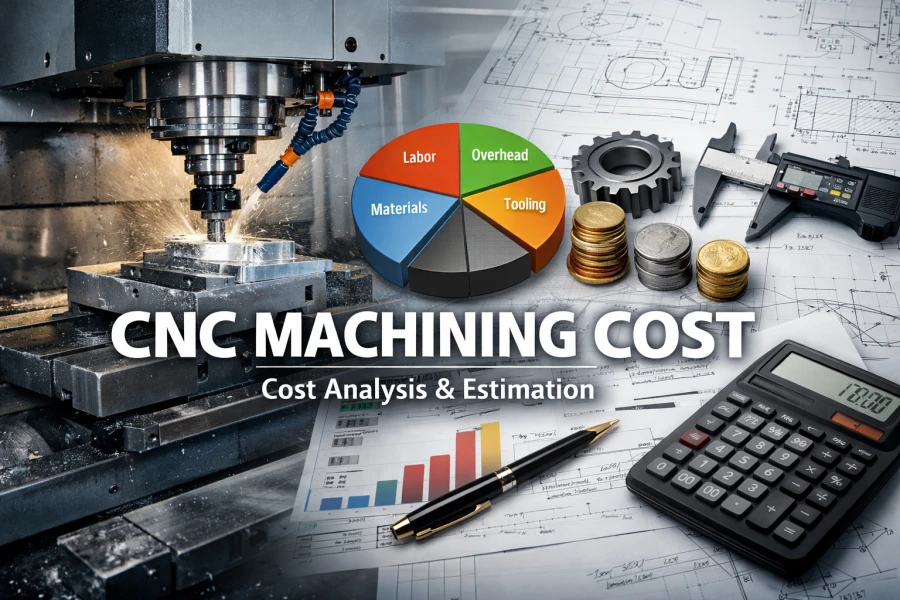
The Machine-Hour Rate: Foundation of CNC Machining Cost Calculation
Every CNC machining cost estimation begins with the machine-hour rate—the fundamental unit cost that shops use to price spindle time. However, the “rate” is not simply an arbitrary number but a calculated recovery of seven distinct cost categories.
Components of CNC Machining Cost Per Hour
Capital Equipment Depreciation: A new 3-axis vertical machining center costs $75,000–$180,000. Amortized over 10 years at 4,000 annual operating hours yields $1.88–$4.50 per hour in equipment recovery. Five-axis machines costing $350,000–$800,000 add $8.75–$20.00 per hour.
Facility Overhead Allocation: Rent, utilities, climate control, compressed air, and facility maintenance distribute across all machines. A 10,000 square foot shop with $18,000 monthly overhead running 12 machines at 3,500 hours annually allocates approximately $5.14 per machine-hour.
Direct Labor Cost: CNC operators earn $22–$38 per hour in US markets. With payroll taxes and benefits multiplying base wages by 1.35–1.45, the true labor cost reaches $30–$55 per hour. One operator typically runs 1–3 machines simultaneously, distributing this cost accordingly.
Tooling Consumption: Cutting tools wear predictably. A shop running 70% aluminum, 20% steel, and 10% stainless might average $8–$14 per machine-hour in carbide endmills, drills, and inserts. Hard materials or precision work increases this to $25–$45 per hour.
Maintenance and Repair Reserve: Preventive maintenance, spindle rebuilds, ballscrew replacement, and unexpected repairs average 4–7% of equipment value annually. For a $120,000 machine, this represents $4,800–$8,400 yearly, or $1.20–$2.10 per operating hour.
Utility Consumption: A typical machining center consumes 8–15 kW under load, plus coolant chiller and air compressor demand. At $0.12 per kWh, direct power costs add $1.10–$2.20 per hour.
Profit Margin and Business Risk: Shops target 20–35% gross margin to cover sales, engineering, administration, and profit. This multiplier transforms direct costs into billable rates.
Calculating the True Cost of CNC Machining Per Hour
Using the components above, a typical 3-axis machining center hourly rate calculation:
- Equipment depreciation: $3.20
- Facility overhead: $5.14
- Labor (one operator, two machines): $22.50
- Tooling average: $11.00
- Maintenance reserve: $1.65
- Utilities: $1.80
- Subtotal direct cost: $45.29
- Profit margin (28%): $12.68
- Total billable rate: $57.97/hour
This explains why asking “how much does CNC machining cost per hour” yields answers ranging from $45 to $95 for 3-axis work—shops vary in their overhead structure, labor markets, equipment age, and profit expectations.
For 5-axis machining, the calculation shifts:
- Equipment depreciation: $14.50
- Facility overhead: $5.14
- Labor (dedicated operator): $42.00
- Tooling average: $18.50
- Maintenance reserve: $4.20
- Utilities: $2.40
- Subtotal direct cost: $86.74
- Profit margin (30%): $26.02
- Total billable rate: $112.76/hour
How Much Does CNC Machining Cost? A Framework-Based Answer
The question “how much does CNC machining cost” requires context-specific variables. Rather than a single number, engineers should think in terms of a cost equation:
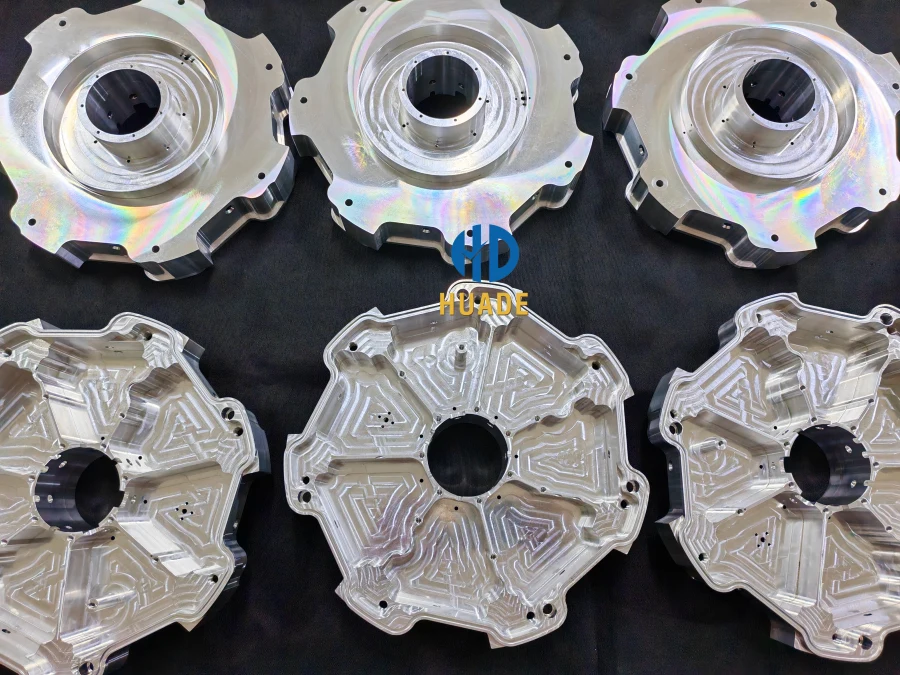
High-complexity multi-axis CNC machined parts significantly increase cycle time and programming cost.
Total Part Cost = (M × H × C × T) + S + I + F
Where:
- M = Base machine-hour rate
- H = Estimated cycle time in hours
- C = Complexity multiplier (1.0–2.8)
- T = Tolerance multiplier (1.0–2.2)
- S = Setup cost
- I = Inspection cost
- F = Finishing and secondary operations cost
This framework shifts the question from “what does it cost” to “what drives variance in my specific application.”
The Complexity Multiplier in CNC Machining Costs
Geometric complexity affects both cycle time and programming effort. We can quantify this through a complexity scoring system:
Complexity Factor 1.0: Simple prismatic geometry, orthogonal features only, no undercuts, 2.5D milling from one setup. Example: flat mounting plate with through-holes and counterbores.
Complexity Factor 1.4: Multiple setups required, simple 3D contouring, standard fillets and chamfers, basic pocket milling. Example: aluminum enclosure with internal ribs.
Complexity Factor 1.8: Compound angles, sculptured surfaces, 4-axis indexing required, thin-wall features requiring careful tool path planning. Example: turbine blade or impeller housing.
Complexity Factor 2.4: Full 5-axis simultaneous contouring, multiple datum relationships, intricate organic geometry, extensive tool clearance analysis needed. Example: medical implant or aerospace structural fitting.
This multiplier affects both machine time (through conservative feeds/speeds) and programming hours (CAM complexity). A part estimated at 3.0 hours base cycle time with complexity factor 1.8 actually requires 5.4 hours of spindle time, dramatically changing the cost of CNC machining per hour impact on total price.
The Tolerance Multiplier Effect
Tolerance requirements exponentially influence CNC machining cost calculation. This relationship is not linear but follows a stepped progression:
| Tolerance Range | Cost Multiplier | Additional Requirements |
|---|---|---|
| ±0.13 mm (±0.005″) | 1.0× (baseline) | Standard shop practices |
| ±0.05 mm (±0.002″) | 1.15–1.25× | Tool presetting, mid-cycle verification |
| ±0.025 mm (±0.001″) | 1.35–1.55× | Temperature control, probe verification |
| ±0.013 mm (±0.0005″) | 1.70–2.00× | CMM inspection, spring passes, tight process control |
| ±0.005 mm (±0.0002″) | 2.20–2.80× | Grinding operations, climate control, statistical process control |
When engineers specify ±0.01 mm precision across all features “to be safe,” they unknowingly multiply CNC machining costs by 1.4–1.7× versus applying tight tolerances only where functionally required. This represents the single highest-impact cost reduction opportunity in most designs.
Industry Benchmark Data: CNC Machining Cost Per Hour by Market Segment
Machine shop rates vary significantly by industry vertical due to certification requirements, equipment sophistication, and typical lot sizes.
General Machine Shop Rates
Job Shop (Mixed Work): $52–$78/hour for 3-axis milling, $95–$140/hour for 5-axis. These shops prioritize flexibility over specialization, accept one-off prototypes, and maintain broad material capabilities.
Production Machining (Volume Focus): $48–$68/hour for 3-axis, $85–$115/hour for multi-axis. Higher efficiency through dedicated fixtures, optimized tool paths, and lights-out machining offset lower rates with faster throughput.
Prototype and R&D Shops: $70–$110/hour for 3-axis, $125–$180/hour for 5-axis. Premium pricing reflects rapid turnaround capability, engineering support, and design-for-manufacturing consultation included in service.
Aerospace Machining Cost Benchmarks
AS9100-certified aerospace machining requires traceability, advanced inspection, and often exotic materials:
- 3-axis aerospace work: $85–$125/hour
- 5-axis titanium/Inconel machining: $165–$240/hour
- First article inspection overhead: +$400–$1,200 per part
- Material certifications and lot traceability: +$75–$180 per order
These rates reflect not just equipment but the quality system overhead, inspection rigor, and material handling protocols aerospace work demands.
Medical Device Machining Rates
ISO 13485-certified medical machining carries similar quality burdens:
- 3-axis precision work: $75–$115/hour
- 5-axis implantable component machining: $145–$210/hour
- Biocompatibility documentation: +$200–$500 per material/process combination
- Validation and process qualification: +15–25% project overhead
Automotive Prototyping Benchmarks
Automotive prototype machining operates at higher volumes than aerospace but tighter timelines:
- 3-axis aluminum work: $58–$88/hour
- 5-axis complex geometry: $110–$155/hour
- Reverse engineering and scanning services: +$95–$140/hour
- Rush surcharges (sub-48-hour delivery): +30–50%
Robotics and Consumer Electronics Machining
These sectors prioritize cost efficiency and rapid iteration:
- 3-axis aluminum housings: $50–$75/hour
- Precision bearing bores and alignments: $68–$95/hour
- Anodizing and surface finishing: +$25–$65 per part
- Low-volume production (100–500 units): $45–$70/hour with optimized fixturing
The Setup Cost Problem in CNC Machining Cost Estimation
Setup cost represents the non-recurring engineering and preparation work required before the first chip falls. For low quantities, setup can exceed actual machining cost.
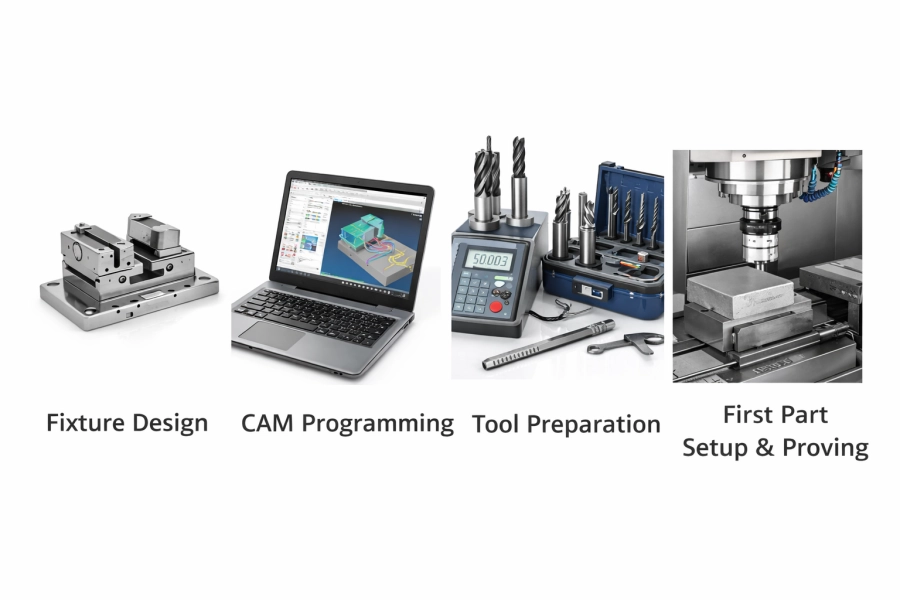
Key components of CNC setup cost: fixture design, CAM programming, tool preparation, and first-part proving.
Setup Cost Components
Fixture Design and Fabrication: Custom work-holding might require CAD design (2–4 hours), soft jaw machining (3–6 hours), and verification (1–2 hours). Total cost: $400–$900.
CAM Programming: A skilled CAM programmer requires 1–3 hours for simple geometry, 6–15 hours for complex multi-axis work. At $65–$95/hour programming rates, this adds $65–$1,425.
Tool Preparation: Selecting, presetting, and organizing cutting tools takes 0.5–2.0 hours depending on job complexity.
First Part Setup and Proving: Loading material, work offset establishment, program verification, and first-article machining consumes 1–4 hours of machine time at full billable rates.
Total Setup Range: $500–$3,200 for a typical precision part.
Setup Amortization Formula
The setup cost impact per part follows this relationship:
Per-Part Setup Cost = Total Setup Cost ÷ Batch Quantity
For a job with $800 setup cost:
- Quantity 1: $800.00 per part
- Quantity 5: $160.00 per part
- Quantity 25: $32.00 per part
- Quantity 100: $8.00 per part
This explains why prototype machining quotes appear expensive—a $45 part at quantity 100 might quote at $285 for a single prototype when setup is included.
Material Cost Influence Model in CNC Machining Cost Calculation
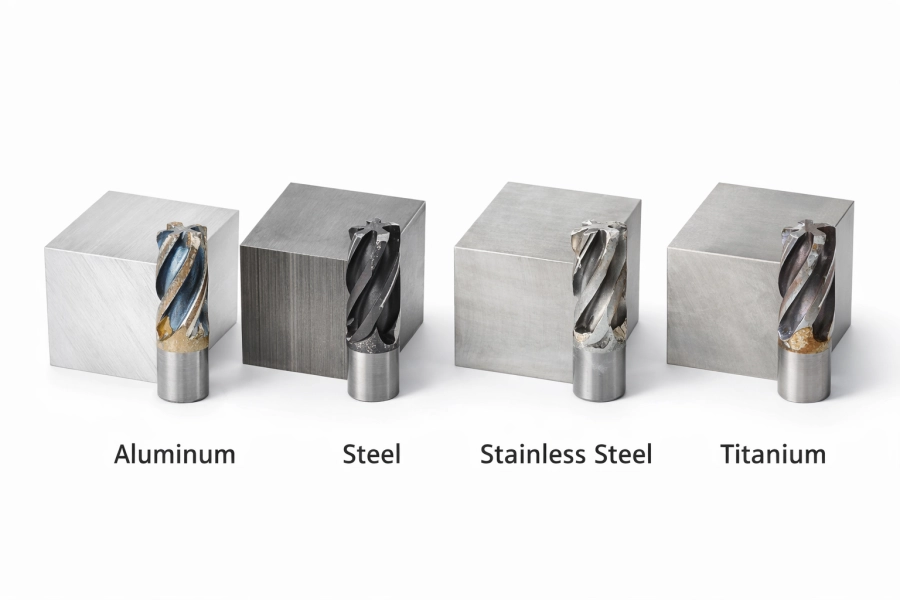
Material hardness directly affects tool wear and CNC machining efficiency.
Material selection impacts both raw stock cost and machining efficiency. The total material influence combines purchase cost, yield efficiency, and machinability.
Material Cost Structure
Raw material pricing varies dramatically:
- Aluminum 6061-T6: $4.50–$6.80 per kg
- Aluminum 7075-T6: $9.20–$13.50 per kg
- Stainless steel 304: $5.80–$8.20 per kg
- Stainless steel 316: $7.50–$10.80 per kg
- Brass C360: $8.90–$12.40 per kg
- Titanium Ti-6Al-4V: $35.00–$52.00 per kg
- Inconel 718: $48.00–$75.00 per kg
Machine shops apply 25–40% markup on material costs to cover procurement, inventory carrying cost, and handling overhead.
Material Efficiency and Buy-to-Fly Ratio
The buy-to-fly ratio describes how much raw stock you purchase versus how much ends up in the finished part. This dramatically affects how much does CNC machining cost:
Low-complexity parts: 2:1 ratio (50% material utilization) Medium-complexity parts: 4:1 ratio (25% material utilization) High-complexity aerospace parts: 10:1 or higher (10% material utilization or less)
For a 2 kg finished aluminum part with 5:1 buy-to-fly ratio, you purchase 10 kg of stock at $5.50/kg with 35% markup = $74.25 material cost, even though only $11.00 remains in the part. This inefficiency is inherent to subtractive manufacturing.
Machinability Impact on Cycle Time
Material hardness and chip formation characteristics affect achievable metal removal rates:
Aluminum alloys: Baseline efficiency. High speeds (10,000+ RPM) and feeds (3,000+ mm/min) possible.
Brass: 85% of aluminum efficiency. Excellent surface finish but slightly lower removal rates.
Mild steel: 40% of aluminum efficiency. Moderate speeds (3,500 RPM) and conservative feeds required.
Stainless steel: 25% of aluminum efficiency. Generates heat, requires coolant management, tools wear 3–4× faster.
Titanium: 15% of aluminum efficiency. Extreme tool wear, slow feeds essential to prevent work hardening.
Inconel: 10% of aluminum efficiency. Requires carbide or ceramic tooling, frequent tool changes, thermal management critical.
When a designer switches from aluminum to stainless steel without understanding machinability impact, cycle time increases 4×, tooling cost increases 3×, and total CNC machining costs rise 180–220% even with identical geometry.
Hidden Cost Factors in CNC Machining Cost Estimates
Procurement teams focused solely on quoted part price often miss ancillary costs that inflate total program expense.
Revision and Engineering Change Cost
Design iterations during development create rework costs. If a prototype requires geometry changes after first article:
- CAM re-programming: 40–60% of original programming time
- Fixture modification or re-work: $150–$600
- Scrapped material from obsolete parts: full material cost
- Delay cost in development timeline: opportunity cost
Shops with strong engineering support identify manufacturability issues during quote review, preventing costly downstream changes. This service has quantifiable value even if not line-itemed.
Quality Escapes and Scrap Rate
No manufacturing process achieves 100% yield. CNC machining typically runs 96–99.5% first-pass yield, but the 0.5–4% scrap rate affects cost:
Industry scrap rate allowances:
- Simple geometry, loose tolerance: 1–2%
- Complex geometry, standard tolerance: 2–4%
- High-precision work, tight tolerance: 3–6%
Shops build scrap allowance into pricing. A batch of 100 parts might actually require 104 parts to be machined to guarantee 100 good parts, adding 4% to total cost.
Inspection Overhead by Verification Level
Visual inspection only: Included in machining rate, no upcharge
Dimensional inspection (random sampling): +$25–$75 per batch
First article inspection report (FAIR): +$200–$600 per part number
100% CMM verification: +$15–$45 per part depending on feature count
Statistical process control documentation: +$300–$800 per production run
When comparing quotes, verify what inspection is included. The lowest quoted part price may exclude critical verification, creating downstream quality risk.
Minimum Order Charges
In America, many shops impose minimum order values ($250–$750) regardless of part cost. For inexpensive parts, this creates effective price floors:
- Part machining cost: $18
- Minimum order: $500
- Effective price until quantity 28: $17.86–$500 depending on quantity
But if you choose to source in China, low-MOQ manufacturers such as Dongguan Huade Precision Manufacturing Co., Ltd. remove this barrier — allowing you to produce even a single prototype at a truly economical unit cost.
Strategies to Reduce CNC Machining Cost Without Compromising Quality
Cost reduction in CNC machining comes from intelligent design decisions and strategic sourcing, not aggressive price negotiation alone.
Design for Manufacturability Optimization
Standard tool access: Design features accessible with standard endmill lengths (3×D depth maximum). Deep pockets requiring 6×D or 8×D tools slow feeds by 40–60% and increase tool cost.
Tolerance rationalization: Apply ±0.013 mm or tighter tolerances only on critical mating surfaces. Use ±0.13 mm standard tolerances elsewhere. This single change can reduce machining costs 25–40%.
Feature consolidation: Combine multiple components into single machined parts where feasible. Eliminating assembly operations and fasteners often justifies higher machining cost.
Material selection: Specify aluminum alloys (6061, 7075) unless strength or environment requires steel or exotics. Aluminum machines 4× faster than stainless, dramatically reducing cycle time cost.
Standard hole sizes: Design clearance holes and tapped holes around standard drill and tap sizes. Avoiding metric/inch mixing and odd sizes prevents tool procurement delays and costs.
Batch Quantity Optimization
The setup amortization curve creates distinct cost efficiency zones:
Quantities 1–5: Prototype pricing dominates. Focus on design iteration speed, not cost per part.
Quantities 6–25: Setup amortization becomes significant. Consider ordering slightly higher quantities if any design uncertainty remains.
Quantities 25–100: Production pricing begins. Custom fixturing becomes cost-effective. Request production-optimized CAM.
Quantities 100+: Dedicated tooling, pallet systems, and lights-out machining maximize efficiency. Negotiate annual pricing agreements for recurring parts.
Geographic and Strategic Sourcing
US domestic shops: Best for iterative prototyping, tight communication loops, 2–5 day lead times, no import complexity. Cost: baseline.
Asian manufacturers (e.g., Dongguan Huade Precision Manufacturing Co., Ltd): Best for production quantities, stable designs, 15–30 day lead times acceptable. Cost: 35–55% reduction with equivalent quality on aluminum and steel parts.
Hybrid approach: Prototype domestically, then transition proven designs to offshore production. Balance cost savings with iteration speed and intellectual property considerations.
Long-Term Partnership Value
Working repeatedly with a single shop creates efficiency advantages:
- Fixture reuse: Saved fixtures from previous jobs reduce setup cost on similar parts
- Process knowledge: Shop learns your tolerance priorities and application requirements
- Streamlined quoting: Established communication reduces quote cycle time
- Volume leverage: Annual spend creates negotiating position for rate reductions
These intangible benefits can represent 10–20% effective cost reduction versus constantly re-sourcing to the lowest bidder.
Low Cost CNC Machining: When “Cheap” Becomes Expensive
The term “low cost CNC machining” attracts buyers, but inadequate quality becomes extremely expensive through:
Scrap and rework cascade: A $200 machined part that fails tolerance requires re-machining ($200), delays assembly ($500 in schedule impact), and potentially scraps mating components ($800). Total cost of “saving” $50 on machining: $1,550.
Design iteration inefficiency: Shops offering minimal engineering support may machine exactly what you specified—even if the design has manufacturability issues. Paying 15% more to a shop that catches problems during quote review prevents 100% cost overruns from re-work.
Hidden exclusions: Ultra-low quotes sometimes exclude inspection, deburring, material certifications, or packaging. Total landed cost ends up higher than competitors who included complete services.
Delivery uncertainty: Shops quoting unsustainably low prices often manage cash flow through schedule manipulation, delaying your parts to prioritize higher-margin work.
The optimal strategy is not seeking the absolute lowest cost but the best value: predictable quality, transparent pricing, engineering support, and reliable delivery at competitive market rates.
How Dongguan Huade Precision Manufacturing Co., Ltd Delivers Predictable CNC Machining Cost
Dongguan Huade Precision Manufacturing Co., Ltd. has built its business model around cost predictability and engineering-driven efficiency rather than competing solely on price.
Structured Cost Estimation Process
Our quoting workflow eliminates ambiguity through a standardized methodology:
- Automated DFM analysis: Uploaded CAD files undergo algorithmic review flagging tolerance conflicts, thin-wall risk areas, and tool access limitations before human review begins.
- Itemized cost breakdowns: Quotes separate setup, machine time, material, finishing, and inspection costs rather than providing single total-only pricing. This transparency enables customers to make informed quantity and specification decisions.
- Alternative cost scenarios: For parts near critical batch quantity thresholds, we provide pricing at multiple quantities showing where amortization economics shift.
- Tolerance rationalization recommendations: When tight tolerances appear on non-critical features, engineering notes suggest relaxation options with quantified cost impacts.
Capacity Planning for Stable Lead Times
Unpredictable delivery creates hidden costs through expediting fees, disrupted assembly schedules, and inventory safety stock. Our capacity management approach ensures quoted lead times hold:
- Equipment redundancy: Critical machine types (3-axis VMCs, precision lathes) maintained in multiple units prevents single point bottlenecks
- Queue visibility: Real-time production scheduling provides customers with work-in-process status
- Reserved prototype capacity: 20% of total capacity allocated to 2–3 day rapid prototyping work, preventing production jobs from delaying R&D parts
Technical Capabilities Supporting Cost-Effective Precision
±0.01 mm tolerance achievement: Climate-controlled manufacturing environment, Renishaw probe-equipped machines, and Zeiss CMM verification enable tight-tolerance work without premium pricing typically associated with precision machining.
Integrated milling and turning: In-house turning capability eliminates subcontracting delays and markup on hybrid parts requiring both operations.
Low minimum order quantity policy: No minimum order value requirements. Single-piece prototypes priced at true cost without artificial minimums that inflate effective price.
Material inventory management: Stocked aluminum (6061, 7075), stainless steel (303, 304, 316), brass, and engineering plastics eliminate material procurement lead time from critical path.
Engineering Support as Cost Reduction Tool
Many “extra cost” line items stem from miscommunication or incomplete specifications. Our engineering team proactively addresses these:
- Tolerance stack analysis: For assemblies, we verify that specified tolerances actually achieve required fits before machining begins
- Surface finish recommendations: We clarify which surfaces require specified Ra values versus where as-machined finish suffices, potentially reducing cycle time
- Threading and tapped hole verification: Standard thread callouts sometimes conflict with design intent; we verify before cutting metal
This engineering involvement reduces the hidden costs of rework, scrap, and delayed iterations that often exceed 15–25% of initial project budgets.
Frequently Asked Questions About CNC Machining Cost
How much does CNC machining cost for a typical prototype part?
CNC machining cost for prototypes ranges from $150 to $2,500 per part depending on size, complexity, material, and tolerance requirements. A simple aluminum bracket (100 mm × 75 mm × 25 mm) with standard tolerances might cost $180–$280 for a single prototype, while a precision stainless steel fitting with ±0.013 mm tolerances could reach $800–$1,400.
The high unit cost at prototype quantities reflects setup cost concentration—the same bracket costs $45–$75 per part at quantity 50 as setup amortizes across the batch. Material choice significantly impacts pricing: aluminum machines 4× faster than stainless steel, titanium machines 8× slower than aluminum. For accurate estimates on specific designs, upload CAD files to manufacturing partners who can provide itemized quotes showing setup, machine time, and material costs separately.
What is the average CNC machining cost per hour in the United States?
Average CNC machining cost per hour in US shops ranges from $55 to $95 for 3-axis vertical mills, $85 to $140 for 4-axis machines, and $110 to $180 for 5-axis machining centers. These rates vary by geographic region (California and Northeast command 15–25% premiums over Southeast and Midwest), shop specialization (aerospace-certified shops charge 20–40% more than general job shops), and machine capability (high-speed machining centers with 20,000+ RPM spindles bill higher than standard equipment).
The hourly rate includes equipment depreciation, facility overhead, direct labor, tooling consumption, maintenance reserves, and profit margin. When evaluating quotes, verify what the hourly rate includes—some shops itemize tooling separately while others bundle it into the machine rate. For complex parts requiring extensive programming, the effective cost per hour of finished parts may be higher than the quoted machine rate due to CAM engineering time.
Is CNC machining expensive compared to other manufacturing methods?
CNC machining appears expensive on a per-part basis compared to high-volume methods like injection molding or stamping, but the cost comparison must include tooling investment and minimum quantity requirements. Injection molds cost $3,000–$100,000 and require 500–5,000 unit minimums to amortize tooling effectively. CNC machining has zero tooling cost and accepts single-unit orders, making it dramatically less expensive for prototypes and low volumes.
The crossover point where molding becomes cheaper than machining typically occurs at 800–2,500 units for simple parts, 2,500–8,000 units for complex geometries. For production runs below these thresholds, CNC machining delivers lower total program cost despite higher per-part pricing. Additionally, CNC offers design flexibility—engineering changes cost $0 in new tooling versus $5,000–$40,000 for mold modifications. When time-to-market matters, paying $125 per CNC machined part beats waiting 8–12 weeks for mold fabrication.
How can I reduce CNC machining costs without compromising part quality?
The most effective CNC machining cost reduction strategies involve design optimization rather than vendor price negotiation. First, rationalize tolerances—apply ±0.013 mm or tighter specifications only on critical mating surfaces and functional features, using ±0.13 mm standard tolerances elsewhere. This single change can reduce machining time 20–35%. Second, design for standard tooling access by keeping pocket depths at 3× diameter or less and using standard hole sizes, avoiding specialized tool procurement.
Third, optimize batch quantities to amortize setup costs effectively—ordering 25 units instead of 10 often reduces per-part cost by 30–45% with minimal total budget increase. Fourth, select aluminum alloys unless strength requires steel or exotic materials; aluminum machines 4× faster than stainless steel. Fifth, engage manufacturers early in design review to identify manufacturability issues before committing to geometry.
Shops like Dongguan Huade Precision Manufacturing Co., Ltd provide design-for-manufacturing analysis during quoting at no charge, catching problems that would cause expensive rework later. Finally, consolidate suppliers for related parts to build volume leverage and establish long-term pricing agreements.
Why do CNC machining quotes vary so much between different shops?
CNC machining quote variation stems from differences in overhead structure, equipment capability, capacity utilization, and pricing strategy rather than arbitrary pricing. Shops with newer equipment have higher depreciation costs but machine faster; those with older paid-off machines have lower capital recovery but potentially longer cycle times. Geographic location drives variance—California shops face 40–60% higher facility and labor costs than Southeast operations.
Specialization matters: aerospace-certified AS9100 shops include quality system overhead that general job shops don’t carry, adding 25–40% to base rates. Capacity utilization affects willingness to discount—a shop at 50% capacity may quote aggressively to fill machines, while a busy shop adds premiums to ration limited slots. Some shops quote itemized breakdowns showing setup, machine time, material, and finishing separately, while others provide total-only pricing that obscures cost drivers.
To compare quotes meaningfully, request breakdowns showing setup cost, machine time at specified hourly rates, material cost with markup percentage, and any finishing operations. This transparency reveals whether variance stems from genuine efficiency differences or simply different quoting formats.
Conclusion: Building a Systematic Approach to CNC Machining Cost Management
CNC machining cost management requires moving beyond simple price comparison to understanding the underlying cost drivers, modeling expected expenses through quantitative frameworks, and making design decisions that optimize manufacturability. The machine-hour rate, complexity multiplier, tolerance multiplier, and setup amortization formula provide engineers with tools to estimate costs before requesting quotes and to evaluate vendor proposals against baseline expectations.
The questions “how much does CNC machining cost” and “how much does CNC machining cost per hour” have no single answers, but the frameworks presented here enable context-specific analysis. A simple aluminum prototype with standard tolerances might cost $250–$400 at quantities of 1–5 and $85–$140 per part at quantity 50. A precision stainless steel component with ±0.013 mm tolerances could range from $900–$1,600 for prototypes and $380–$620 at quantity 50.
Success in managing CNC machining costs comes from:
- Applying tight tolerances only where functionally required
- Designing for standard tool access and minimizing setups
- Selecting materials based on both performance requirements and machinability
- Optimizing batch quantities to amortize setup costs effectively
- Working with manufacturing partners who provide engineering support and transparent cost breakdowns
By combining intelligent design decisions with strategic sourcing, engineering teams can achieve 30–50% cost reductions compared to uninformed specification and lowest-bidder selection—without compromising quality, delivery, or performance.
Need accurate CNC machining cost estimates for your project? Upload your CAD files to hdproto.com for detailed quotes with itemized cost breakdowns. Our engineering team reviews every design for manufacturability and provides cost-saving recommendations before you commit. Get transparent pricing with no hidden fees—quotes delivered within 24 hours.
 English
 Deutsch
 Español
 Français
 Português do Brasil
 Italiano