
There is a moment on the shop floor — just after the spindle lifts and the coolant mist clears — when you can see whether a part is right or wrong before the CMM even touches it. The surface tells you. The way light catches a bore, the crispness of a milled edge, the thread geometry sitting clean and uniform under a loupe. After years of producing CNC bike pedals for brands across three continents, our machinists have developed a feel for this. Not instinct — discipline. The kind that only forms when tight tolerances are the daily standard, not the occasional goal.
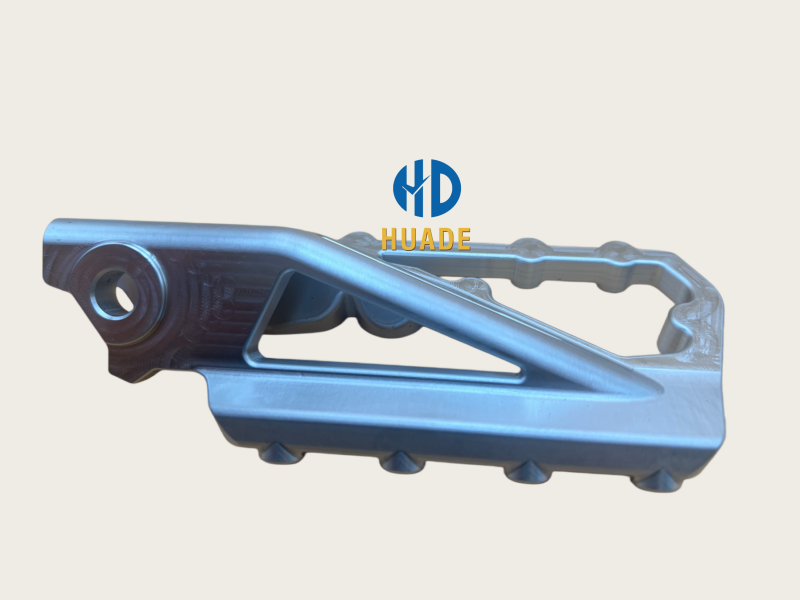
This is what manufacturing a CNC machined bike pedal body actually looks like from the inside.
Why a CNC Bike Pedal Body Demands More Than Most Parts
A bicycle pedal body is a deceptively demanding component. From the outside, it may look like a simple platform — a flat surface with some holes and a profile. But every dimension on that part is load-bearing in one way or another. The axle bore governs bearing alignment and long-term rotational feel. The threaded pin holes control grip traction under muddy, wet, or high-torque conditions. The platform geometry determines where a rider’s foot naturally sits and how the shoe interface behaves mid-climb or mid-descent.
When a brand comes to us with a custom CNC bike pedal specification, they are not just buying aluminum removal. They are buying the guarantee that every one of those functional relationships holds — not on sample number one, but across every unit in the production run. That is a manufacturing promise, and it starts with how the job is set up long before the first cut.
How a Pedal Body Is Actually Made: Turning First, Then Milling
The workflow that produces a production-grade CNC machined bike pedal body is a carefully sequenced two-process operation, and the sequencing is not arbitrary.
We always begin with the turned features — the axle bore and any critical cylindrical geometry. Turning establishes the datum. It is the reference that every subsequent milling operation will index against. On our CNC turning centers, the axle bore is held to a tolerance of ±0.005 mm. That number might seem abstract until you consider what it means at assembly: it is the difference between a spindle that slides in with the right pre-load and one that introduces play before the first ride. At this tolerance level, the bore is not just a hole — it is a precision fit that defines the mechanical character of the entire pedal.
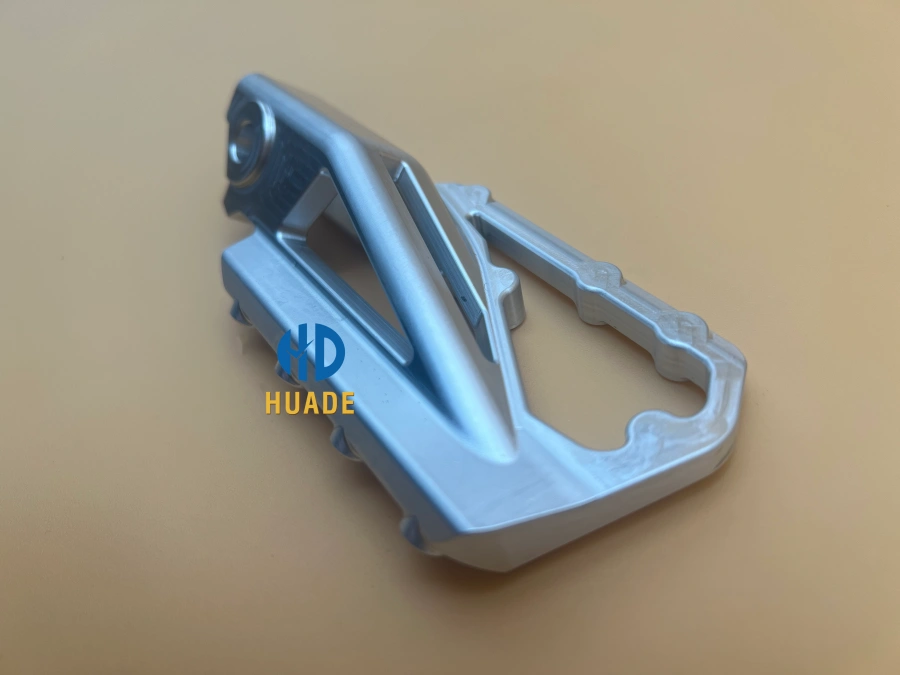
From there, the part moves to multi-axis milling. This is where the pedal body takes its shape — the weight-relief pockets cut deep into the platform underside, the grip-pin hole pattern laid out across the top surface, the serrated perimeter edges, the compound angles that give a modern flat pedal its distinctive silhouette. Our milling operations hold ±0.01 mm on structural geometry, which means that flatness, pocket depth, and edge profiles are consistent across the batch. For a part that will be anodized and branded, this dimensional consistency also determines how evenly the surface treatment builds up — which directly affects both aesthetics and corrosion resistance in the field.
What buyers do not always see is the fixturing strategy underneath all of this. Holding a pedal body securely through multiple operations — without distorting the part or losing positional accuracy — requires custom fixtures engineered for each geometry. A fixture designed for one pedal platform will not work for another. This is one of the hidden costs of high precision machining that good manufacturers absorb into their process development, not their per-part pricing.
Threaded Holes on a CNC Machined Footpeg: Small Feature, High Stakes
Among all the features on a CNC machined footpeg or pedal body, the threaded pin holes tend to receive the least attention in a specification sheet and cause the most problems in production when they are done poorly.
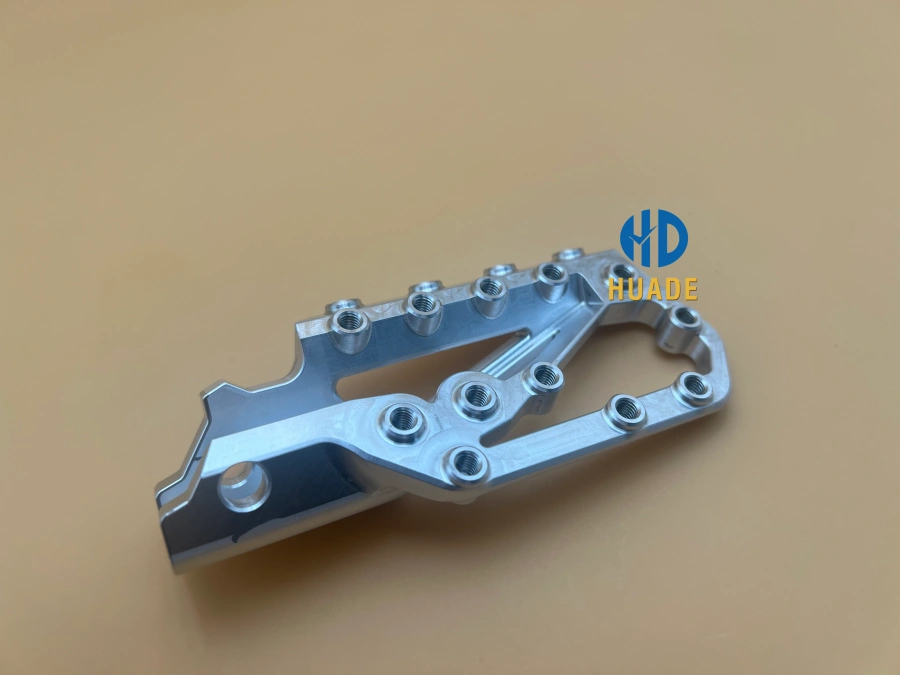
Each threaded hole on a flat pedal platform must meet pitch tolerance, minor diameter, thread depth, and positional accuracy — simultaneously. A hole that is dimensionally correct but 0.3 mm off-position creates an assembly problem for the customer. A thread that passes a go/no-go gauge but was cut with worn tooling will strip under torque earlier than expected. In a product that riders depend on in demanding terrain, that is a warranty issue and a brand reputation issue.
Our process addresses this by treating threaded holes as turned features, not milled afterthoughts. They are programmed, tooled, and inspected with the same rigor as the axle bore. Thread pitch is verified. Depth is checked. Position is confirmed on the CMM before the batch ships. For OEM customers who specify custom pin thread standards — M4, M5, proprietary pitches — we maintain dedicated tooling for each specification rather than substituting nearest-available tooling.
Material, Surface, and the Long Game
Most serious custom CNC aluminum pedals in the performance cycling market are machined from 6061-T6 or 7075-T6 aluminum alloy. The choice between them is a function of the application: 6061 offers better machinability and sufficient strength for trail and gravel use; 7075 delivers higher yield strength for enduro and downhill applications where platform loading is more severe.
After machining, the parts in our facility go through deburring, surface preparation, and then anodizing — Type II for standard wear resistance and color, Type III hard anodizing for applications where the grip surface will see aggressive shoe contact and contamination over thousands of kilometers. Hard anodizing penetrates the aluminum substrate rather than simply coating it, creating a surface that wears with the part rather than peeling away from it.
Final inspection is CMM-based. Critical dimensions are measured against the customer’s drawing tolerances, and full inspection reports are available for OEM customers who require traceability documentation. We do not ship on visual inspection alone.
What a Production Run Actually Looks Like
For brands sourcing CNC bike pedals at volume, the most important quality is not the tolerance on any single dimension — it is the consistency of those tolerances across every unit in the order. A pedal that measures perfect on the first article and drifts on unit 200 is a quality system failure, not a machining achievement.
The controls that prevent this are process-level, not inspection-level. Tool life monitoring ensures that cutting tools are replaced before they begin to introduce dimensional drift. Coolant management keeps thermal expansion consistent across a shift. Fixture wear is tracked and fixtures are recalibrated at defined intervals. These are unglamorous details. They are also why a precision contract manufacturer produces different results than a general job shop quoting the same drawing.
Source Custom CNC Bike Pedals: Start With the Right Manufacturer
Whether you are developing a new platform geometry from CAD files, refining an existing design ahead of a production launch, or looking to qualify a second-source manufacturer for an established SKU, the starting point is the same: a conversation about your drawing tolerances, your volume requirements, and your timeline.
Dongguan Huade Precision Manufacturing Co., Ltd. offers DFM review, first-article inspection, and full production capability for custom CNC machined bike pedal bodies and footpeg components. Send us your files — we will tell you exactly what we can hold and at what cost.
 English
 Deutsch
 Español
 Français
 Português do Brasil
 Italiano