
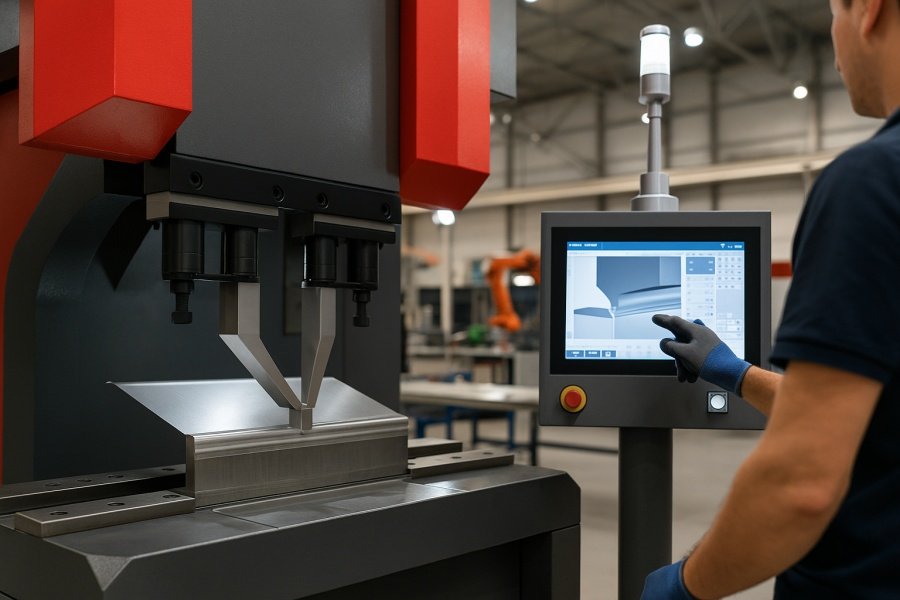
Sheet metal hemming represents one of the most critical joining and edge-finishing processes in modern manufacturing. This sophisticated technique, which involves folding sheet metal edges over themselves or onto other components, has evolved significantly with the integration of Computer Numerical Control (CNC) technology. Understanding the nuances of hemming operations, from tool selection to machine integration, can dramatically impact product quality and manufacturing efficiency.
The Evolution of Hemming in Manufacturing
Traditional hemming processes relied heavily on manual operation and simple press brake tooling. However, the automotive industry’s demand for precision and consistency has driven significant technological advancement. Modern manufacturers now face complex challenges: reducing cycle times while maintaining dimensional accuracy, achieving consistent edge quality across high-volume production runs, and managing the delicate balance between material properties and forming forces.
The transition from manual to automated hemming has fundamentally changed how engineers approach part design and production planning. Where operators once relied on experience and intuition to achieve proper hem formation, today’s processes demand precise control of multiple variables simultaneously.
Understanding Hemming Machine Technology
A sheet metal hemming machine incorporates several sophisticated systems working in harmony. The primary forming mechanism typically consists of hydraulic or servo-electric actuators that provide controlled force application. These systems must deliver consistent pressure while adapting to variations in material thickness and properties.
Modern hemming machines integrate advanced sensor technology to monitor the forming process in real-time. Force feedback systems detect variations in material response, allowing automatic adjustment of forming parameters. Position sensors ensure precise tool positioning, critical for achieving the tight tolerances required in automotive and aerospace applications.
The control systems governing these machines have become increasingly sophisticated. Rather than simple on/off operations, contemporary hemming equipment employs complex algorithms that optimize forming sequences based on material properties, part geometry, and quality requirements.
Tool Selection and Design Considerations
Selecting appropriate sheet metal hemming tools requires careful consideration of multiple factors. Tool geometry directly influences the final hem quality, with radius selection being particularly critical. Too sharp a radius can cause material cracking, while excessive radius results in poor hem closure and potential quality issues.
Material compatibility represents another crucial consideration. Steel, aluminum, and advanced high-strength materials each respond differently to hemming operations. Tool coatings and surface treatments must be selected to minimize wear while preventing material marking or adhesion.
The relationship between tool design and part geometry cannot be understated. Complex part shapes may require specialized tooling configurations, including segmented tools for curved edges or adjustable systems for variable hem dimensions. Understanding these requirements during the design phase prevents costly modifications during production implementation.
Integration with CNC Systems
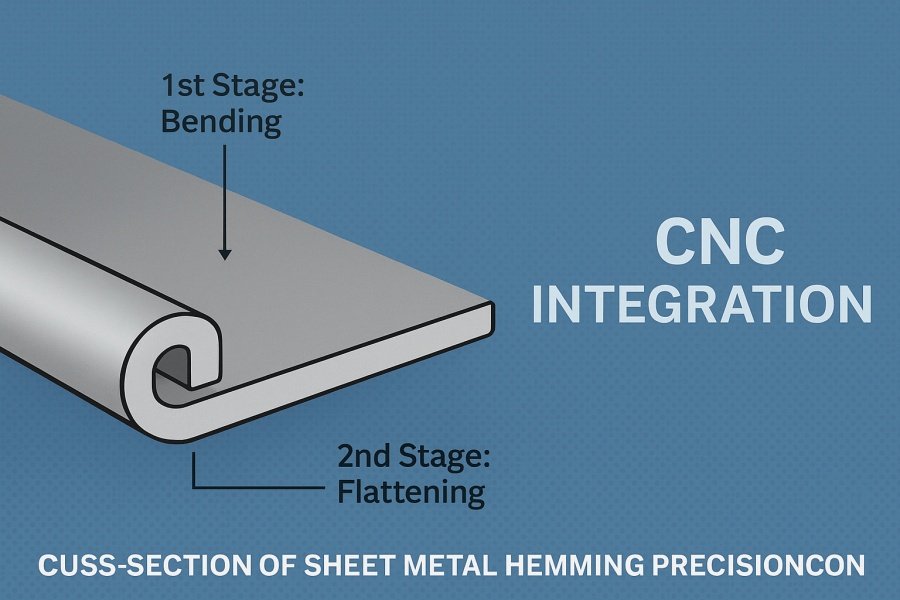
CNC integration has revolutionized hemming operations by providing unprecedented control over the forming process. Programmable positioning systems enable precise tool placement, critical for maintaining consistent hem dimensions across complex part geometries. This level of control extends beyond simple positioning to include force modulation, speed control, and real-time process monitoring.
The programming aspects of CNC-controlled hemming require specialized knowledge. Unlike traditional machining operations, hemming involves dynamic material behavior that changes throughout the forming cycle. Successful programs must account for material springback, tool deflection, and variations in material properties.
Modern CNC systems also enable sophisticated quality control integration. Vision systems can inspect hem quality during the forming process, triggering automatic adjustments or part rejection when specifications are not met. This real-time feedback capability significantly reduces scrap rates and improves overall process reliability.
Process Optimization and Quality Control
Achieving consistent hem quality requires careful attention to multiple process variables. Material preparation plays a crucial role, with edge condition and surface cleanliness directly affecting final results. Even minor variations in blank preparation can result in significant quality issues downstream.
The forming sequence itself demands careful optimization. Multi-stage hemming operations, common in automotive applications, require precise coordination between forming stations. Each stage must prepare the material for subsequent operations while achieving intermediate quality targets.
Temperature control represents an often-overlooked aspect of hem quality. Material temperature affects formability and springback characteristics. In high-volume production environments, heat generation from the forming process can create consistency issues if not properly managed.
Troubleshooting Common Hemming Challenges
Material springback remains one of the most persistent challenges in hemming operations. This phenomenon, where formed materials partially return to their original shape after tool removal, requires careful compensation in tool design and process parameters. Advanced materials, particularly high-strength steels, exhibit increased springback tendencies that demand sophisticated compensation strategies.
Edge cracking presents another common issue, often resulting from excessive forming forces or inappropriate tool geometry. Understanding the relationship between material properties, tool design, and forming parameters is essential for preventing this costly defect.
Dimensional variations across production runs typically stem from inconsistent material properties or process parameter drift. Implementing robust process control systems with real-time monitoring capabilities helps identify and correct these variations before they result in quality issues.
Future Developments in Hemming Technology
The hemming industry continues to evolve with advancing technology. Artificial intelligence and machine learning algorithms are beginning to influence process optimization, enabling predictive adjustments based on historical data and real-time process feedback.
Advanced materials present both challenges and opportunities for hemming technology. Ultra-high-strength materials require new approaches to tool design and process control, while lightweight alternatives like carbon fiber composites demand entirely different forming strategies.
Digital twin technology promises to revolutionize hemming process development by enabling virtual optimization before physical implementation. This capability could significantly reduce development time and costs while improving process reliability.
To Wrap Thing Up
Sheet metal hemming technology represents a sophisticated intersection of materials science, mechanical engineering, and process control. Success in implementing these systems requires comprehensive understanding of material behavior, tool design principles, and control system integration. As manufacturing continues to evolve toward increased automation and quality demands, mastering these hemming technologies becomes increasingly critical for competitive advantage.
The integration of CNC technology with traditional hemming processes offers unprecedented opportunities for quality improvement and cost reduction. However, realizing these benefits requires careful attention to tool selection, process optimization, and quality control systems. Manufacturers who invest in understanding these complex interactions will find themselves well-positioned for future success in an increasingly demanding marketplace.
 English
 Deutsch
 Español
 Français
 Português do Brasil
 Italiano