
In the realm of CNC machining, the debate between brass vs copper (and conversely, copper vs brass) is a frequent one among designers, engineers, and manufacturers.
These two metals, both derived from copper-based materials, offer distinct properties that can make or break the success of precision parts. Factors like price, color, conductivity, machinability, and specific applications—such as pipes or jewelry—play crucial roles in material selection. As global markets fluctuate, understanding these differences ensures optimal performance, cost savings, and durability in your projects.
At Dongguan Huade Precision Manufacturing Co., Ltd., we specialize in delivering high-precision CNC machined components using both brass and copper. With over a decade of expertise in custom manufacturing, we’ve assisted clients across industries like electronics, plumbing, jewelry, medical devices, and aerospace in choosing the right material.
This comprehensive guide dives deep into the brass vs copper comparison, tailored for CNC applications, to help you decide which metal triumphs for your precision needs. We’ll also explore practical tools like design checklists, tolerance guidelines, failure modes, DFM considerations, and manufacturing routes to enhance your decision-making process.
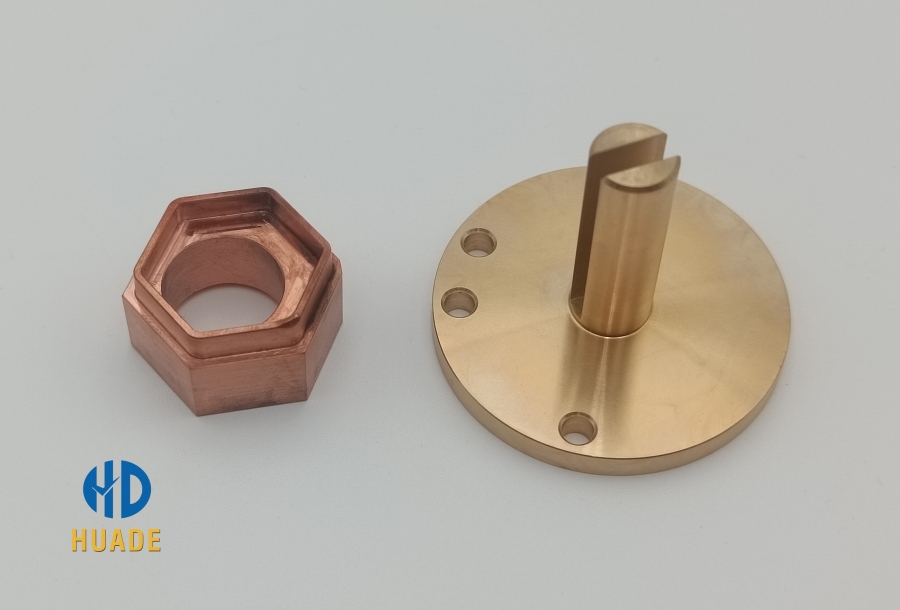
Visual comparison of brass vs copper in CNC machined parts: Left – pure copper hexagonal component with reddish-orange tone; Right – brass precision flange with golden-yellow finish. Produced by Dongguan Huade Precision Manufacturing Co., Ltd.
Key Differences: Brass vs Copper
1. Composition and Brass vs Copper Color
Copper is a pure elemental metal, typically 99.9% Cu, boasting a warm, reddish-orange appearance that develops a natural patina over time. Brass, on the other hand, is an alloy primarily composed of copper (60-90%) and zinc (10-40%), giving it a brighter, golden-yellow hue. This brass vs copper color distinction is vital in visible applications, where brass’s luster mimics gold, making it preferable for decorative elements, while copper’s earthy tone suits industrial or artistic designs.
2. Brass vs Copper Price
As of January 2026, copper prices are around $12-13 per kg, driven by demand in renewable energy and electronics. Brass, benefiting from zinc’s lower cost, typically ranges 20-30% cheaper, often $9-11 per kg depending on the alloy grade and market conditions. For large-scale CNC production, this brass vs copper price gap can lead to significant savings without compromising quality.
3. Brass vs Copper Conductivity
Copper excels in electrical and thermal conductivity, rated at nearly 100% on the International Annealed Copper Standard (IACS), making it ideal for heat exchangers and wiring. Brass, with its zinc content, offers 25-45% IACS, sufficient for many applications but not as efficient. In brass vs copper conductivity scenarios, copper is the go-to for high-performance electrical parts, while brass balances conductivity with added strength.
4. Machinability in CNC Processing
Brass, particularly grades like C36000, is renowned for its free-cutting properties, producing short, brittle chips that minimize tool wear and allow faster spindle speeds. Copper, being softer and more ductile, can be “gummy,” leading to longer chips and potential burrs, necessitating coolant and specialized tools. This makes brass more efficient for intricate CNC operations, reducing cycle times by up to 30%.
5. Corrosion Resistance and Durability
Both metals resist corrosion effectively, but brass’s zinc enhances protection in moist environments, while copper forms a self-healing patina. Brass generally offers higher tensile strength (up to 550 MPa vs. copper’s 220 MPa), making it more durable for load-bearing parts.

CNC manufacturing expert with 15+ years of experience. William helps engineering teams turn prototypes into stable production parts through DFM optimization, tolerance planning, machining strategy selection, and inspection-driven quality control.
william@hdproto.comFor any CNC-machined part — whether shafts, housings, brackets, manifolds, or structural components — the foundation of reliable manufacturing starts with clean geometry, well-defined datums, and machining-friendly features that minimize re-clamping risks.
We support function-driven tolerances (down to ±0.01 mm when required) and offer full inspection options including CMM reports, thread gauges, and surface-finish verification to ensure repeatability from prototype to production.
CONTACT OUR EXPERT NOWApplications: Where Each Metal Excels
Brass vs Copper Pipe and Fittings
In plumbing and fluid systems, brass shines for brass vs copper pipe components due to its machinability and resistance to dezincification. CNC-machined brass fittings, like valves and connectors, provide leak-proof seals. Copper, with superior thermal conductivity, is favored for heat transfer pipes in HVAC systems.
Brass vs Copper Jewelry
For brass vs copper jewelry, brass’s golden appearance and affordability make it popular for CNC-produced clasps, beads, and pendants. Copper’s antimicrobial properties appeal to health-focused designs, though it may tarnish faster. Precision machining ensures intricate details without material waste.
CNC-crafted brass vs copper jewelry components, showcasing fine engravings and finishes.
Electrical and Precision Parts
Copper dominates in conductive elements like busbars, while brass is used for connectors requiring both conductivity and mechanical integrity.
Design Checklist for Brass vs Copper Selection
To streamline your CNC project, use this checklist:
- Application Needs: Does it require high conductivity (favor copper) or aesthetics (favor brass)?
- Environmental Factors: Exposure to water or chemicals? Brass for better corrosion in some cases.
- Budget Constraints: Calculate brass vs copper price impact on total costs.
- Machining Complexity: Opt for brass if tight tolerances and high speeds are needed.
- End-Use Testing: Prototype both if unsure.
Tolerance Guidance in CNC Machining
For brass, standard tolerances are ±0.005 mm for critical features, thanks to its stability. Copper, being softer, may require ±0.01 mm to account for thermal expansion. Always specify IT grades (e.g., IT7 for precision fits) in drawings to avoid rework.
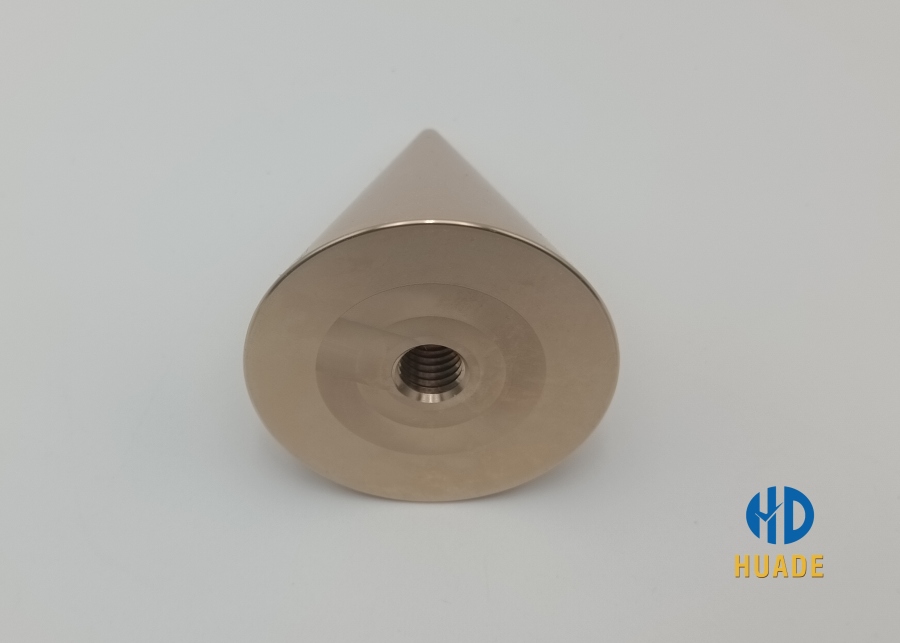
High-precision CNC machined brass conical component with internal threading and flawless surface finish, demonstrating brass’s superior machinability. Manufactured by Dongguan Huade Precision Manufacturing Co., Ltd.
Common Failure Modes and Countermeasures
- Burr Formation in Copper: Counter with deburring tools or optimized feeds.
- Dezincification in Brass: Use leaded alloys or coatings.
- Thermal Distortion: Pre-heat materials and use fixtures.
- Cracking Under Stress: Anneal post-machining for both.
RFQ and DFM Considerations
When submitting an RFQ to us at Dongguan Huade Precision Manufacturing Co., Ltd., include material specs, tolerances, and quantities. DFM (Design for Manufacturability) tips: Avoid sharp internal corners in copper to prevent tool breakage; leverage brass’s machinability for undercuts.
CNC-Related Manufacturing Process Routes
A typical route for brass parts: Raw bar stock → CNC turning/milling → Deburring → Plating (if needed) → Quality inspection. For copper: Add annealing steps to manage ductility. Multi-axis CNC enhances efficiency for complex geometries.
Comparison Table: Brass vs Copper at a Glance
| Property | Brass | Copper | Winner for Precision CNC Parts |
|---|---|---|---|
| Color | Golden-yellow | Reddish-orange | Brass (aesthetics) |
| Price (Jan 2026 est.) | $9-11/kg | $12-13/kg | Brass |
| Conductivity | 25-45% IACS | 100% IACS | Copper |
| Machinability | Excellent (free-cutting) | Good (ductile) | Brass |
| Strength/Durability | Higher (up to 550 MPa) | Lower (220 MPa) | Brass |
| Corrosion Resistance | Excellent (zinc-enhanced) | Excellent (patina) | Tie |
Which Metal Wins for Your Precision Parts?
Ultimately, brass often edges out in versatile CNC applications due to cost and machinability, while copper prevails in conductivity-critical scenarios. At Dongguan Huade Precision Manufacturing Co., Ltd., our team can guide you through prototypes and production. Contact us for a free DFM review or quote—let’s craft the perfect parts together!
 English
 Deutsch
 Español
 Français
 Português do Brasil
 Italiano