
In every high-value industry—automotive, robotics, aerospace, industrial equipment—the most critical ideas begin life as prototypes. Before a design reaches volume production, it must survive real-world testing, tight deadlines, and strict confidentiality. That is where CNC prototype machining and secure manufacturing processes become the real engine of innovation.
This article looks at how prototype machining services support demanding projects such as the GM 4.5L Duramax V8 prototype and the widely discussed Chevy Corvette ZR1 stolen prototype case—while explaining what this means for any company that needs reliable, confidential CNC-machined parts, not only in the automotive sector.
1. Why High-Stakes Prototypes Depend on CNC Machining
Across industries, engineering teams rely on rapid CNC prototyping to turn CAD models into physical parts that can be tested, tuned, and validated. Compared with casting or tooling-based methods, CNC offers:
- Tight and repeatable tolerances for complex geometries
- Fast iteration cycles without waiting for molds or dies
- Compatibility with a wide range of metals and engineering plastics
- Scalable transition from one-off prototypes to low-volume production
For customers, this means they can validate designs for engine components, brackets, housings, manifolds, jigs, fixtures, or robotic end-effectors long before committing to mass-production investment.
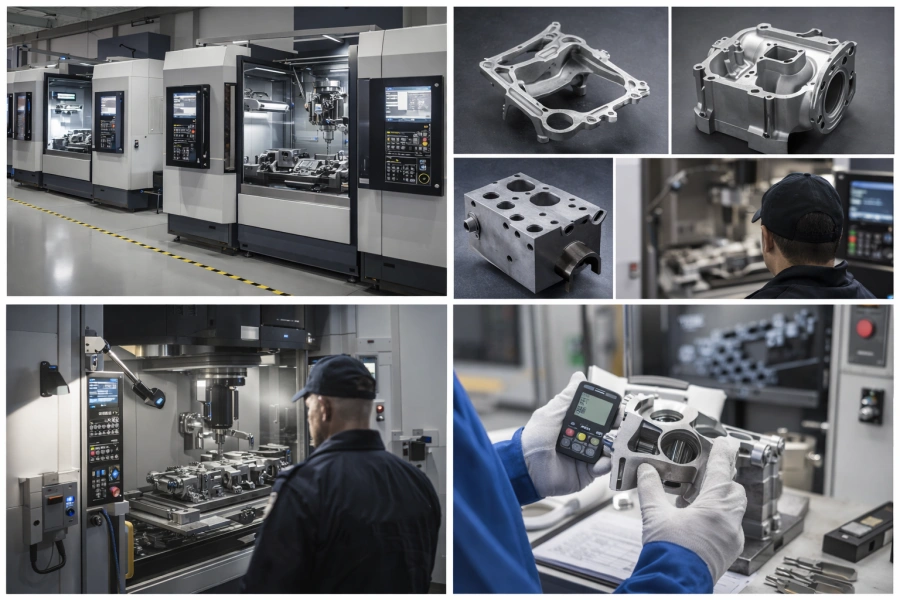
Secure CNC machining workflow, inspection, and prototype part handling.
A specialist shop that offers prototype machining services is not limited to one sector. The same equipment and process control that produce automotive CNC prototypes can also be used for aerospace brackets, industrial automation components, or medical device housings.
2. GM 4.5L Duramax V8 Prototype: CNC Machined Engine Components Under Pressure
The GM 4.5L Duramax V8 prototype is often cited as a benchmark for modern powertrain development. Although the full production program never reached the market, the engineering work behind it illustrates how demanding engine prototypes can be.
To bring such a powertrain to life, engineers depend on:
- CNC machined engine components such as cylinder heads, blocks, bearing caps, and main housings
- Precision fuel-system parts and turbocharger housings with internal oil and coolant passages
- Custom brackets, mounts, covers, and test fixtures designed for dyno and vehicle trials
Because these parts must survive high loads, temperatures, and long test cycles, they cannot be simple “visual models.” They need functional accuracy, controlled surface finishes, and stable material properties. That is exactly where CNC prototype machining excels—combining production-grade quality with the flexibility to change details between iterations.
Shops that support this type of work must deliver:
- Stable, high-rigidity machining centers
- Proven process control for aluminum, steel and high-strength alloys
- Documented inspection for critical dimensions and GD&T features
- The ability to scale successful prototypes into short-run batches
Even if your current project is “only” a machined bracket for a vehicle, or a housing for an industrial gearbox, it benefits from the same mindset used on flagship prototypes like the Duramax: precision first, then repeatability.
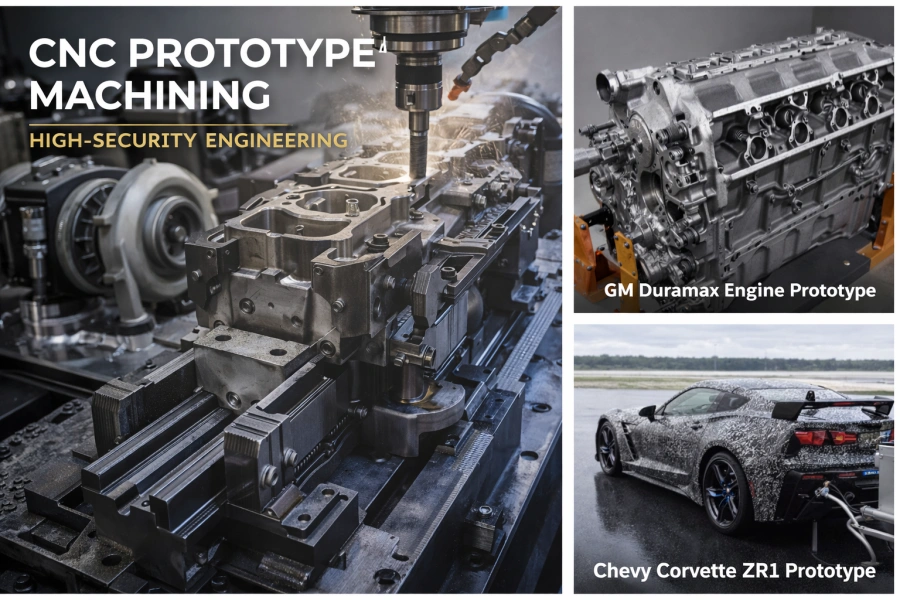
High-security CNC prototype machining for automotive and industrial components.
3. Chevy Corvette ZR1 Stolen Prototype: Why Secure CNC Machining Matters
The story of the Chevy Corvette ZR1 stolen prototype made headlines because it combined public interest with a hard business lesson: a prototype is not just a physical car—it carries years of design work, testing data, and competitive strategy.
For manufacturers and their suppliers, this highlights the importance of secure CNC machining and confidential prototype machining:
- Controlled access – Restricted entry to machining cells, inspection rooms, and prototype storage.
- Digital security – Encrypted file transfer, limited data access, air-gapped CAM servers, and traceable revisions.
- Part tracking – Unique serialization or RFID tagging of sensitive components to know exactly where each part travels.
- Discreet logistics – Neutral packaging and vetted shipping partners to prevent attention during transport.
These practices are now increasingly expected not only in the automotive world but also for robotics, defense, high-end consumer electronics, and medical devices—anywhere that a leaked prototype could damage a company’s market position.
A CNC supplier that treats every prototype as “high-stakes,” even when it is just one bracket or housing, gives engineers the confidence to outsource critical work without exposing their IP.
4. Beyond Automotive: Prototypes for Robotics, Aerospace and Industrial Systems
Although iconic programs like the Duramax V8 or Corvette ZR1 attract media attention, most prototype parts worldwide are far more low-key: robot joints and gearboxes, actuator housings, machine-tool components, or structural parts for drones and industrial equipment.
Typical examples include:
- Precision-machined aluminum frames and arms for industrial robots
- Stainless steel components for food-grade automation lines
- Aerospace brackets and mounts requiring both light weight and high stiffness
- Custom manifolds, housings, and covers for process equipment
For these projects, rapid CNC prototyping allows design teams to test fit, function, and durability with real materials and real tolerances. When the prototype proves successful, the same CNC process can be used for bridge production or as an ongoing low-volume supply.
By combining process control, inspection capability, and secure handling of CAD/CAM data, a machining partner can support multi-industry customers—not just OEM car makers.
5. How HDProto Supports High-Value Prototype Machining Projects
At Dongguan Huade Precision Manufacturing Co., Ltd., we position ourselves as a CNC prototype machining and production machining partner rather than an automotive design studio. That means:
- We machine CNC engine components, brackets, housings, shafts, and precision blocks for customers in automotive, aerospace, robotics, and industrial equipment.
- Our prototype machining services cover one-off test parts, small prototype builds, and pilot production runs.
- We offer confidential prototype machining with NDAs, controlled data access, and careful packaging for international shipments.
- For customers who need to move quickly, we provide rapid CNC prototyping with practical DFM feedback to keep designs manufacturable.

Confidential CNC prototype handling, inspection, and secure shipment.
Whether you are working on a new vehicle subsystem, an industrial robot, or a high-value testing fixture, our goal is the same: deliver accurate, secure and repeatable CNC parts that help you move from concept to reliable production.
6. Conclusion: Prototypes Need Both Precision and Protection
The cases of the GM 4.5L Duramax V8 prototype and the Chevy Corvette ZR1 stolen prototype demonstrate two sides of the same reality:
- High-performance designs depend on precise, reliable CNC prototype machining.
- Those prototypes must also be protected through secure CNC machining practices and disciplined handling of both physical parts and digital data.
For engineering teams, choosing the right machining partner is no longer just about price per piece. It’s about finding a supplier who understands the technical demands of complex parts and the responsibility that comes with handling confidential prototypes.
If you are planning your next high-value project and need a trustworthy CNC machining partner, our team at HDProto is ready to help—from rapid prototypes to low-volume production.
👉 Share your drawings and requirements with us at www.hdproto.com, and we’ll provide a tailored CNC machining solution for your prototypes and production parts. Contact us today!
 English
 Deutsch
 Español
 Français
 Português do Brasil
 Italiano