
Precision machining for the aerospace industry is essential in one of the most technically demanding manufacturing environments in modern engineering. Aircraft structures, propulsion systems, and satellite assemblies rely on precision-engineered components that must operate reliably under extreme mechanical loads, temperature fluctuations, vibration, and pressure variations.
Because aerospace systems require extremely high reliability and safety standards, precision machining plays a critical role in producing aerospace components with tight tolerance control, consistent dimensional accuracy, and superior surface finish.
For this reason, precision machining for the aerospace industry plays a fundamental role in ensuring component reliability and performance. Aerospace manufacturers require parts with extremely tight tolerances, consistent dimensional accuracy, and high-quality surface finishes to meet strict engineering and safety standards.
Advanced CNC machining technologies enable manufacturers to produce complex aerospace components with exceptional precision and repeatability. Through controlled machining environments, high-accuracy equipment, and rigorous inspection procedures, modern aerospace machining suppliers can achieve tolerances as tight as ±0.01 mm, ensuring that each component meets demanding functional requirements. For a broader overview of aerospace manufacturing technologies, see our guide to aerospace CNC machining.
At Dongguan Huade Precision Manufacturing Co., Ltd., we specialize in high-precision CNC machining solutions that support aerospace engineers, product developers, and procurement teams requiring reliable prototype and production components.
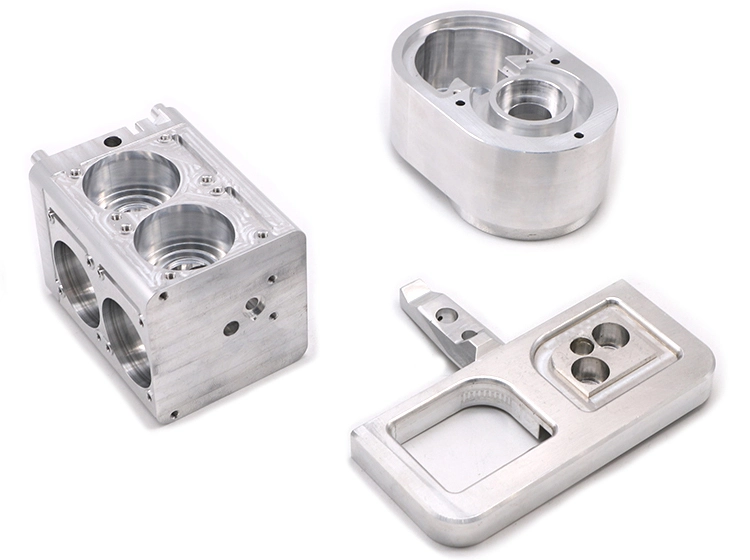
Why Aerospace Manufacturing Requires Extreme Precision
Precision is not simply desirable in aerospace manufacturing—it is essential. Even minor dimensional deviations can lead to performance degradation, increased vibration, or premature component failure.
Aerospace systems operate under conditions that place enormous stress on mechanical parts, including:
- High rotational speeds in turbine assemblies
- Extreme thermal loads in propulsion systems
- Continuous vibration during flight
- Significant structural loads on airframe components
In such environments, component accuracy directly influences reliability and safety.
Precision machining ensures that aerospace components:
- Fit correctly within assemblies
- Maintain mechanical balance during operation
- Prevent leakage in hydraulic systems
- Preserve aerodynamic efficiency
These requirements make tight tolerance machining a core capability in aerospace manufacturing.
Typical Machining Tolerances in Aerospace Components
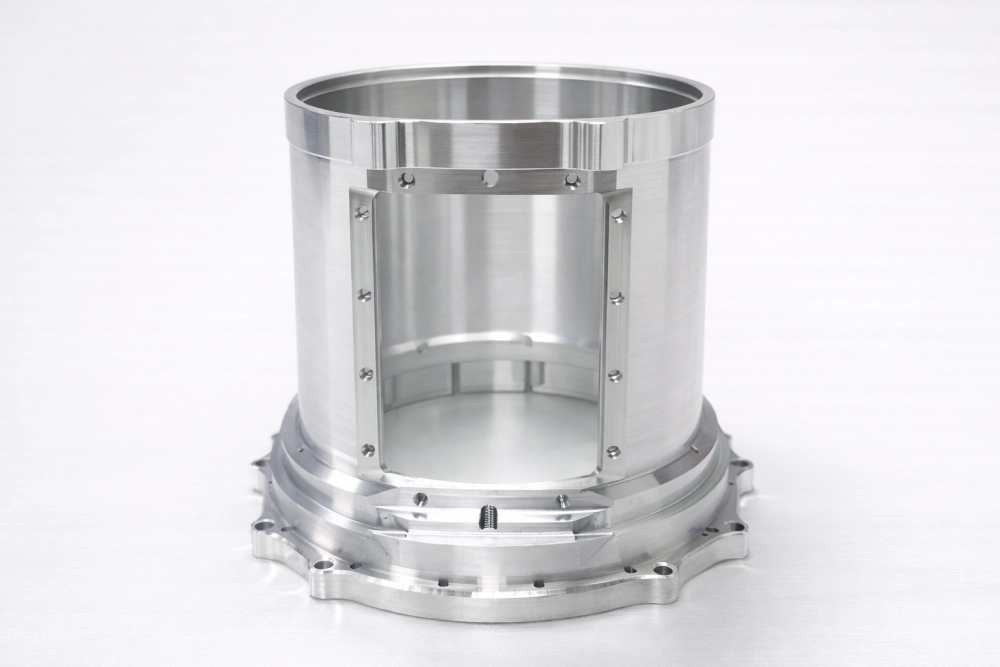
Tolerance control is one of the defining characteristics of precision machining in aerospace applications. While general industrial components may allow relatively large dimensional variations, aerospace components require far tighter control.
Typical aerospace machining tolerances include:
| Component Type | Typical Tolerance |
|---|---|
| General structural parts | ±0.05 mm |
| Precision housings | ±0.02 mm |
| Bearing bores | ±0.01 mm |
| High-precision rotating components | ±0.005 mm |
In addition to dimensional tolerances, aerospace parts often require specific surface finish standards.
Typical surface roughness values include:
- Ra 1.6 μm for standard machined surfaces
- Ra 0.8 μm for sealing surfaces
- Ra 0.4 μm or better for precision interfaces
These specifications ensure proper sealing, reduced friction, and long-term component durability.
Types of Precision Aerospace Components
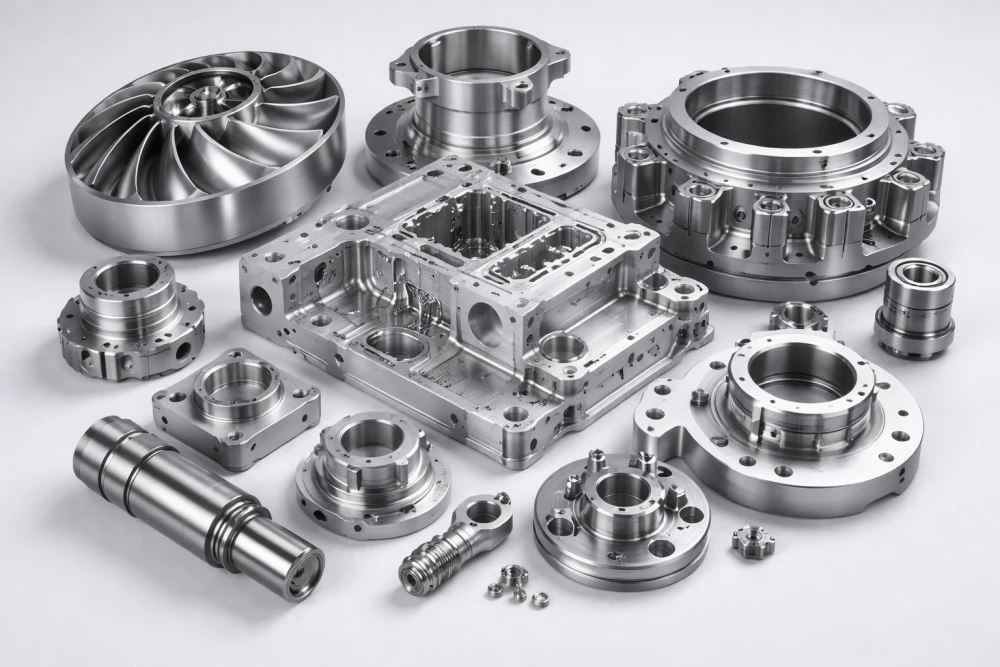
Examples of precision-machined aerospace components manufactured using advanced CNC machining technology.
Many aerospace parts require extremely high dimensional accuracy to ensure correct mechanical performance.
Common precision aerospace components include:
Bearing Housings
Bearing housings must maintain perfect roundness and dimensional accuracy to support rotating shafts and turbines. Even small deviations can increase friction or cause vibration.
Turbine Shafts
Turbine shafts operate at extremely high rotational speeds and require tight tolerance machining to ensure balanced rotation and long service life.
Valve Bodies
Hydraulic and fuel system valves rely on precision-machined passages and sealing surfaces to maintain reliable fluid control.
Sensor Housings
Aircraft and satellite sensors are often enclosed in precision-machined housings that protect delicate electronics while maintaining exact dimensional alignment.
Actuator Components
Actuator systems controlling flight surfaces rely on precision-machined parts that must maintain accurate motion under load.
These components demonstrate why precision machining is critical in aerospace manufacturing.
Factors That Affect Machining Accuracy
Achieving ±0.01 mm machining accuracy requires careful control of multiple manufacturing variables.
Several factors influence precision machining performance.
Thermal Expansion
Temperature changes during machining can cause both tools and workpieces to expand or contract. Aerospace machining facilities often operate in temperature-controlled environments to minimize thermal distortion.
Tool Wear
Cutting tools gradually wear during machining operations. Monitoring tool condition and replacing tools at appropriate intervals ensures consistent dimensional accuracy.
Machine Rigidity
High-precision machining requires rigid machine structures that minimize vibration during cutting. Modern CNC machining centers use advanced spindle systems and heavy machine frames to maintain stability.
Workholding and Fixturing
Improper fixturing can allow workpieces to shift or deform under cutting forces. Custom fixtures are often used to secure aerospace components during machining.
Controlling these factors is essential for maintaining precision across both prototype and production runs.
How CNC Machining Achieves ±0.01 mm Accuracy
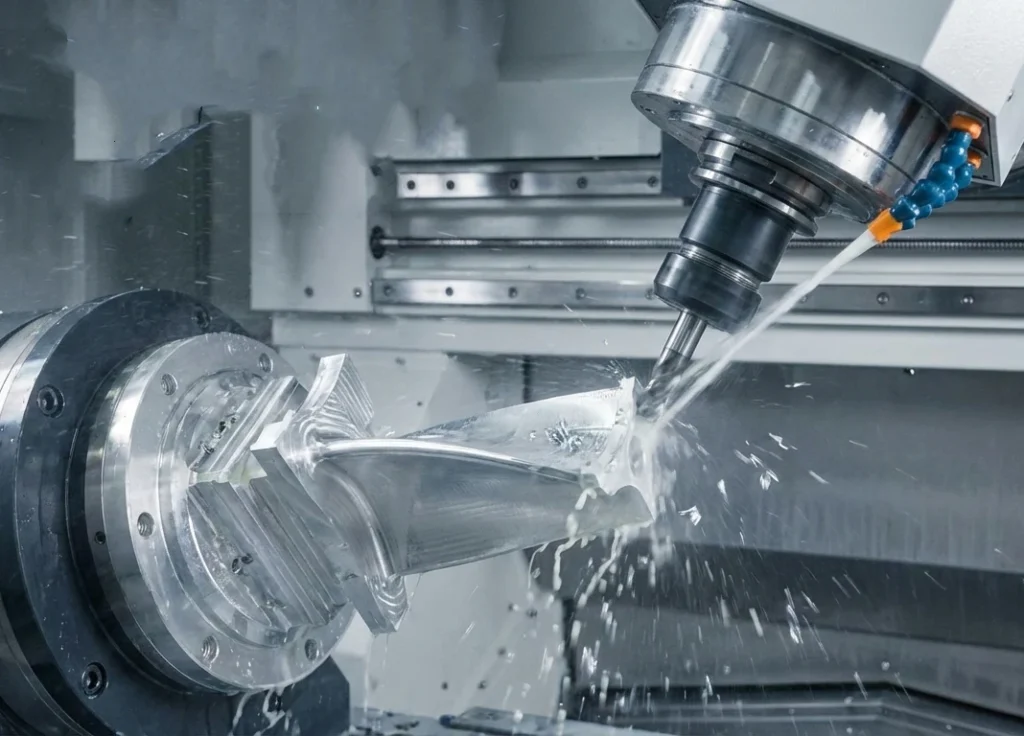
Advanced CNC machining process used to manufacture high-precision aerospace components.
Modern CNC machining technologies allow manufacturers to achieve extremely tight tolerances consistently.
Several technological advancements contribute to high-precision aerospace machining.
Multi-Axis Machining
Multi-axis CNC machining enables complex parts to be manufactured in fewer setups, reducing positioning errors and improving overall accuracy.
High-Precision Spindles
Advanced spindle systems maintain stable rotational performance, allowing cutting tools to maintain precise tool paths.
Tool Path Optimization
CAM software calculates optimized cutting paths that minimize tool deflection and maintain dimensional consistency.
In-Process Measurement
Some machining centers include probing systems that measure part features during machining to ensure dimensional accuracy.
Through these technologies, aerospace manufacturers can produce parts that meet demanding engineering specifications.
Inspection Methods for Precision Aerospace Parts
Precision aerospace machining requires rigorous inspection procedures to verify dimensional accuracy.
Typical inspection methods include:
CMM Measurement
Coordinate Measuring Machines (CMMs) are widely used to verify complex part geometries. These machines measure precise locations on the part surface and compare them with CAD models.
GD&T Verification
Geometric Dimensioning and Tolerancing (GD&T) inspection ensures that form, orientation, and positional tolerances meet engineering requirements.
Surface Finish Measurement
Surface roughness testers measure the quality of machined surfaces to ensure compliance with aerospace standards.
Visual and Functional Testing
Additional inspections may include assembly fit checks, thread verification, and functional testing.
These quality control procedures ensure that each aerospace component meets strict performance standards.
Rapid Prototyping for Aerospace Component Development
Rapid prototyping is an essential part of aerospace product development. Engineers often require prototype components to test designs before moving to full production.
Precision CNC machining allows prototype parts to be produced quickly while maintaining realistic material properties.
Rapid CNC prototyping allows engineers to evaluate:
- Structural strength
- Assembly compatibility
- Mechanical performance
- Design feasibility
At Dongguan Huade Precision Manufacturing Co., Ltd., we offer 2–3 day rapid prototyping, enabling engineering teams to accelerate development cycles and refine designs more efficiently.
Working with a Precision Machining Supplier
Choosing the right manufacturing partner is critical when producing aerospace components.
Important evaluation factors include:
- Precision capability
- Experience with aerospace materials
- Inspection equipment and quality control systems
- Prototype turnaround time
- Production scalability
A capable supplier should be able to support both prototype development and production manufacturing while maintaining strict tolerance control.
Dongguan Huade Precision Manufacturing Co., Ltd.
Dongguan Huade Precision Manufacturing Co., Ltd. provides high-precision CNC machining solutions for complex industrial components.
Our machining capabilities include:
- CNC milling and CNC turning services
- Precision machining accuracy up to ±0.01 mm
- Rapid prototype machining within 2–3 days
- Low-volume and production manufacturing
- Machining of aluminum, titanium, stainless steel, and advanced engineering materials
We work closely with engineering teams and procurement specialists to deliver precision-machined components that meet demanding performance and reliability requirements.
FAQ: Precision Machining for the Aerospace Industry
What is precision machining in aerospace manufacturing?
Precision machining refers to CNC manufacturing processes capable of producing aerospace components with extremely tight tolerances and high dimensional accuracy. These parts must meet strict engineering standards to ensure safe and reliable operation.
Why are tight tolerances important in aerospace components?
Tight tolerances ensure proper assembly fit, mechanical stability, and efficient system performance. Even small dimensional variations can lead to vibration, leakage, or structural failure.
What tolerance levels are typical in aerospace machining?
Many aerospace components require tolerances of ±0.01 mm or tighter, depending on the part’s functional requirements.
What materials are commonly used in aerospace precision machining?
Typical aerospace machining materials include:
- Aluminum alloys (6061, 7075)
- Titanium alloys
- Stainless steel
- High-temperature nickel alloys
These materials provide the strength, corrosion resistance, and thermal stability required in aerospace environments.
How does rapid prototyping benefit aerospace product development?
Rapid CNC prototyping allows engineers to quickly test and validate designs before full production. This reduces development time and allows faster iteration of aerospace components.
Request a Quote for Precision Aerospace Machining
If you are looking for reliable precision machining for the aerospace industry, our engineering team is ready to support your project. Dongguan Huade Precision Manufacturing Co., Ltd. provides high-precision CNC machining services for aerospace components, including CNC milling, CNC turning, and high-precision machining with tolerances ranging from ±0.005 mm to ±0.01 mm.
Whether you require rapid prototyping for aerospace product development or low-volume production of precision aerospace components, our experienced manufacturing team can deliver accurate and reliable parts based on your drawings or CAD files.
Submit your project requirements using the form below and our engineering team will review your design and provide a professional quotation together with machining recommendations to help optimize manufacturability, cost, and lead time.
 English
 Deutsch
 Español
 Français
 Português do Brasil