
Modern aerospace engineering relies on materials that combine extreme strength, lightweight structures, and high temperature resistance. These demanding performance requirements mean that manufacturing aerospace components is significantly more complex than producing conventional industrial parts.
Among the various materials used in aircraft structures and propulsion systems, titanium CNC machining plays a critical role in enabling the production of high-strength components that must operate reliably in extreme environments. Aerospace manufacturers depend on precision machining processes to produce structural frames, turbine components, sensor housings, and actuator systems with tight tolerances and stable mechanical performance.
However, titanium is only one part of the aerospace material landscape. Aluminum alloys, titanium alloys, and nickel-based superalloys each play distinct roles in aircraft design, and each material presents unique machining challenges that must be addressed through optimized CNC processes.
Understanding how these aerospace materials behave during machining is essential for producing reliable high-precision components.
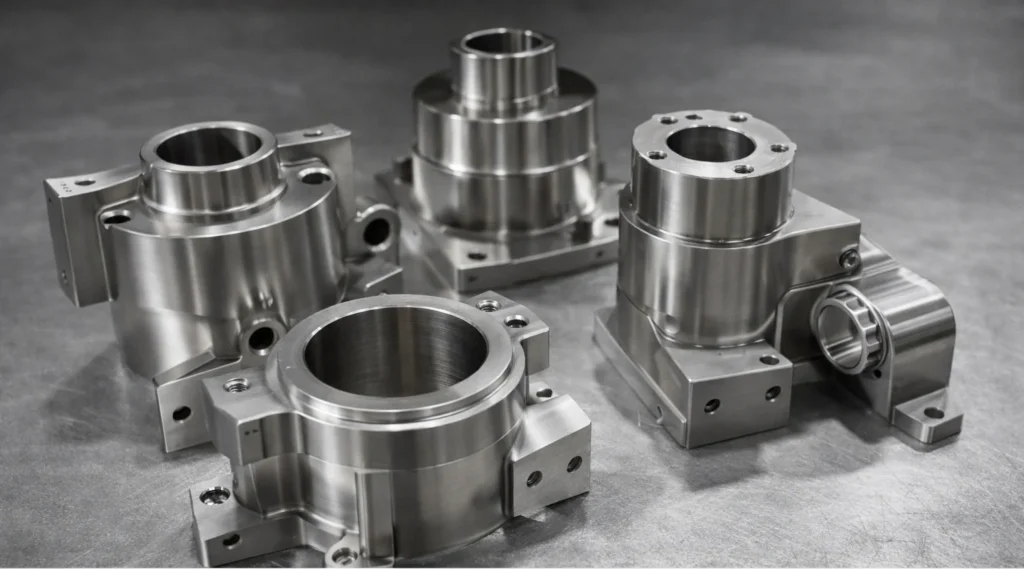
High precision titanium aerospace components manufactured by CNC machining at Dongguan Huade Precision Manufacturing Co., Ltd.
Why Aerospace Components Use Advanced Materials
Aerospace systems operate in some of the most demanding environments in modern engineering. Aircraft engines experience extreme heat, structural components must withstand continuous vibration and fatigue, and flight systems require lightweight designs without compromising strength.
To meet these requirements, aerospace manufacturers commonly rely on three categories of materials:
- Aluminum alloys for lightweight structural parts
- Titanium alloys for high-strength, corrosion-resistant components
- Nickel-based superalloys for high-temperature engine environments
Each of these materials offers specific advantages, but their machining characteristics vary significantly.
This is why aerospace CNC machining requires specialized process control and advanced equipment to maintain dimensional accuracy and surface quality.
Aluminum Alloys in Aerospace Machining
Aluminum alloys are widely used in aerospace manufacturing due to their excellent strength-to-weight ratio and relatively high machinability. Common aerospace aluminum grades include 6061, 7075, and 2024, which are frequently used in aircraft structures, brackets, and lightweight assemblies.
From a machining perspective, aluminum offers several advantages. It allows higher cutting speeds, smoother surface finishes, and efficient material removal rates. These characteristics make aluminum particularly suitable for large structural components and precision housings.
Typical aluminum aerospace components include:
- Aircraft structural brackets
- UAV frame components
- Lightweight sensor housings
- Aircraft interior structural supports
Despite its machinability, aluminum aerospace components often include thin-wall geometries and complex pockets designed to reduce weight. These structures can deform under cutting forces if machining parameters and fixturing are not carefully controlled.
For this reason, aerospace manufacturers often rely on high-speed CNC milling strategies and optimized tool paths to maintain structural accuracy.
Titanium CNC Machining for Aerospace Applications
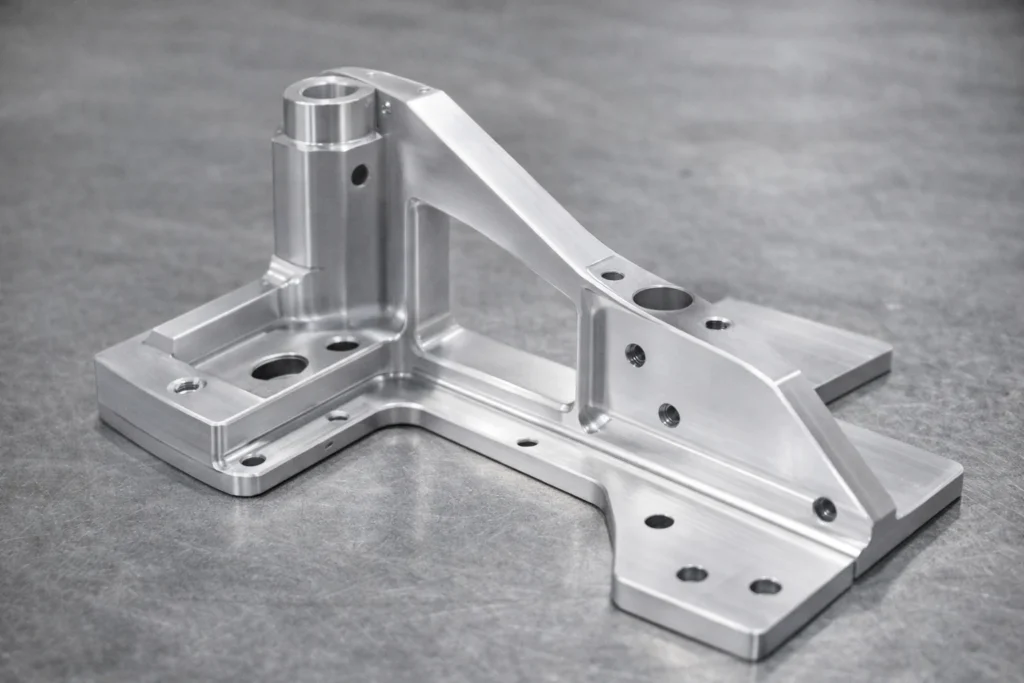
High-precision titanium CNC machined structural component designed for aerospace applications.
Titanium alloys are among the most important materials used in aerospace manufacturing. Components such as landing gear parts, turbine shafts, and structural fasteners frequently rely on titanium due to its exceptional strength, corrosion resistance, and temperature stability.
Titanium CNC machining is significantly more challenging than machining aluminum. Titanium has low thermal conductivity, meaning that heat generated during cutting remains concentrated at the tool edge. This increases tool wear and makes temperature control critical.
However, titanium CNC machining is significantly more challenging than machining aluminum. If you want to understand how material choice affects production cost, you can also read our CNC machining cost caculation guide.
Several characteristics make titanium difficult to machine:
- High strength even at elevated temperatures
- Low heat dissipation during cutting
- Strong chemical reactivity with cutting tools
- High cutting forces during material removal
To overcome these challenges, manufacturers typically employ specialized machining strategies. Lower cutting speeds, high-performance carbide tooling, and high-pressure coolant systems are commonly used to improve tool life and maintain machining stability.
When properly optimized, CNC machining can achieve tight tolerances in titanium aerospace components while maintaining high surface quality and dimensional accuracy.

CNC manufacturing expert with 15+ years of experience. William helps engineering teams turn prototypes into stable production parts through DFM optimization, tolerance planning, machining strategy selection, and inspection-driven quality control.
william@hdproto.comFor any CNC-machined part — whether shafts, housings, brackets, manifolds, or structural components — the foundation of reliable manufacturing starts with clean geometry, well-defined datums, and machining-friendly features that minimize re-clamping risks.
We support function-driven tolerances (down to ±0.01 mm when required) and offer full inspection options including CMM reports, thread gauges, and surface-finish verification to ensure repeatability from prototype to production.
CONTACT OUR EXPERT NOWMachining Nickel-Based Superalloys
Nickel-based superalloys are widely used in aircraft engines and other high-temperature aerospace environments. Materials such as Inconel 718, Inconel 625, and Waspaloy maintain their mechanical strength even at extremely high temperatures.
These alloys are essential for turbine blades, exhaust systems, and combustion components.
However, superalloys are widely considered among the most difficult materials to machine. Their hardness and heat resistance cause rapid tool wear and require careful machining strategies to maintain stable cutting conditions.
Machining superalloys typically involves:
- Lower cutting speeds
- Specialized coated carbide tools
- Advanced coolant systems
- Rigid machine setups to minimize vibration
Because of these challenges, machining superalloys requires both high-precision equipment and experienced process control.
Process Challenges in Aerospace Material Machining
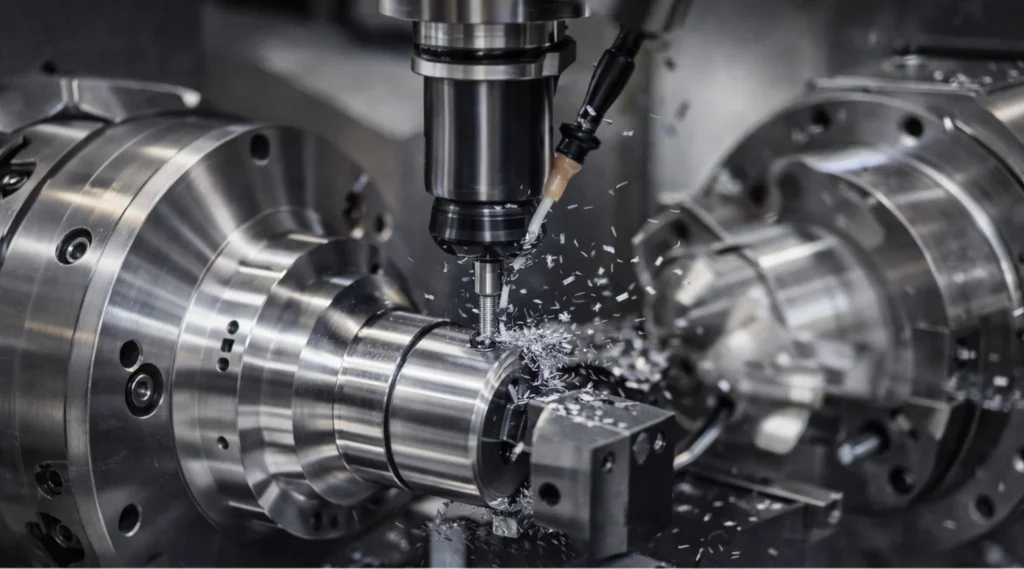
Titanium aerospace component being machined in a CNC turning operation at Dongguan Huade Precision Manufacturing Co., Ltd.
Machining aerospace materials involves several technical challenges that directly influence component quality and production efficiency.
Heat Control
Difficult materials such as titanium and superalloys generate significant heat during cutting. If heat is not effectively managed, it can accelerate tool wear and affect dimensional accuracy.
Tool Wear Management
Advanced aerospace materials place heavy stress on cutting tools. Monitoring tool life and optimizing cutting parameters is essential to maintaining stable machining performance.
Structural Stability
Many aerospace components feature thin-wall structures designed for weight reduction. Maintaining dimensional stability during machining requires carefully designed fixturing systems and balanced cutting strategies.
Surface Integrity
Aerospace parts often require extremely precise surface finishes to ensure fatigue resistance and long-term reliability. Improper machining parameters may introduce micro-defects that compromise component performance.
Precision Machining Solutions for Aerospace Materials
Producing aerospace components requires a combination of advanced machining equipment, optimized process strategies, and strict quality control procedures. Modern CNC machining centers allow manufacturers to process complex aerospace materials while maintaining tight tolerances and repeatable production accuracy.
At Dongguan Huade Precision Manufacturing Co., Ltd., we specialize in high-precision CNC machining solutions for complex industrial and aerospace components. Our manufacturing capabilities include CNC milling and CNC turning services with precision tolerances up to ±0.005 mm for CNC turning and ±0.01 mm for CNC milling, along with rapid prototyping services that allow engineering teams to obtain functional parts within 2–3 days.
Our experience in titanium CNC machining and advanced aerospace materials enables us to support engineers and procurement teams requiring reliable prototype and production components for demanding applications.
Conclusion
The machining of aerospace materials requires advanced manufacturing expertise, precise process control, and specialized tooling strategies. Aluminum alloys, titanium alloys, and nickel-based superalloys each present unique machining challenges that must be addressed through optimized CNC machining processes.
Among these materials, titanium CNC machining remains one of the most critical capabilities for aerospace manufacturing due to titanium’s widespread use in high-strength aircraft components.
For a broader overview of aerospace manufacturing technologies and precision machining requirements, see our guide to precision machining for the aerospace industry.
By combining advanced machining technologies with careful material understanding, manufacturers can produce reliable aerospace components that meet strict engineering standards for safety, durability, and performance.
 English
 Deutsch
 Español
 Français
 Português do Brasil