
Selecting the right stainless steel grade is essential for CNC machining, fabrication, and long-term performance. When comparing 201 vs 304 stainless steel, engineers and purchasing managers must weigh differences in composition, corrosion resistance, mechanical properties, weldability, and cost. This guide provides a clear, application-focused comparison so you can choose the most economical and reliable option for your project.
Quick overview: 201 vs 304 stainless steel
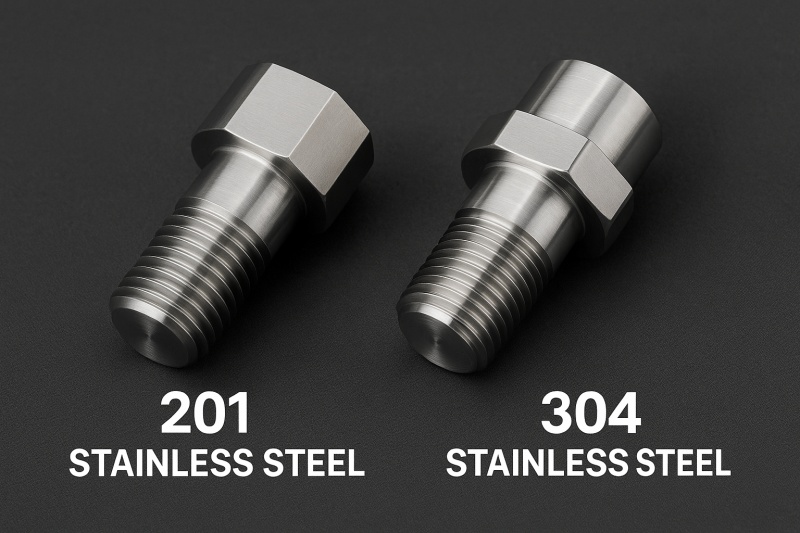
201 vs 304 stainless steel are both austenitic stainless steels, but they serve different needs. 201 stainless steel is an economical alternative with lower nickel content and higher manganese, while 304 stainless steel is the industry workhorse known for superior corrosion resistance and formability. Understanding the trade-offs between 201 stainless steel vs 304 stainless steel helps you optimize performance and budget.
Chemical composition and what it means
The primary difference when looking at 201 vs 304 stainless steel is nickel content. 304 contains higher nickel and chromium levels, which improve corrosion resistance and stability at elevated temperatures. 201 replaces some nickel with manganese and nitrogen, lowering cost but reducing resistance to certain corrosive environments. For detailed chemical data, refer to material databases like MatWeb: https://www.matweb.com
| Property | 201 Stainless Steel | 304 Stainless Steel |
|---|---|---|
| Composition | Lower nickel, higher manganese | Higher nickel and chromium |
| Corrosion resistance | Adequate in mild environments | Better overall corrosion resistance |
| Cost | Less expensive | More expensive |
| Common applications | Decorative trim, indoor fixtures, appliances | Kitchen equipment, medical devices, outdoor architecture |
Corrosion resistance and service environments
Corrosion resistance is often the decisive factor. In most indoor applications and mild environments, 201 stainless steel can perform adequately. However, when exposure to chlorides, coastal environments, or aggressive cleaning chemicals is expected, 304 stainless steel is the safer choice. The practical comparison of 201 vs 304 stainless steel shows that 304 typically withstands oxidizing and chloride-containing conditions better and requires less maintenance over time.
If your application demands even higher corrosion resistance (for marine or highly corrosive chemical environments), consider the broader comparison of 201 vs 304 vs 316 stainless steel—316 contains molybdenum, providing superior pitting resistance in chloride-rich conditions.
Mechanical properties and machinability
For CNC machining and precision fabrication, both 201 vs 304 stainless steel have good toughness and ductility. 201 stainless steel can be slightly harder and less ductile than 304, which can influence tool wear and forming operations. Conversely, 304 stainless steel often offers better overall formability and weldability, making it preferable for complex shapes.
When evaluating 201 stainless steel vs 304 stainless steel for turned, milled, or bent components, consider prototypes to verify tool life, tolerances, and surface finish. Machinability data is available from various standards organizations and material suppliers.
Weldability and fabrication
Weldability can be a deciding factor in assemblies and welded structures. 304 stainless steel typically welds more predictably and requires less post-weld treatment for corrosion resistance. 201 stainless steel can be welded but may need more careful process control to prevent sensitization and retain intended mechanical properties. If welding is central to your manufacturing process, prioritize 304 in the 201 vs 304 stainless steel decision.
Magnetic properties and annealing
Both 201 vs 304 stainless steel are nominally non-magnetic in the annealed condition, but cold working can induce ferrite and make them slightly magnetic. 201 stainless steel often shows higher magnetic response after cold working than 304. If magnetic permeability is critical (for sensors or MRI compatibility, for example), test parts or consult with your supplier.

Cost considerations
One of the strongest drivers for choosing 201 stainless steel is cost. 201 stainless steel tends to be less expensive because it uses less nickel. For large-volume components where corrosion exposure is mild, 201 can offer significant savings. However, the long-term maintenance, potential replacement costs, and scrap rates should be considered—304 stainless steel may deliver lower total cost of ownership in harsher environments.
When weighing 201 vs 304 stainless steel, perform a lifecycle cost analysis that includes material cost, machining time, surface treatments, and expected service life.
Common applications and when to choose each grade
- Choose 201 stainless steel for decorative trim, indoor fixtures, and budget-sensitive components with limited exposure to chlorides or acids.
- Choose 304 stainless steel for kitchen equipment, food processing, medical devices, and outdoor architectural elements that require stronger corrosion resistance.
- For environments with aggressive chloride exposure, compare 201 vs 304 vs 316 stainless steel—316 is often preferred for marine and chemical applications.
Testing, standards, and certifications
When specifying materials, reference relevant standards (ASTM A240 for 304 and variations) and ask for mill test certificates (MTCs) or material traceability from your supplier. Independent testing—such as salt spray (ASTM B117), pitting resistance testing, and tensile testing—helps validate that 201 stainless steel vs 304 stainless steel will meet your performance needs.
Reliable industry resources include ASM International and standards bodies like ASTM and ISO. For quick reference and datasheets, use MatWeb and manufacturer catalogs.
Best practices for design and procurement
- Define the operating environment: humidity, salt exposure, chemical contact, and temperature range.
- Specify finish and surface treatments: passivation or electropolishing can enhance corrosion resistance, particularly for 201 stainless steel or welded assemblies.
- Include tolerances and surface finish expectations in procurement documents to avoid mismatched assumptions between design and manufacturing.
- Prototype critical parts to assess machinability and fit, especially when choosing between 201 stainless steel vs 304 stainless steel.
Quick comparison table (summary)
- Corrosion resistance: 304 > 201
- Machinability: similar; 304 usually easier to form
- Weldability: 304 > 201
- Cost: 201 < 304
- Applications: 201 for low-corrosion indoor parts; 304 for food, medical, outdoor, and general-purpose use.
When to escalate to 316 or specialty alloys
If your project requires enhanced corrosion resistance—such as in marine or aggressive chemical environments—consider upgrading from 201 or 304 to 316 stainless steel or specialty alloys. Dongguan Huade Precision Manufacturing Co., Ltd. provides prototyping, CNC machining, and full material certification for components made from 201, 304, and 316 stainless steel. Our engineering team offers expert guidance on alloy selection and machining processes to ensure performance, quality, and cost-effectiveness.
Final recommendations
Choosing between 201 vs 304 stainless steel requires balancing cost, corrosion resistance, and long-term performance.
- 201 stainless steel is suitable for decorative trim, indoor fixtures, and cost-sensitive projects in mild environments.
- 304 stainless steel is the preferred choice for food equipment, medical devices, outdoor applications, and projects requiring stronger corrosion resistance.
When in doubt, always prototype, test, and consult material standards to ensure your components meet functional and durability requirements.
External Resources and References
For further technical reading and reliable material data, explore:
- MatWeb Material Database – detailed chemical compositions and mechanical properties of stainless steels.
- ASM International – authoritative resources on metals, alloys, and industry standards.
- Overview of Stainless Steel Grades (Wikipedia) – general background information on stainless steel categories and uses.
📩 Contact us at info@hdproto.com or visit hdproto.com to discuss your stainless steel machining requirements and request a free consultation or quotation.
 English
 Deutsch
 Español
 Français
 Português do Brasil
 Italiano
Bonjour, excellent article comparatif sur les nuances d’acier inoxydable 201 et 304 ! La précision sur les environnements de service et la résistance à la corrosion est particulièrement utile pour le choix des matériaux en usinage CNC.
Cela me fait penser à une question sur un autre type de “résistance” et de “compatibilité”. Dans le domaine médical, pour des composants ou des dispositifs qui pourraient être en contact avec des agents pharmaceutiques agressifs, comme certains corticostéroïdes (par exemple, le Dextason, dont les spécifications peuvent être consultées ici : par exemple, certains corticostéroïdes comme la dexaméthasone), est-ce que l’acier inoxydable 304 standard offre une protection suffisante contre la corrosion chimique ? Ou bien, dans le cas de produits pharmaceutiques très concentrés, seriez-vous d’avis qu’il faille impérativement passer à une nuance supérieure comme le 316L pour garantir l’intégrité du composant et éviter toute contamination ?
Merci pour vos lumières sur cette application très spécifique !
Bonjour Dennis,
Merci beaucoup pour votre question très pertinente — c’est un point tout à fait essentiel.
Dans les environnements pharmaceutiques et médicaux, la résistance à la corrosion seule ne suffit pas. Bien que l’acier inoxydable 304 offre de bonnes performances dans de nombreux contextes industriels, il peut ne pas être adapté lorsque les composants sont exposés à des agents pharmaceutiques agressifs, à des produits de nettoyage chimiques ou à des cycles de stérilisation répétés.
Pour les applications impliquant un contact direct ou indirect avec des substances pharmaceutiques, les aciers inoxydables 316 ou 316L sont généralement privilégiés. Leur teneur plus élevée en molybdène améliore significativement la résistance à la corrosion chimique et au piquage. Dans les cas critiques, le choix du matériau doit également prendre en compte l’état de surface, la passivation, ainsi que la conformité aux normes médicales ou pharmaceutiques applicables.
En résumé :
• L’inox 304 convient aux environnements industriels standards
• Les inox 316 / 316L sont recommandés pour les applications pharmaceutiques, médicales ou chimiquement agressives
Merci encore d’avoir soulevé cette problématique spécifique — ce type d’échange permet d’aborder concrètement les enjeux réels du choix des matériaux.
Bonjour, merci pour cet article très détaillé. En tant que technicien travaillant sur la conception de dispositifs médicaux, je trouve votre comparaison entre le 201 et le 304 extrêmement pertinente, surtout pour l’usinage CNC. J’ai une question concernant la résistance à long terme : dans certains guides techniques sur la maintenance des équipements de précision, notamment ceux traitant de la stabilité des matériaux face à des environnements hautement volatils (comme on peut le voir dans les analyses de risques sur https://custom-metalworks.com), on mentionne souvent que le 304 peut montrer des signes de fatigue précoce face à certains solvants industriels. Selon votre expérience, pour des pièces qui nécessitent une décontamination fréquente avec des solutions chlorées, le passage au 316L est-il une recommandation standard ou existe-t-il des traitements de surface (passivation) capables de rendre le 304 aussi performant dans ces conditions critiques ?
Merci beaucoup pour votre question très pertinente et détaillée.
Vous avez tout à fait raison : dans des environnements impliquant des solutions chlorées ou des solvants agressifs, l’acier inoxydable 304 peut présenter des signes de corrosion ou de dégradation à long terme, en particulier en cas d’exposition répétée.
Dans ce type de conditions, le 316 ou 316L est généralement un choix plus fiable grâce à sa teneur en molybdène, qui améliore significativement la résistance à la corrosion induite par les chlorures.
Les traitements de surface comme la passivation peuvent améliorer la résistance à la corrosion dans une certaine mesure, mais ils ne compensent généralement pas totalement les limites intrinsèques du matériau dans des environnements très agressifs.
Pour des applications critiques, notamment dans le domaine médical ou les équipements de précision, nous recommandons en priorité le choix du bon matériau (par exemple 316L), puis l’optimisation des traitements de surface en complément.
Si vous avez des conditions d’application spécifiques, n’hésitez pas à les partager — nous serions ravis d’en discuter plus en détail.
Nous travaillons régulièrement sur ce type de pièces en usinage CNC de précision, n’hésitez pas à échanger avec nous si besoin.