1215 carbon steel is a free-machining grade used for turned and drilled components where chip control, throughput and surface finish matter. This guide covers its properties, limitations, common applications and the information a supplier needs before quoting.
What Is 1215 Carbon Steel?
1215 carbon steel is a free-machining steel that belongs to the resulfurized and rephosphorized family of cold-drawn steels. It is specifically engineered to offer superior machinability, making it ideal for high-volume production environments where speed and precision are essential.
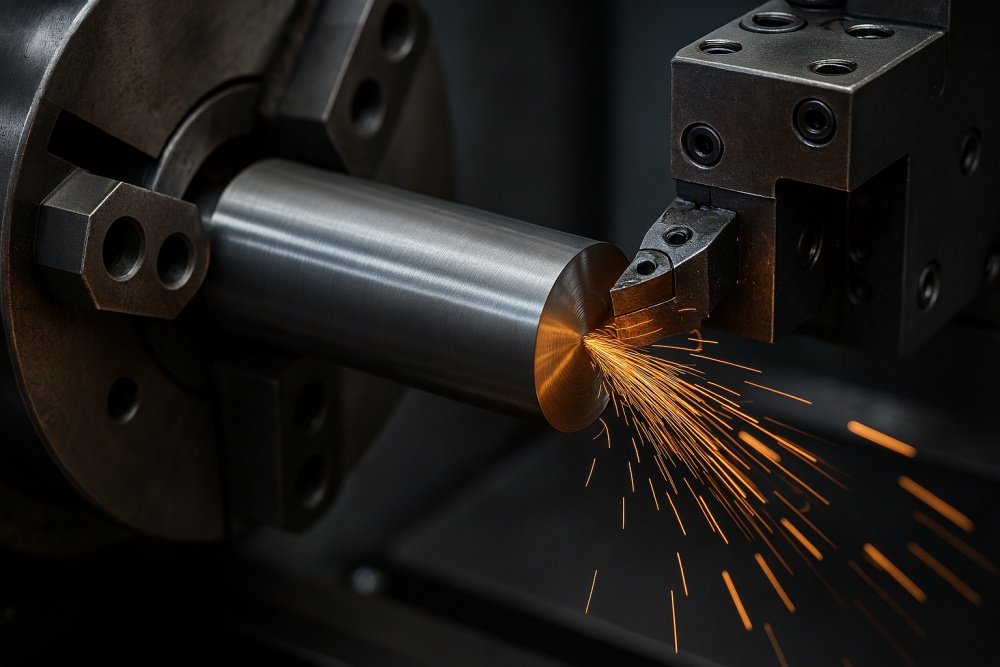
Key characteristics of 1215 carbon steel include:
- Low carbon content (~0.09%) for improved machinability
- High sulfur (~0.26–0.35%) and phosphorus (~0.04–0.09%) levels to enhance chip formation
- Excellent dimensional stability and surface finish
- Limited weldability; confirm any welding or heat-treatment route with the material specification and process supplier
These properties make 1215 carbon steel a preferred material for CNC turning, milling, and drilling operations, especially when producing small to medium-sized components with tight tolerances.
Why 1215 Machines Efficiently
1215 is commonly selected for its free-machining behavior. Sulfur and phosphorus promote chip breaking, which can support efficient turning and a consistent finish when the cutting process is controlled.
Benefits of 1215 carbon steel machining include:
- High-speed performance: Ideal for automated CNC setups and multi-axis machining
- Useful surface finish: Can produce clean turned surfaces with suitable tooling and cutting data
- Repeatable production: Predictable chip formation supports automated turning and drilling
- Tooling efficiency: Free-machining behavior can reduce cutting load compared with lower-machinability steels
- Efficient chip evacuation: Improves productivity and reduces downtime
These advantages make 1215 carbon steel an excellent choice for manufacturers looking to optimize throughput without sacrificing quality.
1215 vs 1018 and 12L14
| Grade | Relative machining behavior | Useful selection note |
|---|---|---|
| 1215 | Free-machining, predictable chip breaking and good finish | Useful for high-volume turned parts when welding is not required |
| 1018 | More difficult to machine but easier to weld and form | Better when fabrication or welding matters more than cycle time |
| 12L14 | Excellent machinability because of lead addition | Confirm regulatory, environmental and customer restrictions before specifying |
Cutting parameters must still be validated on the actual stock, machine, tool and coolant system. Treat published speeds as starting ranges rather than guaranteed production settings.
When 1215 Is Not the Best Choice
Fast chip breaking does not make 1215 the right answer for every steel part. Reconsider the grade when welding, forming, high impact loading, a particular corrosion environment or a customer-controlled material standard governs the design. In those cases, the drawing should name the required grade and standard rather than requesting a generic “free-machining steel.”
Material selection also affects the process route. A turned fitting may be a good fit for CNC turned parts, while a part with multiple faces, pockets and locating features may need a milling or combined route. Reviewing the CNC machining cost factors early helps distinguish a material-driven saving from a setup-driven one.
Common Applications of 1215 Carbon Steel Machined Parts
Due to its machinability and reliability, 1215 carbon steel is used across a wide range of industries, including automotive, electronics, industrial machinery, and consumer products.
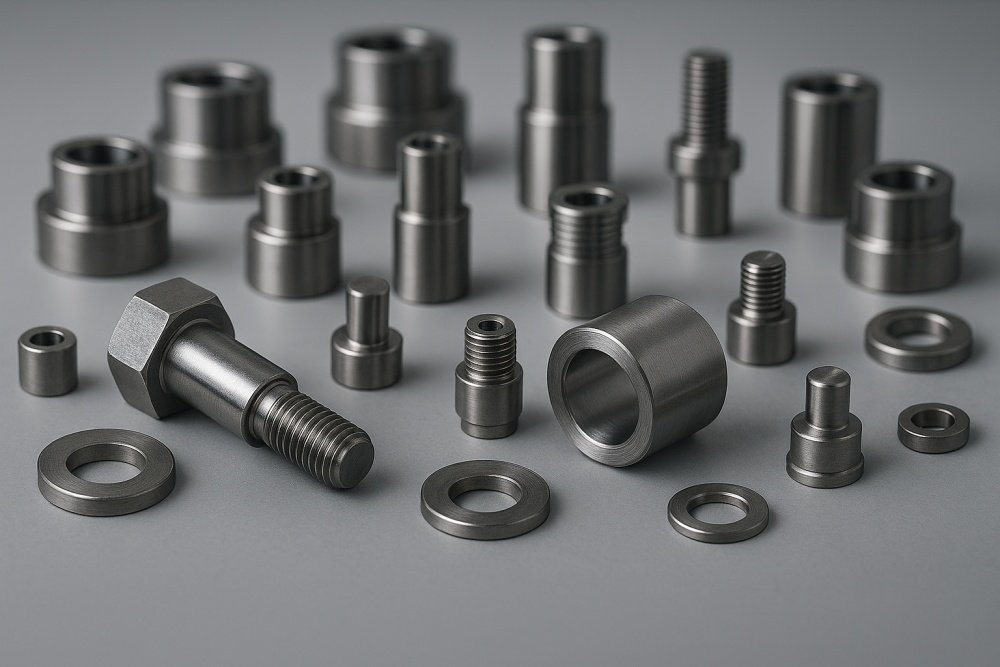
Typical 1215 carbon steel machined parts include:
- Shafts, pins, and rods for mechanical assemblies
- Threaded components such as bolts, studs, and CNC turned connectors
- Bushings, spacers, and sleeves for precision fittings
- Couplings and adapters for hydraulic and pneumatic systems
- Custom fasteners and fittings for electronic enclosures
These parts are often produced using CNC lathes, Swiss-type machines and multi-axis equipment. Actual cycle time and tool life depend on stock condition, geometry, machine rigidity, tooling and coolant strategy.
Choosing a 1215 Carbon Steel Machining Service
Not all CNC machining providers are equipped to handle the specific requirements of 1215 carbon steel. Selecting the right partner is essential to ensure quality, efficiency, and scalability.
Key factors to consider when selecting 1215 carbon steel machining services:
- Technical expertise: Look for providers with experience in machining free-cutting steels and optimizing tool paths, feed rates, and coolant strategies
- Advanced equipment: Multi-axis CNC machines, Swiss lathes, and automated screw machines are ideal for maximizing productivity
- Quality assurance: Ensure the provider offers comprehensive inspection protocols, including CMM measurement, surface roughness testing, and material traceability
- Scalability: Choose a partner that can handle both prototyping and full-scale production with flexible lead times
- Post-processing capabilities: Some projects may require deburring, plating, or coating—select a provider that offers these services in-house
A reliable machining service will not only deliver high-quality 1215 carbon steel machined parts but also help streamline your supply chain and reduce overall project costs. Learn more about the properties of 1215 carbon steel from MatWeb.
Plan Your 1215 Steel RFQ
1215 carbon steel machining offers a powerful combination of speed, precision, and cost-efficiency. Its unique properties make it ideal for CNC applications that demand high-volume production and tight tolerances. By partnering with an experienced machining provider, you can ensure consistent quality, reduce operational costs, and accelerate your time to market.
Whether you’re developing prototypes or scaling up for mass production, 1215 carbon steel machining services can help you achieve your manufacturing goals with confidence and precision.
For a useful quotation, provide the material specification, stock condition, drawing, quantity, tolerance, surface-finish requirement and any plating or corrosion-protection requirement. Submit those details through our RFQ form, or review our CNC turning services and precision carbon steel machining guide.