
Table of Contents
In the world of custom manufacturing, the smallest components often carry the heaviest burdens.
Recently, our engineering team at Dongguan Huade Precision received a query from Mark, a Project Manager at Apex Architectural Fabricators, a firm known for high-end residential installations. Mark sounded stressed. His team had just installed a dual-swing driveway gate for a luxury estate—a massive structure of powder-coated steel and tempered glass weighing nearly 800 pounds per leaf.
The problem? Less than a month after installation, the gate was sagging. The bottom corner was beginning to grind against the cobblestone driveway.
“We used standard heavy-duty weld-ons from a catalog,” Mark explained during our consultation call. “They were rated for the weight, but they’re already failing.”
At Huade Precision, we see this scenario often. The failure wasn’t in Apex’s fabrication of the gate frame; it was in the choice of gate hinges for metal gates. Off-the-shelf components are rarely designed for the dynamic stresses of high-momentum architectural gates.
This case study details how we helped Apex solve this problem by switching from cast parts to custom CNC machining for gate hinges, and outlines the criteria every engineer should use when selecting hinges for metal gates.


The Failure Analysis: Why Standard Metal Gate Hinges Give Way
When Mark sent us the photos and the failed hinge samples, the issue was immediately apparent to our quality control engineers. The top hinge hadn’t snapped, but the barrel had deformed. The internal pin had worn down the inner wall of the barrel, turning a perfect circle into an oval.
This introduced “slop” into the pivot point. In the geometry of metal gate hinges, a mere 1mm of play at the hinge can translate to over 25mm (1 inch) of sag at the end of a ten-foot gate leaf.
Standard cast metal hinges for gates are often mass-produced with loose tolerances. They are rated for static loads (holding the weight still), but they often fail under dynamic loads (the energy of the gate swinging and stopping).
To fix Apex’s problem, we couldn’t just replace the hinge with the same part. We needed to re-engineer the pivot system entirely.
Step 1: Selecting the Right Gate Hinge Materials
The first question we asked Mark was regarding the environmental conditions. Since the estate was located near a coastal region, corrosion resistance was non-negotiable.
When designing custom metal gate hinges, our machinists typically evaluate three material categories:
1. Stainless Steel (The Structural Choice)
For Apex’s heavy gate, we recommended 304 Stainless Steel (and would have suggested 316 for direct salt spray zones).
- The Engineering Logic: Stainless steel offers superior tensile strength. However, the manufacturing method matters. Cast stainless often contains microscopic porosity. By using CNC machining for gate hinges cut from solid billet 304 bars, we ensure a dense, uniform grain structure that is significantly stronger than a casting.
2. Aluminum (The Design Choice)
We often machine aluminum gate hinges (typically 6061-T6 or 7075) for modern, lighter gates where the architect wants a specific anodized color match.
- The Engineering Logic: While aluminum is lightweight, it is softer than steel. When we use aluminum for the hinge body, our shop inserts a press-fit bronze or hardened steel bushing into the barrel to handle the friction, preventing the aluminum from wearing out.
3. Mild Steel (The Weld-On Standard)
Basic metal post gate hinges found in hardware stores are usually mild carbon steel.
- The Engineering Logic: These are easy to weld but prone to rust. For a high-end project like Apex’s, mild steel was insufficient unless it was going to be heavily galvanized post-fabrication.
Decision: We moved forward with solid billet 304 Stainless Steel to ensure the metal gate hinges would last as long as the gate itself.
Step 2: The CNC Advantage Over Casting
Mark asked a valid question: “Why do we need to custom machine these? Can’t we just find a bigger cast hinge?”
This gave us the opportunity to explain the value of precision. CNC machining for gate hinges allows us to control the fit to a level impossible with casting.
Eliminating the “Chatter” In a standard cast hinge, the gap between the pin and barrel might be 0.3mm to 0.5mm to account for coating thickness. This gap causes vibration. At Dongguan Huade, our CNC turning centers bored the hinge barrels to an H7 tolerance. The pin we machined fit with a “hydraulic” precision—sliding in smoothly but with zero lateral wiggle. This tight tolerance is the primary defense against sagging.
Integrating High-Load Bearings Standard metal post gate hinges rely on friction—metal rubbing against metal. To handle the 800lb load, we designed a pocket into the bottom of the hinge barrel to accept a sealed axial ball thrust bearing.
- The Result: Instead of grinding friction, the gate floats on hardened steel balls. This reduced the opening force required from 15lbs to less than 3lbs, significantly reducing strain on the automatic gate opener motors.
Step 3: Solving the Mounting Challenge (Metal vs. Wood)
The installation at the estate presented a unique hybrid challenge. The left gate leaf attached to a structural steel column, but the right leaf attached to a decorative, steel-reinforced timber post.
Mark was worried about using metal hinges for wood surfaces. “The last time we put a heavy gate on wood, the lag screws eventually pulled out because the wood expanded,” he noted.
This is a critical failure point for gate hinges for wood posts. Wood is hygroscopic; it swells and shrinks. Metal does not.
The “Sandwich” Backing Plate Solution
Our design team proposed a solution that moved beyond simple lag screws. We fabricated a custom metal gate to wood post hinge system using a through-bolt method.
- Front Plate: We machined the stainless hinge plate with four counter-bored holes.
- Backing Plate: We machined a matching stainless steel plate to go on the back side of the timber post.
- Connection: Instead of screwing into the wood, Apex’s installers would drill through the post. Stainless steel bolts would pass through the hinge, through the timber, and thread into the backing plate.
This clamped the wood between the two metal plates, distributing the 800lb load across the entire surface area of the post. This transformed a risky metal hinges for wood connection into a rock-solid mechanical bond.
Step 4: Installation and Adjustment Features
For the steel column side, we supplied metal gate post hinges designed for welding. However, knowing that field conditions are rarely perfect, we added a feature that simplified life for Mark’s installation crew.
We CNC milled elongated adjustment channels into the mounting plates. This allowed the installers to bolt the hinge on loosely, adjust the gate’s level by +/- 3 degrees, and then perform the final weld.
The Outcome: Two weeks later, Mark emailed us from the site. The new gate installation hinges went in perfectly. “The difference is night and day,” Mark wrote. “The gate swings silently. The bearings make it feel weightless, and the customer is thrilled with the machined finish on the stainless steel. It looks like jewelry compared to the old cast parts.”
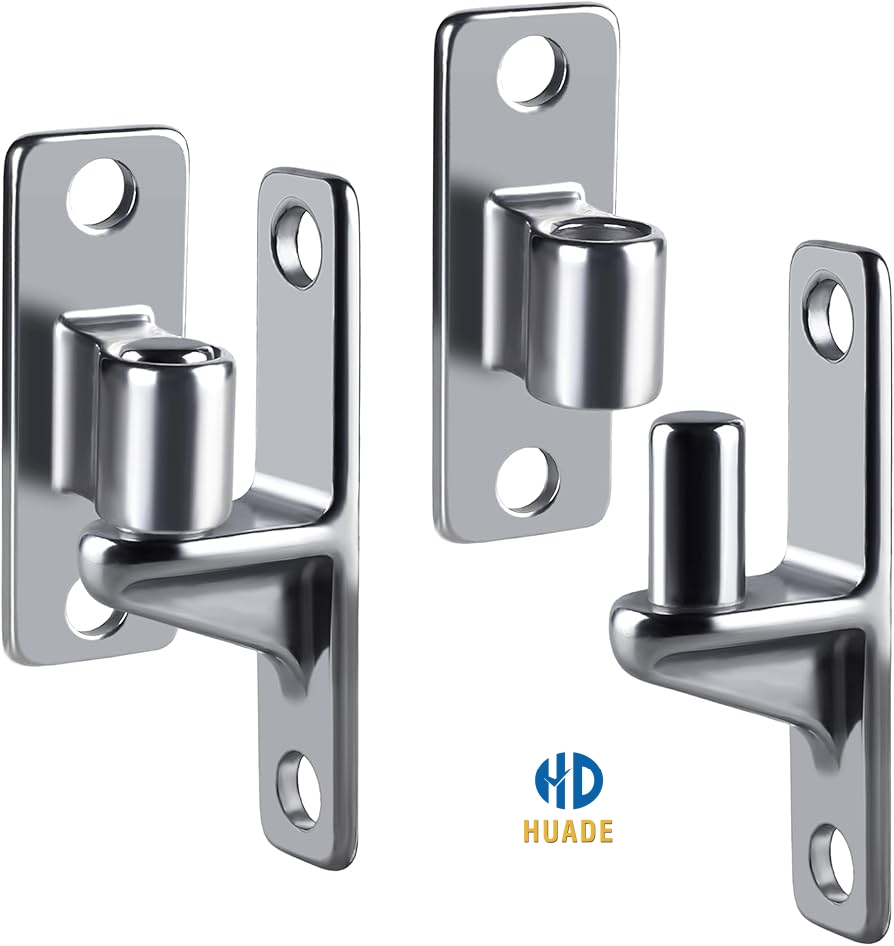
Expert Advice: A Checklist for Choosing Hinges
Based on our experience helping clients like Apex, here is the Dongguan Huade Precision checklist for specifying hinges for metal gates:
- Calculate Dynamic Load: Do not just look at the weight. If the gate is solid (high wind resistance) or wide (high leverage), multiply the weight by 1.5x to select your hinge rating.
- Prioritize Bearings: For any gate over 50kg, avoid simple pin hinges. Use metal gate hinges with integrated ball bearings or tapered roller bearings.
- Match the Mount:
- For metal gate post hinges: Ensure the material grade is compatible for welding.
- For metal gate to wood post hinge scenarios: Always use a through-bolt and backing plate design to prevent pull-out.
- Demand Precision: If the gate is architectural or automated, CNC machining for gate hinges is the only way to ensure the concentricity required for smooth, long-term operation.
Partner with Dongguan Huade for Precision Manufacturing
The difference between a gate that sags and one that endures lies in the precision of its pivot points. At Dongguan Huade Precision Manufacturing Co., Ltd, we don’t just supply parts; we provide engineering solutions for fabricators, architects, and product designers.
Whether you need a custom metal post gate hinge for a unique project or a production run of high-tolerance metal hinges for gates, our facility is equipped to handle it. We specialize in 3-axis to 5-axis CNC milling, turning, and rapid prototyping, working with materials ranging from hardened tool steels to titanium and aluminum.
Don’t let a standard part ruin a premium project. Contact our team today to discuss how we can support your next fabrication challenge.
Get a quote for your precision parts at hdproto.com.
 English
 Deutsch
 Español
 Français
 Português do Brasil
 Italiano