Revisar el paquete de liberación
Temperature, load, chemicals, electrical requirements and moisture exposure establish the material shortlist before machining is planned.
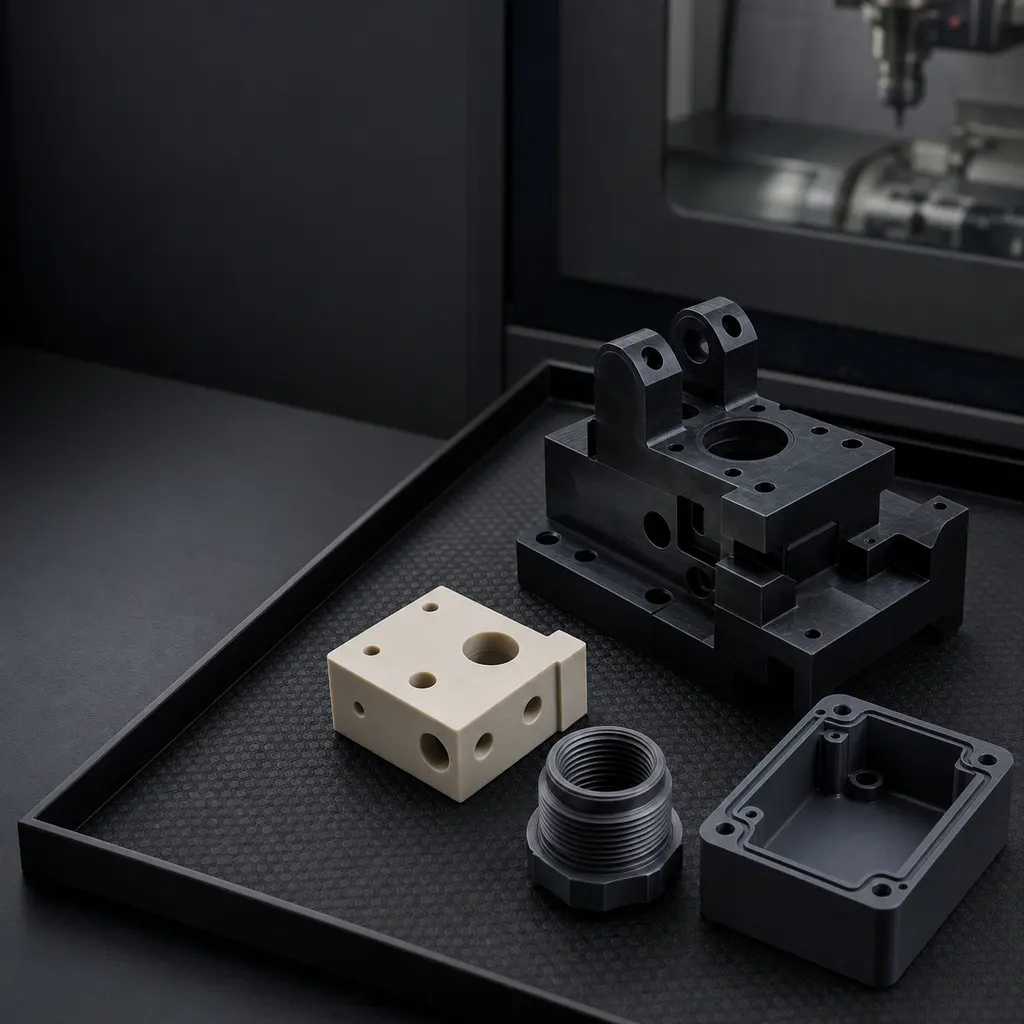
Componentes de polímero técnico
HDProto mecaniza plásticos técnicos cuando importan el aislamiento eléctrico, la resistencia química, el peso o la baja fricción.
Solicitar presupuestoEste servicio es para proyectos donde geometría, entorno y comportamiento dimensional del plástico deben planificarse juntos.
Manufacturing route
Temperature, load, chemicals, electrical requirements and moisture exposure establish the material shortlist before machining is planned.
Wall thickness, unsupported sections, threads and flatness requirements are checked against the material’s stiffness and heat response.
Workholding, cutting conditions and machining sequence are selected to minimize distortion, burrs and local heat effects.
Critical dimensions are evaluated with the stated material, conditioning and reference-temperature assumptions in mind.
Una revisión de plano y criterios de aceptación claros mantienen controlado cada lote repetido.
Las caras de sellado, ajustes a presión, roscas y superficies visibles deben marcarse como críticas desde el inicio.
Las cantidades, entregas parciales y acabados deben cotizarse juntas.
Application decisions
For insulating fixtures, housings and guides, the decision starts with dielectric needs, temperature and chemical exposure. The drawing should state the resin family, color or grade where relevant, and the dimensions that govern assembly.
Bushings, guides and wear pads need a material decision that accounts for mating surface, lubrication, load and heat. A polymer selected only for low friction may not hold the required dimensions in service.
Where a polymer bore, flatness or position controls function, specify the measurement condition. Temperature and moisture assumptions are essential context for a meaningful tolerance and inspection result.
Engineering decision matrix
These are the inputs that change process routing, inspection effort and the usefulness of the completed part. They are not universal specifications; the drawing and service environment remain the source of acceptance requirements.
| Decision | What to review | Risk if omitted | Useful RFQ input |
|---|---|---|---|
| Operating condition | Assess temperature, chemicals, electrical duty, moisture, load and sliding contact before selecting a polymer. | Selecting by name or price alone can produce a part that moves, creeps or degrades in service. | Describe the environment, load case, mating material and any dielectric or chemical requirement. |
| Dimensional condition | Agree the material state and reference temperature for fit-critical dimensions. | A part can measure correctly after machining yet differ after moisture uptake or thermal change. | State measurement temperature, conditioning expectation and the dimensions that control function. |
| Geometry and support | Check wall thickness, long unsupported features, bores and threads against material stiffness. | Metal-style geometry can distort during machining or relax after fixturing is released. | Provide section views, datums, flatness needs and insert or thread requirements. |
| Inspection and assembly | Plan measurements and assembly features around polymer behavior rather than a generic tolerance note. | A tight drawing tolerance without condition context produces an ambiguous acceptance result. | Flag fit-critical bores, inserts, mating parts and requested inspection documentation. |
Many engineering polymers can be machined, including ABS, nylon, PEEK, POM, PTFE, polycarbonate and acrylic. The right choice depends on the operating environment and functional load.
Critical features can be controlled, but tolerances should reflect the polymer, geometry, conditioning and service temperature. Discuss fit-critical requirements at the drawing review stage.
Yes. CNC machining avoids tooling investment and is well suited to prototypes, bridge quantities and low-volume functional components.