CNC Machining
Polycarbonate (PC)
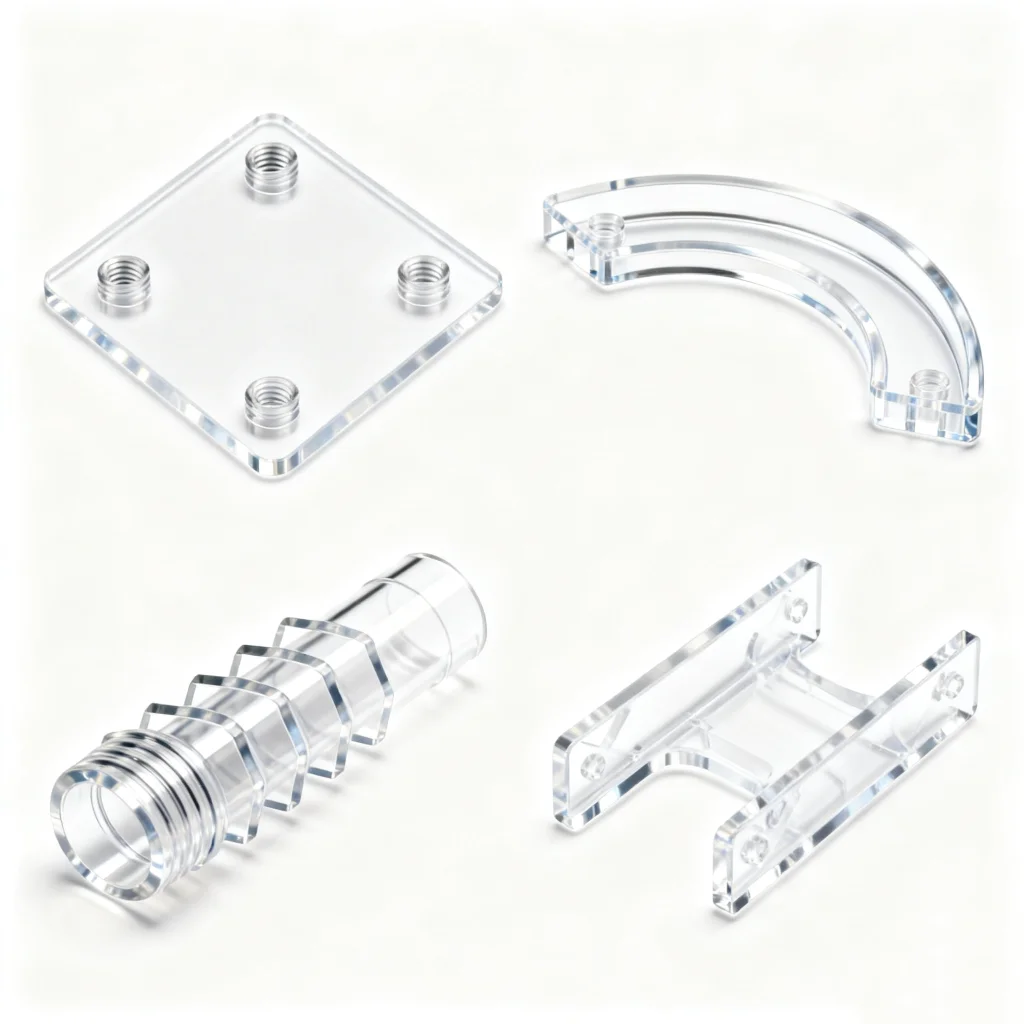
Polycarbonate (PC), commonly known by trade names like Lexan® and Makrolon®, is an incredibly tough, transparent engineering thermoplastic. Offering an impact resistance 250 times greater than glass and excellent heat stability, it is the ultimate material for high-pressure fluid manifolds, bullet-resistant sight glasses, and durable optical housings.
Core Mechanical Properties
Polycarbonate's defining characteristic is its virtually unbreakable nature. It will bend and deform under extreme loads long before it shatters, making it inherently safe for pressurized applications.
| Property | Typical Value | Key Benefit |
|---|---|---|
| Impact Strength (Izod) | 600 - 850 J/m | The highest impact resistance of any transparent plastic. Virtually unbreakable. |
| Light Transmission | ~ 88% | Excellent optical clarity, though slightly less than Acrylic (92%). |
| Tensile Strength | 60 - 70 MPa | High structural integrity, easily capable of handling heavy mechanical fastening. |
| Heat Deflection (HDT) | 135°C - 140°C | Significantly more heat resistant than Acrylic, allowing use in hotter environments. |
Material Comparison: Polycarbonate vs Acrylic
Choosing between Polycarbonate (PC) and Acrylic (PMMA) is the most common dilemma when machining clear plastics. The right choice depends on whether you prioritize impact resistance or absolute optical perfection.
| Feature | Polycarbonate (PC) | Acrylic (PMMA) |
|---|---|---|
| Impact Resistance | Extreme (Bends, won't shatter) | Low (Brittle, chips easily) |
| Optical Clarity | 88% (May have slight blue/grey tint) | 92% (Perfect glass-like clarity) |
| Scratch Resistance | Poor (Scratches easily) | Good |
| Machining Behavior | Forgiving, can be aggressively milled | Must be machined carefully to avoid cracking |
| Glass-Filled Variant | PC GF30 (Opaque, ultra-rigid) | Not typically available |
Application Fit Matrix
Polycarbonate is the transparent plastic to choose when impact resistance and functional toughness matter more than scratch resistance.
| Application | Recommended Material | Why This Material Works | Typical CNC Process | Finish / Risk Note |
|---|---|---|---|---|
| Machine Guards & Safety Shields | Clear Polycarbonate | High impact resistance with visibility. | Routing, drilling, edge finishing | Add hard coating if scratch resistance matters. |
| Protective Covers & Lenses | Optical PC | Tougher than acrylic for impact exposure. | Milling, polishing, drilling | PC can stress-crack with some chemicals. |
| LED Optics & Light Pipes | Clear PC | Good optical performance with toughness. | Milling, engraving, polishing | Optical areas need controlled tool marks. |
| Electronic Housings | PC or PC-ABS | Impact-resistant and flame-rated options. | Milling, pocketing, tapping | Use inserts for repeated assembly. |
| Automotive Prototype Parts | PC | Durable enough for fit and functional trials. | Milling, routing, trimming | Check heat and chemical exposure. |
Selection Rule
Match the grade to the part's real job first: strength, heat, wear, corrosion, insulation, transparency, or cosmetic finish.
DFM Reminder
Material choice changes tolerance risk, burr control, wall thickness, thread strategy, and finishing route.
Quote Tip
Share the operating environment, mating parts, finish expectations, and inspection requirements with the drawing.
Expert Machining Tips
While PC will not shatter like Acrylic, it is "gummy" and prone to severe Environmental Stress Cracking (ESC) if exposed to the wrong chemicals during or after machining.
- 1
Strict Coolant Control
Polycarbonate reacts violently to many synthetic, oil-based, or alkaline coolants, which will cause it to craze (develop micro-cracks) days after machining. We use highly controlled, pure air blasts or specifically approved PC-safe coolants.
- 2
Managing "Gummyness"
Because it is so tough and ductile, PC tends to melt and smear rather than chip cleanly. We use extremely sharp, uncoated, single-flute carbide end mills with high spindle speeds and aggressive feed rates to forcefully eject the material before it heats up.
- 3
Annealing Before Polishing
Aggressive CNC milling builds significant internal stress within the PC billet. If the part is vapor polished without relieving this stress, it will instantly craze. We perform strict oven annealing cycles prior to any chemical polishing.
Polishing & Finishing Options
CNC machined Polycarbonate emerges opaque and frosted. We offer advanced post-processing to restore transparency and improve surface hardness.
1. Vapor Polishing (Methylene Chloride)
The most effective way to polish complex internal channels. A highly controlled chemical vapor melts the outer micron of the surface, restoring optical clarity. *Note: PC vapor polishing is more difficult and less perfectly clear than Acrylic vapor polishing.*
2. Mechanical Buffing
For flat outer surfaces, we use progressive wet-sanding followed by mechanical buffing wheels. This provides excellent clarity without the risk of chemical crazing.
3. Hard Coating (Anti-Scratch)
The biggest weakness of Polycarbonate is that it scratches very easily. For visible faceplates or lenses, we highly recommend applying a secondary UV-cured or silicone-based hard coating to protect the machined surface.
Start Your Manufacturing RFQ
Upload your 3D CAD files today. Our engineers will review your high-impact plastic specifications, provide a free DFM report, and return an accurate quote within 24 hours.