The Pinnacle of High-Performance Plastics

CNC Machining
PEEK

PEEK (Polyether Ether Ketone) is an ultra-high-performance semi-crystalline engineering thermoplastic. Capable of continuous operation at 250°C (482°F), inherently flame retardant, and 100% biocompatible, PEEK is the ultimate lightweight metal-replacement material for aerospace, medical implants, and deep-sea oil exploration.

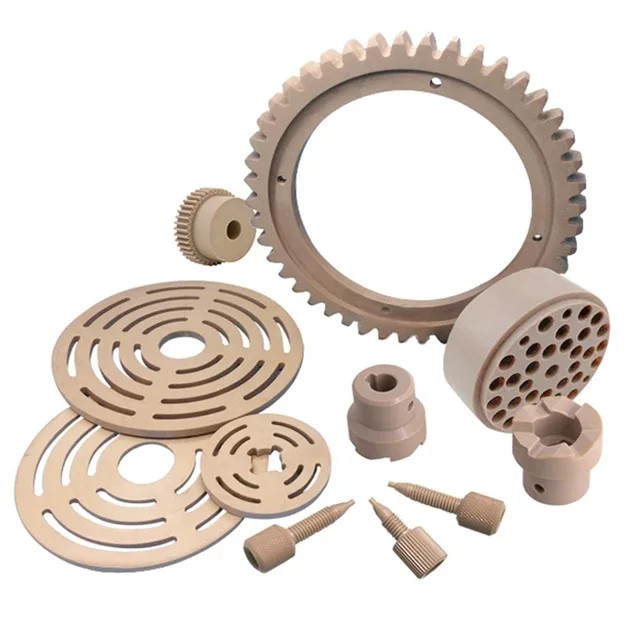
Precision CNC Machined PEEK Gears, Discs, and Threaded Components
Precision PEEK Components

Core Mechanical Properties

PEEK bridges the gap between plastics and metals. Below are the typical mechanical and thermal properties for standard unfilled PEEK billets used in precision CNC machining.

Property Typical Value (Unfilled) Key Benefit
Continuous Use Temp. 250°C (482°F) Survives extreme heat environments that would melt standard engineering plastics like Delrin or Nylon.
Tensile Strength 90 - 100 MPa Exceptional load-bearing capabilities. Can exceed 150 MPa in Carbon-Filled (CF30) variants.
Chemical Resistance Outstanding Insoluble in all common solvents; resists steam, boiling water, and harsh chemicals without degrading.
Flammability Rating UL94 V-0 Inherently flame retardant without toxic additives. Emits ultra-low smoke and toxic gas when exposed to fire.

Material Comparison: PEEK Grades

Depending on your structural or tribological requirements, PEEK can be compounded with various fillers to drastically alter its performance characteristics.

Material Grade Visual Identifier Key Characteristics & Use Case
Unfilled PEEK Natural (Tan/Brown) The purest form. Offers the highest elongation and toughness. FDA-compliant and biocompatible, making it the absolute standard for medical instruments and food-contact parts.
PEEK GF30 Opaque (Grey/Tan) Contains 30% glass fibers. Dramatically increases rigidity, compressive strength, and creep resistance at high temperatures. Ideal for structural aerospace components.
PEEK CF30 Black Contains 30% carbon fibers. Provides the highest strength, stiffness, and thermal conductivity. Frequently used to replace aluminum parts to reduce weight without sacrificing load capacity.
Bearing Grade PEEK Dark Grey / Black Typically filled with PTFE, graphite, and carbon fibers. Engineered for the lowest possible friction and highest wear resistance. Perfect for high-speed, unlubricated bearings and seals.
Application Engineering

Application Fit Matrix

PEEK is expensive, so it belongs where heat, chemicals, sterilization, or metal replacement justify the material cost.

Application Recommended Material Why This Material Works Typical CNC Process Finish / Risk Note
Medical Instruments & Implant Trials Medical-Grade PEEK Biocompatible, sterilizable, and radiolucent. 5-axis milling, micro drilling, polishing Confirm certification and traceability.
Aerospace Valve Seats & Gears PEEK or Bearing-Grade PEEK Lightweight, fuel-resistant, and heat-stable. Turning, milling, gear cutting Annealing may protect dimensional stability.
Semiconductor Fixtures PEEK or PEEK CF30 Clean, stiff, and heat-resistant. Milling, drilling, pocketing Filled grades need high-wear tooling strategy.
Oil & Gas Seals / Backup Rings PEEK or PEEK CF30 Handles heat, pressure, and aggressive fluids. Turning, grooving, boring Review service temperature and chemicals.
High-Temperature Electrical Insulators PEEK GF30 Excellent dielectric behavior with high thermal capability. Milling, drilling, threading Avoid sharp corners in filled grades.

Selection Rule

Match the grade to the part's real job first: strength, heat, wear, corrosion, insulation, transparency, or cosmetic finish.

DFM Reminder

Material choice changes tolerance risk, burr control, wall thickness, thread strategy, and finishing route.

Quote Tip

Share the operating environment, mating parts, finish expectations, and inspection requirements with the drawing.

Real Project References

PEEK CNC Machining Case Studies

Projects involving PEEK engineering plastic parts, grinder systems, dimensional stability, wear behavior, and coordinated production with metal components.

More Case Studies

Expert Machining Tips

Machining PEEK is challenging due to its high cost and tendency to warp if internal stresses are not managed. Huade engineers apply stringent protocols to guarantee perfection:

  • 1

    Critical Annealing Cycles

    PEEK billets hold immense internal stress. To prevent the part from warping or cracking during or after machining, we often perform multiple thermal annealing cycles (heating and slowly cooling the part) between heavy roughing and final finishing passes.

  • 2

    Liquid Coolant is Mandatory

    Unlike standard plastics where air blasts suffice, PEEK must be kept cool to maintain its tight tolerances and prevent localized melting. We use copious amounts of water-soluble coolants, especially when drilling deep holes.

  • 3

    PCD Tooling for Filled Grades

    While unfilled PEEK can be machined with sharp carbide, Carbon-Filled (CF30) and Glass-Filled (GF30) PEEK are violently abrasive. We strictly use Polycrystalline Diamond (PCD) tooling to prevent rapid tool wear and ensure dimensional consistency.

Post-Processing & Assembly

PEEK’s inherent chemical resistance means it cannot be solvent-welded or easily glued. Post-processing focuses on thermal stability, cleanliness, and mechanical fastening.

1. Post-Machining Annealing

While not a cosmetic surface finish, a final annealing cycle is often the most important post-process. It relieves any remaining surface stresses induced by the cutting tool, ensuring the part maintains its exact shape in service.

2. Ultrasonic Cleaning

For medical and aerospace components, PEEK parts are run through industrial ultrasonic cleaning baths to remove all traces of cutting fluids, dust, and handling contaminants before clean-room packaging.

3. Laser Marking & Engraving

Medical implants and high-value aerospace components require strict traceability. PEEK reacts exceptionally well to laser marking, allowing us to permanently etch part numbers, lot codes, or QR matrices directly onto the surface.

Ready To Machine PEEK?

Start Your Manufacturing RFQ

Upload your 3D CAD files today. Our engineers will review your high-performance plastic specifications, provide a free DFM report, and return an accurate quote within 24 hours.

Email WhatsApp