CNC Machining
PET (Ertalyte)
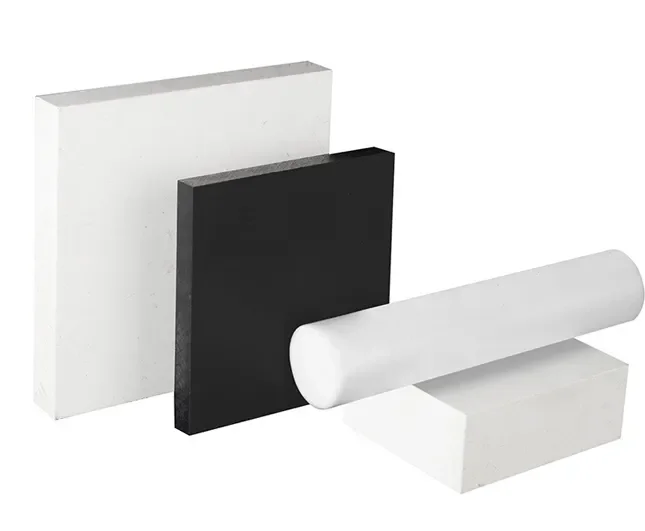
PET (Polyethylene Terephthalate), commonly known by its trade name Ertalyte®, is a premium semi-crystalline thermoplastic. Offering excellent wear resistance, extremely low moisture absorption, and FDA compliance, it is the superior choice over Nylon and POM for precision components in food processing and wet environments.
Core Mechanical Properties
Machine-grade PET boasts incredible dimensional stability. Because it absorbs virtually no moisture, parts machined to tight tolerances will not warp or swell when exposed to high humidity or submerged in fluids.
| Property | Typical Value (Unfilled) | Key Benefit |
|---|---|---|
| Moisture Absorption | < 0.2% (at saturation) | Vastly outperforms Nylon. Tolerances remain absolutely stable in wet or washdown environments. |
| Tensile Strength | ~ 80 - 90 MPa | Higher structural strength and rigidity compared to standard Acetal (POM). |
| Continuous Use Temp. | 100°C - 115°C | Survives hot water sterilization and harsh industrial cleaning cycles. |
| Coefficient of Friction | Very Low | Excellent self-lubricating wear properties, ideal for dynamic load-bearing parts. |
Material Comparison: PET vs Competitors
PET (Ertalyte) is often evaluated against POM (Delrin) and Nylon. We also offer modified PET grades tailored for extreme wear applications.
| Material Grade | Visual Appearance | Key Characteristics & Use Case |
|---|---|---|
| PET (Ertalyte®) | Natural (White) / Black | Unfilled PET. FDA and USDA compliant. Offers the best dimensional stability and strength for food processing components, manifolds, and precision gears. |
| PET-TX (Ertalyte® TX) | Pale Grey | PET compounded with solid lubricants. Specifically formulated for extreme wear resistance and high pressure-velocity (PV) capabilities in unlubricated bearings. |
| Acetal (POM / Delrin®) | Natural / Black | The closest alternative. Easier to machine than PET and highly impact-resistant, but has lower strength and slightly worse dimensional stability under high loads. |
Application Fit Matrix
PET is a stable engineering plastic for wear components, guides, and food-adjacent parts where low moisture absorption is valuable.
| Application | Recommended Material | Why This Material Works | Typical CNC Process | Finish / Risk Note |
|---|---|---|---|---|
| Conveyor Guides & Wear Strips | PET-P | Low friction, good wear resistance, and moisture stability. | Milling, routing, drilling | Define sliding speed and mating material. |
| Food Processing Components | PET-P | Dimensionally stable for many food-contact style parts. | Milling, turning, chamfering | Confirm food-contact compliance. |
| Rollers & Bushings | PET-P | Clean machinability and stable fit. | Turning, boring, grooving | Avoid press fits that create excessive stress. |
| Precision Spacers | PET-P | Stable dimensions compared with moisture-sensitive plastics. | Turning, milling, drilling | Burr control matters for stacked assemblies. |
| Packaging Machine Parts | PET-P | Wear-friendly and rigid for guides and cams. | Milling, profiling, drilling | Choose POM when lower friction dominates. |
Selection Rule
Match the grade to the part's real job first: strength, heat, wear, corrosion, insulation, transparency, or cosmetic finish.
DFM Reminder
Material choice changes tolerance risk, burr control, wall thickness, thread strategy, and finishing route.
Quote Tip
Share the operating environment, mating parts, finish expectations, and inspection requirements with the drawing.
Expert Machining Tips
While PET possesses excellent structural properties, it requires specific machining strategies to avoid heat buildup and manage its characteristic stringy chips.
- 1
Aggressive Chip Control
Unlike Acetal (POM) which breaks into clean, powdery chips, PET tends to produce continuous, stringy ribbons during turning and drilling. We utilize specific peck-drilling cycles and chip-breaker tooling to prevent chips from wrapping around the spindle.
- 2
Sharp, Positive-Rake Tooling
PET is notch-sensitive and susceptible to heat. We strictly use highly polished, sharp carbide tools with large positive rake angles to smoothly slice the plastic, minimizing friction and avoiding surface smearing or localized melting.
- 3
Managing Internal Stress
Extruded PET billets can hold residual stress. For parts requiring asymmetrical or heavy material removal, we carefully balance our roughing passes on all sides of the billet to prevent bowing, often applying coolant to maintain strict thermal equilibrium.
Machining FAQs
Understanding the specific nuances of PET helps ensure your project's success and compliance.
Should I choose PET or Acetal (Delrin)?
Choose PET (Ertalyte) if you need absolute dimensional stability, higher load-bearing capacity, and better wear resistance. Choose Acetal (POM) if you need higher impact resistance or if the part has an extremely complex geometry that is difficult to machine with stringy chips.
Is CNC machined PET food safe?
Yes. Natural (White) and Black unfilled PET grades are fully FDA, USDA, and 3A-Dairy compliant. We ensure that our CNC machining process utilizes clean tooling and approved non-toxic coolants (or dry machining) to maintain this hygienic certification.
Can machined PET be polished clear?
No. Unlike Polycarbonate or Acrylic, machine-grade semi-crystalline PET is naturally opaque (white or black). If you need a transparent, clear plastic for a sight glass or fluid manifold, we recommend switching to Acrylic (PMMA) or Polycarbonate (PC).
Start Your Manufacturing RFQ
Upload your 3D CAD files today. Our engineers will review your plastic specifications, provide a free DFM report, and return an accurate quote within 24 hours.