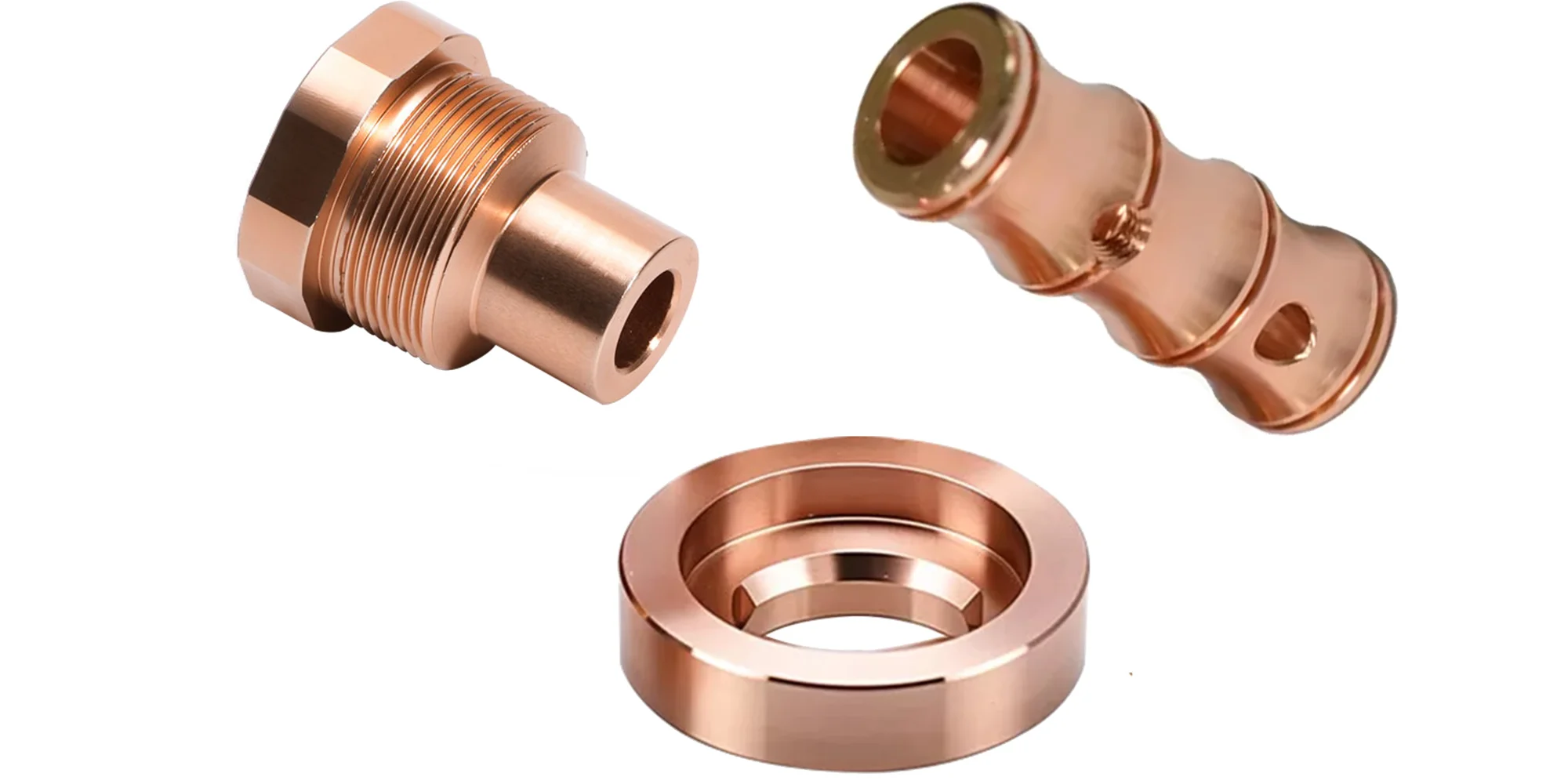
Copper CNC Machining Services
Electrical, Thermal and RF Parts
Copper is chosen for conductivity, but the shop floor sees a soft, sticky material that moves heat fast and punishes dull tools. The best grade is often the one that gives enough conductivity while still letting the feature be machined cleanly.
Best fit
busbars, heat spreaders, RF parts, contacts and electrodes
Common grades
C110, C101 and C145 copper
Watch point
built-up edge, thermal growth and burr-prone small features
Typical route
sharp-tool milling, turning, drilling, plating and anti-tarnish protection
Copper Grades For CNC Machining
Pure copper grades are close in strength. The real decision is purity versus machinability, especially when the drawing has deep holes, fine threads or small contact features.
| Grade | Yield Strength | Tensile Strength | Hardness |
|---|---|---|---|
| C110 ETP Copper | ~ 275 MPa | ~ 310 MPa | 35-45 HRB |
| C101 OFE Copper | ~ 260 MPa | ~ 300 MPa | 35-45 HRB |
| C145 Tellurium Copper | ~ 300 MPa | ~ 330 MPa | 40-50 HRB |
International Grade Comparison
If your application does not need oxygen-free copper, C110 is usually the practical default. If the geometry is difficult, C145 can reduce machining risk without giving up too much conductivity.
| ASTM / AISI / UNS | DIN / EN | GB | Engineer Note |
|---|---|---|---|
| C11000 | CW004A / E-Cu57 | T2 | The common ETP copper choice for busbars, terminals and heat transfer parts. |
| C10100 | CW009A / Cu-OFE | TU1 | Oxygen-free copper for vacuum, high-purity electrical and sensitive electronics work. |
| C14500 | CW118C / CuTeP | QTe0.5 | Tellurium copper machines much cleaner than pure copper while keeping strong conductivity. |
Application Fit Matrix
Copper parts are usually specified for conductivity or heat transfer, so the plan should protect geometry and functional surface quality.
| Application | Recommended Material | Why This Material Works | Typical CNC Process | Finish / Risk Note |
|---|---|---|---|---|
| Busbars & Power Contacts | C110 Copper | Very high electrical conductivity for compact power distribution. | Milling, drilling, slotting | Specify edge breaks without reducing contact area. |
| Heat Spreaders & Thermal Plates | C110 or C101 Copper | Excellent heat transfer for electronics, lasers, and cooling interfaces. | Face milling, pocketing, drilling | Flatness and surface finish control thermal interface performance. |
| RF & Microwave Components | C101 Oxygen-Free Copper | High purity supports stable electrical performance and clean plating. | Precision milling, boring, tapping | Protect surfaces from scratches and oxidation before plating. |
| EDM Electrodes | C110 Copper | Conductive, machinable, and suitable for detailed electrode geometry. | High-speed milling, engraving | Sharp corners wear in use; match design to burn strategy. |
| Welding & Battery Fixtures | C110 Copper | Dissipates heat quickly and resists local overheating. | Milling, turning, drilling | Copper is gummy; allow realistic tolerances on deep narrow features. |
Selection Rule
Match the grade to the part's real job first: strength, heat, wear, corrosion, insulation, transparency, or cosmetic finish.
DFM Reminder
Material choice changes tolerance risk, burr control, wall thickness, thread strategy, and finishing route.
Quote Tip
Share the operating environment, mating parts, finish expectations, and inspection requirements with the drawing.
What We Check Before Cutting Copper
Copper machining is mostly discipline: sharp tools, clean chip evacuation and no pretending that gummy material will behave like brass.
- 1
Use Sharp, Polished Cutting Edges
A dull tool smears copper instead of cutting it. We use sharp geometry and polished flutes to reduce built-up edge.
- 2
Control Part Temperature
Copper moves heat quickly, so the part can grow during aggressive cuts. Coolant strategy and inspection temperature matter on tight fits.
- 3
Consider C145 For Complex Features
For fine threads, deep holes or small precision pins, C145 often gives a better total result than forcing C110 through a difficult toolpath.
Surface Treatments That Actually Fit
Copper oxidizes quickly. Choose a finish based on contact resistance, appearance and storage environment.
1. Nickel Plating
A practical industrial finish for oxidation control and improved surface durability.
2. Silver or Gold Plating
Used when low contact resistance and stable RF or electrical performance justify the added cost.
3. Anti-Tarnish or Clear Coat
Good when the raw copper look must be preserved, but contact surfaces may need masking.
Send The Details That Change The Quote
Send conductivity requirements, plating notes, contact areas, flatness requirements and whether C145 is acceptable for difficult machined features.
Material condition
Name the exact grade, stock condition and certificate requirement. The same alloy can machine and perform differently after heat treatment, aging or cold work.
Functional features
Flag threads, bearing bores, sealing faces and mating materials. These features determine the machining sequence, surface requirement and inspection plan.
Finish and release
Include coating, masking, cosmetic zones and report needs in the controlled RFQ so finished dimensions and acceptance criteria are aligned before production.