CNC Machining
G-10 Garolite
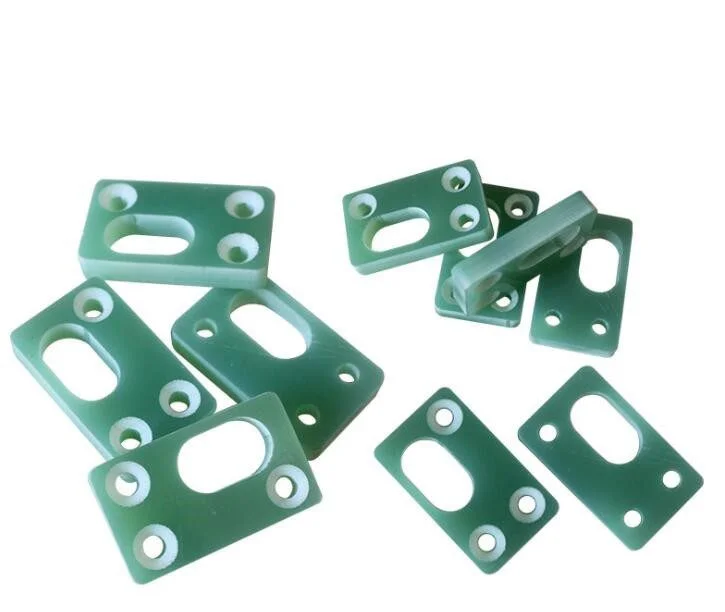
G-10 is an industrial-grade thermoset composite made of continuous woven glass fabric combined with an epoxy resin binder. Characterized by its near-zero moisture absorption, immense mechanical strength, and superb electrical insulation, it is the premier material for cryogenic systems, marine components, and heavy-duty electromechanical mounts.
Core Mechanical Properties
G-10 boasts mechanical properties that often rival or exceed those of aluminum, while maintaining a fraction of the weight. Below are typical values for standard G-10 laminates.
| Property | Typical Value | Key Benefit |
|---|---|---|
| Tensile Strength | ~ 275 - 310 MPa | Exceptional load-bearing capacity. Will not yield or permanently deform under heavy stress. |
| Water Absorption | < 0.1% | Maintains dimensional stability and electrical insulation even when completely submerged in water. |
| Dielectric Strength | ~ 19 kV/mm | Prevents electrical arcing in high-voltage industrial and marine applications. |
| Operating Temp. | -200°C to 130°C | Retains flexibility and strength in deep-freeze cryogenic environments without becoming brittle. |
Material Comparison: G-10 vs. FR4
The most common question in composite machining is whether to use G-10 or FR4. While nearly identical in strength, their chemical composition dictates their specific use cases.
| Material Grade | Flame Retardant | Halogen Content | Primary Use Case |
|---|---|---|---|
| G-10 (Garolite) | No | Halogen-Free | Used in marine, cryogenic, and structural applications where flame retardancy is not required. Halogen-free properties make it safer in specific sealed environments if ignited. |
| FR-4 | Yes (UL94 V-0) | Contains Bromine | Essentially G-10 with added bromine to make it self-extinguishing. The mandatory standard for PCBs and consumer electronic housings. |
| Phenolic (Bakelite) | No | Halogen-Free | Made with paper or cotton cloth instead of fiberglass. Cheaper and easier to machine than G-10, but significantly weaker with higher moisture absorption. |
Application Fit Matrix
G-10 is a glass-epoxy laminate for rigid, non-conductive machined parts that need strength and dimensional stability.
| Application | Recommended Material | Why This Material Works | Typical CNC Process | Finish / Risk Note |
|---|---|---|---|---|
| Insulating Structural Brackets | G-10 | Strong laminate support while remaining electrically insulating. | Routing, drilling, milling | Layer edges can chip; use generous radii. |
| Cryogenic Fixtures | G-10 | Good low-temperature performance and low thermal conductivity. | Milling, drilling, slotting | Confirm temperature range and dimensions. |
| Electronic Test Nests | G-10 | Stable and non-conductive for holding components. | Routing, pocketing, precision drilling | Deburr holes to protect wires and pins. |
| Mechanical Spacers & Standoffs | G-10 | Lightweight, stiff, and electrically isolating. | Turning, milling, drilling | Use inserts or through-bolts for high clamp loads. |
| Tooling Plates | G-10 | Rigid handling fixtures where metal would short or transfer heat. | Milling, drilling, engraving | Laminate orientation may matter. |
Selection Rule
Match the grade to the part's real job first: strength, heat, wear, corrosion, insulation, transparency, or cosmetic finish.
DFM Reminder
Material choice changes tolerance risk, burr control, wall thickness, thread strategy, and finishing route.
Quote Tip
Share the operating environment, mating parts, finish expectations, and inspection requirements with the drawing.
Expert Machining Tips
Like FR4, G-10 is extremely abrasive. The glass fibers will rapidly destroy standard tooling. Huade engineers apply stringent protocols to machine it cleanly and accurately:
- 1
PCD Tooling is Mandatory
High-Speed Steel (HSS) will dull in minutes. We strictly utilize Polycrystalline Diamond (PCD) tipped cutters or specialized diamond-cut router bits to cleanly shear the glass fibers without fraying the edges.
- 2
Mitigating Delamination
Because G-10 is a laminate, heavy axial forces (like drilling) can cause the layers to split apart at the exit hole. We use high-speed spindles, ramped entry paths, and rigid sacrificial backing boards to prevent "blowout" delamination.
- 3
Strict Environmental Dust Control
Machining G-10 produces fine glass dust rather than chips. This dust is abrasive to machine guideways and hazardous to operators. We machine all composites in dedicated, enclosed CNC routers with high-velocity vacuum extraction.
Post-Processing & Assembly
G-10 components prioritize function over form. Post-processing is typically focused on preventing moisture ingress at the cut surfaces and establishing robust fastening points.
1. Edge Sealing
While the faces of G-10 are sealed by epoxy, the cut edges expose microscopic glass fibers. For critical subsea or high-humidity applications, we apply an epoxy or polyurethane conformal coating to the machined edges to block moisture wicking.
2. Threaded Inserts (Helicoils)
Tapping fine threads directly into G-10 is not recommended for parts that will be repeatedly assembled and disassembled, as the glass fibers will abrade the fasteners. We install brass or stainless steel threaded inserts to provide secure, reusable threads.
3. Precision Sanding & Cleaning
For components requiring tight mating surfaces, G-10 can be sanded to a very smooth finish. Following machining, all parts undergo rigorous cleaning to remove lingering abrasive dust before shipping.
Start Your Manufacturing RFQ
Upload your 3D CAD files today. Our engineers will review your composite specifications, provide a free DFM report, and return an accurate quote within 24 hours.