Many first-time CNC prototyping buyers ask the same question before sending an RFQ: “How long does CNC prototyping take?” The honest answer is rarely one fixed number. A simple aluminum bracket may be machined in a few days, while a tight-tolerance titanium part with anodizing, threaded holes, and inspection reports can take two or three weeks.
The difference is not just machine speed. CNC prototype lead time depends on drawing clarity, material availability, setup strategy, tolerance risk, surface finishing, inspection requirements, and international shipping. This guide walks through the CNC machining process from file review to delivery so product managers, hardware engineers, and startup founders can plan prototype schedules with fewer surprises.
If you already have a design ready, Huade Precision can review your CAD files through the RFQ page and provide practical feedback on manufacturability, timing, and cost. For process details, you can also compare our CNC milling service, CNC turning service, CNC materials, plastic machining options, and surface finishing services.
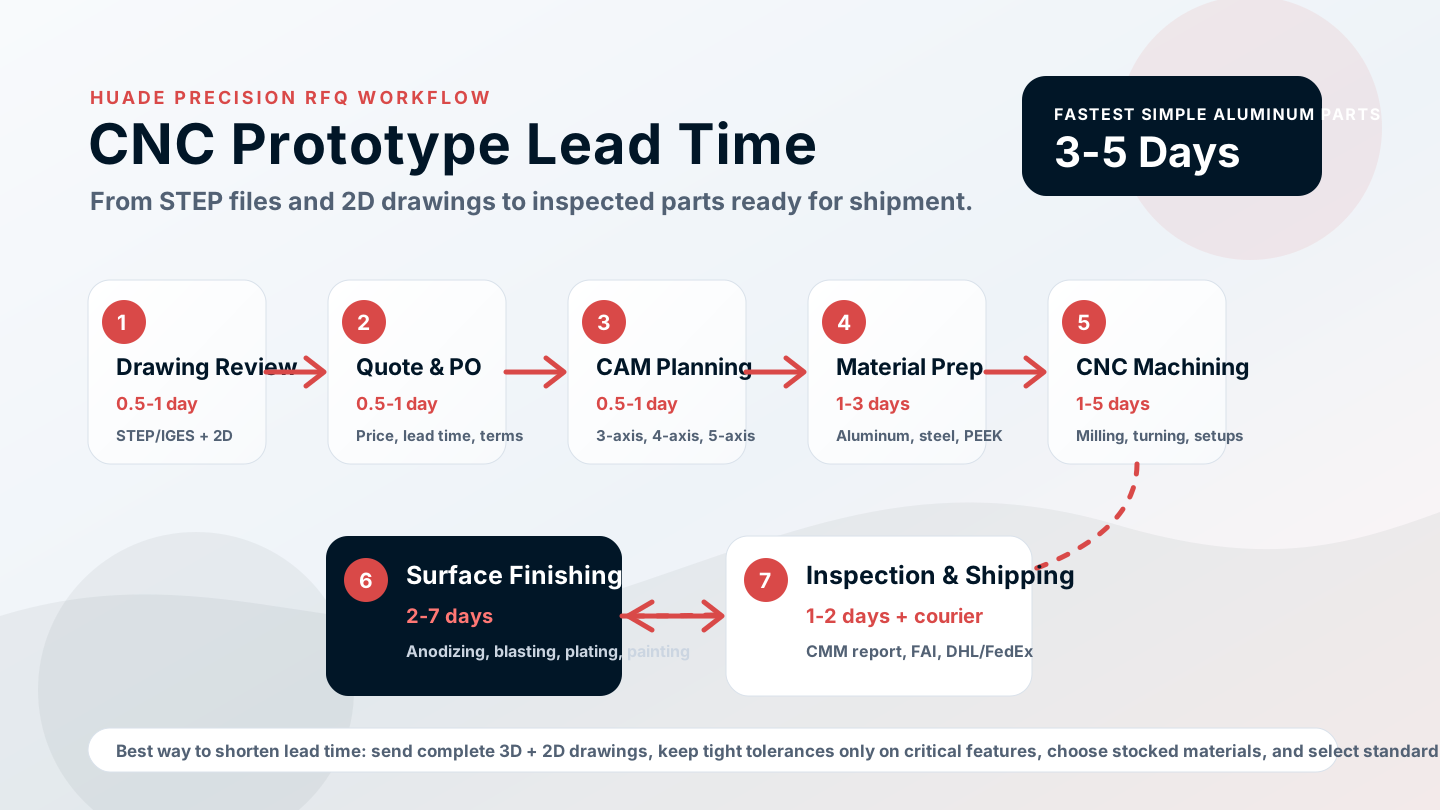
Why CNC Prototype Lead Time Is Not a Single Fixed Number
CNC machining is a subtractive manufacturing process controlled by programmed toolpaths. In simple terms, the machine removes material from a metal or plastic blank until the final geometry matches the CAD model. You can read a general background explanation on Wikipedia’s CNC page, but in real sourcing work the timeline is shaped by many small decisions before the cutter ever touches the part.
At Huade Precision, we usually think about lead time in four layers:
- Engineering time: file review, DFM feedback, quote confirmation, CAM programming, fixture planning.
- Supply time: material stock, special alloy procurement, cutting blanks, outsourced process coordination if needed.
- Production time: machine setup, roughing, finishing, deburring, re-clamping, and operator checks.
- Release time: surface treatment, quality inspection, packing, export documents, and courier pickup.
When a supplier says “3-5 days,” that may only refer to machining a simple raw part. If the same part needs black anodizing, bead blasting, laser marking, and a dimensional report, the real project lead time is longer.
Step 1. Drawing and Requirement Review: 0.5-1 Day
The fastest CNC prototype projects start with clear input files. For most RFQs, the ideal package includes:
- A 3D CAD file such as STEP, IGES, X_T, or SolidWorks.
- A 2D PDF drawing showing critical tolerances, threaded holes, datums, surface roughness, material grade, and finish.
- Quantity, target delivery date, application context, and inspection requirements.
STEP and IGES are common neutral CAD exchange formats. If you want background context, see Wikipedia’s STEP file overview and IGES overview.
What Huade does: Our engineers review tool access, minimum wall thickness, internal radii, thread depth, flatness risk, and whether the part is better suited for 3-axis, 4-axis, 5-axis, or turning-milling production. For milled parts, the CNC milling design guidelines are a useful starting point.
Common delay: Sending only a STEP file without a 2D drawing. The model tells us shape, but it does not always tell us which dimensions are critical. If every feature is treated as high precision, the quote may become slower and more expensive than necessary.
Step 2. Quotation and Order Confirmation: 0.5-1 Day
After the file review, the quote is built around material, machine route, setup count, quantity, surface finish, inspection level, and delivery target. For example, a 6061 aluminum housing with black anodizing is a very different job from a PEEK medical fixture or a titanium aerospace bracket.
What the buyer should confirm: material grade, quantity, finish color, tolerance priorities, shipping destination, payment terms, and whether a formal inspection report is required.
What Huade does: We provide pricing, expected CNC prototyping lead time, manufacturability notes, and any schedule risks. If the part is still in design iteration, our team may suggest a faster first prototype route and reserve tighter cosmetic finishing for the next revision.
Common delay: Changing material or finish after the quote is approved. A switch from aluminum to stainless steel, or from raw machining to anodizing plus laser marking, can change the schedule immediately.
Step 3. CAM Programming and Process Planning: 0.5-1 Day
Once the order is confirmed, the part moves into CAM programming. CAM planning converts CAD geometry into cutting toolpaths, workholding strategy, and machining sequence. Autodesk has a helpful high-level explanation of CNC milling and CAM workflows for readers who want a broader software view.
What Huade does: We choose the machining route: standard 3-axis milling for accessible prismatic parts, 4-axis machining for rotary or side features, 5-axis machining for complex multi-face geometry, and CNC turning for shafts, bushings, spacers, and round parts. We also plan cutting tools, datum strategy, setup order, and fixture needs.
Common delay: Hidden complexity. A part may look small, but angled holes, deep pockets, thin walls, tight positional tolerances, or cosmetic faces can require more programming and setup time.
For buyers comparing machine routes, these pages can help:
- CNC milling services for housings, brackets, plates, molds, and multi-face components.
- CNC turning services for shafts, sleeves, pins, bushings, and round components.
- 5-axis CNC machining cost guide for advanced multi-axis cost logic.
Step 4. Material Preparation: 1-3 Days
Material availability has a major impact on CNC prototype lead time. Common aluminum grades, mild steel, stainless steel, brass, copper, ABS, POM, and nylon are often faster because they are easier to source. Titanium, Inconel, PEEK, PPSU, and special certified materials may require extra procurement time.
Typical timing: Common stocked materials may be ready the same day or next day. Special grades can add 2-5 days depending on supplier availability and certification requirements.
What the buyer can do: Choose a material that matches the prototype’s real purpose. If the first prototype is mainly for fit and assembly, a more available material may be enough. If it must pass thermal, chemical, or load testing, the production-intent material is usually worth the extra time.
Huade’s material pages can help narrow the decision:
- Aluminum CNC machining for lightweight housings, brackets, fixtures, and prototypes.
- Stainless steel CNC machining for corrosion resistance and strength.
- Titanium CNC machining for high strength-to-weight and demanding applications.
- PEEK machining for high-performance engineering plastic parts.
- POM / Delrin machining for low-friction mechanical components.
You can also use our CNC material selector when you are comparing performance, machinability, and cost.
Step 5. CNC Machining: 1-5 Days
This is the stage most people picture when they think of CNC prototyping: cutting chips, checking dimensions, deburring edges, and refining the part until it matches the drawing. Simple parts may take only a few hours of actual machine time. Complex parts may require multiple setups, special workholding, slower feeds, and several inspection checkpoints.
What Huade does: We machine the part according to the approved route, monitor critical dimensions, deburr edges, and protect cosmetic surfaces. For tight-tolerance projects, in-process checks help catch problems before a full batch is completed.
Common delay: Overly tight tolerances on non-critical features. A tolerance of +/-0.01 mm may be necessary for bearing seats or alignment datums, but applying it to every edge and clearance hole can slow machining, inspection, and cost approval.
For thread-heavy designs, the tap drill and thread calculator is useful during early design checks.
Step 6. Surface Finishing: 2-7 Days
Surface finishing is one of the most underestimated parts of CNC prototype lead time. A raw machined part can leave the machine quickly, but a finished prototype may need bead blasting, anodizing, passivation, polishing, black oxide, electroplating, powder coating, spray painting, or laser marking.
Typical timing: Clear or black anodizing often takes around 3-5 days. Sandblasting can be faster when paired with anodizing preparation. Electroplating, painting, PVD-style coatings, and specialty colors may take longer due to batching, pretreatment, drying, curing, or vendor scheduling.
What Huade does: We coordinate finishing with dimensional requirements, masking needs, cosmetic expectations, and packaging. If coating thickness may affect function, we flag it before production.
Common delay: Choosing rare colors or multiple finishes on one part. Standard colors such as black anodizing are usually faster than special colors, high-gloss cosmetic paint, or process combinations that need extra masking.
Useful finish pages:
- Anodizing for aluminum corrosion resistance and color.
- Sandblasting for matte surfaces before anodizing.
- Black oxide for steel appearance and mild corrosion resistance.
- Passivation for stainless steel corrosion performance.
- Polishing for cosmetic or low-roughness surfaces.
Step 7. Inspection, Packing, and Shipping: 1-2 Days
The final stage confirms that the part is ready to leave the factory. For simple prototypes, inspection may include caliper, micrometer, thread gauge, and visual checks. For critical parts, the process may include CMM inspection, dimensional reports, material certificates, and first article inspection records.
What Huade does: Our quality workflow supports dimensional verification, CMM inspection when required, visual inspection, protective packaging, and shipping coordination. You can learn more on our quality control page. For customers working in regulated or higher-risk industries, ISO’s quality management principles are useful background reading.
Shipping note: International courier delivery by DHL, FedEx, UPS, or similar services often adds 3-5 business days depending on destination, customs clearance, and declared value requirements.
Common delay: Requesting a full inspection report after parts are already finished. If reports, certificates, or FAIR-style documentation are needed, list them in the RFQ so inspection can be planned from the start.
CNC Prototype Lead Time Reference Table
The table below is a practical planning reference. Actual timing depends on drawing complexity, material availability, tolerance level, finishing capacity, inspection scope, and shipment destination.
| Prototype Type | Without Surface Finish | With Standard Anodizing |
|---|---|---|
| Simple aluminum parts, up to 5 pcs | 3-5 days | 7-10 days |
| Medium-complexity housings, brackets, fixtures | 5-7 days | 10-14 days |
| Complex multi-face parts, titanium, PEEK, tight tolerances | 7-14 days | 14-21 days |
For urgent projects, the fastest route is usually a simple first prototype in a stocked material, followed by a finished cosmetic revision once dimensions and assembly are confirmed.
How to Shorten CNC Prototyping Lead Time
The best schedule improvements usually happen before the RFQ is sent. Here are the practical steps that help Huade quote and produce faster:
- Send complete 3D CAD plus 2D PDF drawings in one package.
- Mark only critical dimensions with tight tolerances and relax non-critical features.
- Use standard thread sizes, standard hole sizes, and accessible internal radii where possible.
- Choose stocked materials such as 6061 aluminum, 304/316 stainless steel, brass, POM, or nylon when the application allows.
- Select standard finishes, especially black anodizing for aluminum when color flexibility exists.
- Confirm inspection report needs at the RFQ stage.
- Avoid changing material, quantity, finish, or tolerance requirements after order confirmation.
A good CNC supplier should also help you identify where schedule risk is hiding. At Huade, that usually means reviewing wall thickness, feature access, datum strategy, finish thickness, tolerance stack-up, and inspection method before machining starts.
What to Send for a Faster RFQ
If you want an accurate CNC prototype lead time estimate, send the following:
| RFQ Input | Why It Matters |
|---|---|
| STEP, IGES, X_T, or native CAD file | Lets engineers review geometry, tool access, and machining route. |
| 2D PDF drawing | Confirms tolerances, threads, datums, surface roughness, and finish requirements. |
| Material grade | Affects sourcing time, cutting speed, tool wear, and finish compatibility. |
| Quantity and target date | Helps plan batch size, setup priority, and shipping method. |
| Surface finish | Often adds more lead time than buyers expect. |
| Inspection requirements | Determines whether CMM reports, FAI, or material certificates are needed. |
For general buyer questions, Huade’s help center covers lead time, quality, tolerances, material options, and RFQ preparation.
Final Thoughts: Plan the Whole CNC Machining Process, Not Just Machine Time
CNC prototyping is fastest when the drawing, material, machining route, finishing plan, and inspection requirements are aligned from the start. The machine cycle is only one part of the timeline. The real schedule is built across engineering review, CAM planning, material preparation, machining, finishing, inspection, and delivery.
If you have a drawing and want to understand the likely CNC prototype lead time, send the files through the Huade quote page or contact our engineering team. We typically review complete RFQs within 24 hours and can suggest faster material, tolerance, or finishing choices when the deadline is tight.