Bronze and brass can look similar on a workbench, especially when both pieces are clean, polished, and cut from copper-based stock. In CNC machining, that similarity can create expensive mistakes. A buyer may order the wrong alloy. A machinist may choose the wrong speeds and feeds. A finished part may pass visual inspection but fail early in service.
This guide explains how to tell the difference between bronze and brass, why the difference matters for cnc bronze projects, and when bronze CNC machining is the stronger choice for bearings, bushings, sliding components, marine hardware, and other machined parts that need wear resistance and corrosion resistance.
If you only need a quick rule: brass is usually brighter yellow because it is mainly copper and zinc. Bronze is usually darker, redder, or browner because it is mainly copper and tin, sometimes with aluminum, silicon, phosphorus, or manganese. But color alone is not enough. For production work, you should check the application, alloy grade, mechanical properties, and machining behavior before releasing a purchase order.
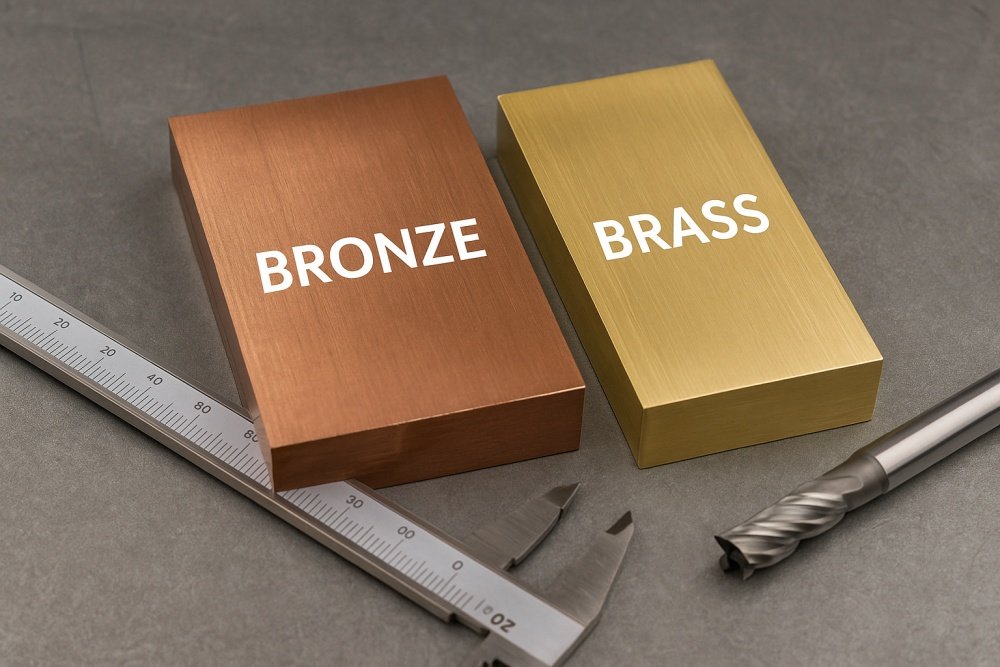
Bronze vs Brass at a Glance
Bronze and brass are both copper alloys, but they are designed for different jobs. If you are already comparing material pages, our bronze CNC machining material guide and brass CNC machining material guide give more detail on grades, applications, and manufacturability.
| Factor | Bronze | Brass |
|---|---|---|
| Main alloying element | Tin, aluminum, silicon, phosphorus, or manganese | Zinc |
| Typical color | Reddish brown, brown gold, or darker copper tone | Yellow gold or bright gold |
| General feel | Harder, denser, more wear resistant | Softer, easier to form and cut |
| Common CNC uses | Bearings bushings, gears, sleeves, wear plates, marine fittings | Fittings, decorative hardware, electrical parts, valves, connectors |
| Key strength | Wear resistance and resistant properties in demanding environments | Machinability, formability, appearance, and cost efficiency |
| Corrosion behavior | Strong corrosion resistance, especially in marine or wet applications depending on grade | Good corrosion resistance in many indoor and low-load applications |
The practical difference is simple. Brass is often selected when the part needs clean machining, attractive appearance, and efficient production. Bronze is often selected when the part must carry load, resist sliding wear, survive moisture, or run against another metal surface for a long time. For a broader copper-alloy comparison, see our article on brass vs copper CNC machining.
That is why bronze parts are common in pumps, valves, industrial machinery, marine assemblies, food equipment, oil and gas hardware, and motion systems. In those applications, bronze is not just a material choice. It is part of the reliability plan.
How to Tell the Difference Between Bronze and Brass
You can start with simple checks before moving to formal material verification.
1. Check the color
Fresh brass usually has a brighter yellow or gold tone. It may look close to gold when polished. Bronze usually looks darker, redder, or more brown. Older bronze can develop a brown, green, or blue-green patina because of oxidation.
Color is useful for sorting known samples, but it is not a final test. Surface finish, plating, heat exposure, and age can change appearance. A polished bronze part may look brighter than expected, and a tarnished brass part may look darker than expected.
2. Compare weight and hardness
Bronze is often harder and slightly denser than common brass grades. It usually feels more solid in the hand and is harder to scratch. Brass is usually softer and easier to mark with a file.
This matters in machining. A soft free-machining brass can produce small chips and very clean finishes. A harder bronze may need sharper tooling, better coolant control, and more attention to heat and chip evacuation.
3. Listen to the sound
When tapped gently with another metal object, brass often gives a brighter ringing sound. Bronze usually sounds deeper and more muted. This is only a workshop clue, but it can help when sorting similar offcuts.
4. Look at the application
The part’s intended job is often the best clue. Bearings bushings, thrust washers, wear sleeves, and sliding plates are often bronze because machined bronze performs well under friction. Decorative trim, plumbing fittings, low-load connectors, and nameplates are often brass.
5. Verify the alloy when performance matters
For production, do not rely on visual checks alone. Ask for mill certificates, material traceability, or positive material identification if the part is safety-critical. The difference between C932 bearing bronze, aluminum bronze, phosphor bronze, free-cutting brass, and naval brass can change strength, tool life, surface finish, corrosion resistance, and final cost. If copper is also on your shortlist, our bronze vs copper CNC machining guide explains the tradeoffs in more depth.
Why the Difference Matters in CNC Machining
CNC machining services depend on predictable material behavior. Bronze and brass may both machine well, but they do not behave the same way.
Brass is often easier to cut. Many brass grades are free-machining, stable, and friendly to high-volume turning. They can hold good surface finishes with relatively low tool wear. That makes brass attractive for fittings, small turned parts, electrical hardware, and appearance-focused components.
Bronze is usually chosen for strength, wear resistance, and service life. It is especially valuable when a part slides, rotates, supports a shaft, or works in wet conditions. Bronze CNC machining is common for:
- Bearing sleeves
- Bushings
- Worm gears
- Pump components
- Valve guides
- Thrust washers
- Marine hardware
- Wear plates
- Heavy equipment components
Because bronze can be tougher and more abrasive than brass, the machining plan must be more deliberate. Tool geometry, insert grade, coolant, workholding, and inspection all affect whether the final bronze parts meet precise tolerance requirements.
When to Choose CNC Bronze Instead of Brass
Choose cnc bronze when the finished component needs at least one of these performance advantages:
- Sliding wear resistance: Bronze is a strong option for parts that rotate, slide, or rub against steel shafts.
- Load support: Many bronze alloys handle higher bearing loads than brass.
- Corrosion resistance: Bronze is often preferred for marine, wet, and outdoor service, especially when the grade is selected correctly.
- Dimensional stability: Machined bronze can hold tight tolerances when the process controls heat and stress.
- Long service life: Bronze may cost more upfront, but it can reduce replacement frequency in moving assemblies.
Choose brass when the part prioritizes easy machining, lower cost, decorative finish, electrical conductivity, or moderate-duty fittings.
The best decision is not bronze versus brass in general. It is the correct alloy for the load, environment, finish, tolerance, and production quantity.
Bronze CNC Machining: Process Considerations
Bronze CNC machining is not difficult when the process is matched to the alloy. The challenge is that “bronze” covers several families, and each one cuts a little differently.
CNC turning for machined bronze sleeves and bushings
CNC turning is the standard process for round bronze parts such as bushings, spacers, sleeves, glands, and bearing housings. The key concerns are roundness, bore size, surface finish, and concentricity.
For tight tolerances, the shop should control:
- Insert sharpness and nose radius
- Roughing and finishing allowances
- Chucking pressure
- Heat from long turning passes
- Bore measurement after the part reaches room temperature
Small changes matter. A bushing that looks correct on the lathe may close up after pressing into a housing. Good suppliers ask how the part will be installed, not just what the drawing says.
CNC milling for bronze parts with flats, pockets, and slots
CNC milling is used for bronze wear plates, guide blocks, valve bodies, brackets, and housings. Bronze can produce excellent machined surfaces, but chatter and heat can affect dimensional control.
Stable workholding is essential. Thin plates, long slots, and interrupted cuts may need soft jaws, fixture plates, or staged machining to keep the workpiece flat.
Drilling, reaming, and tapping
Bronze can drill and ream cleanly, but chip control matters. Deep holes, small tapped holes, and blind features should be planned carefully. If the application requires oil grooves, cross holes, or lubrication channels, those features should be reviewed early because they affect fixturing and inspection.
Surface finish and post-processing
Many bronze parts are used as functional surfaces, not just structural shapes. A bearing bore, shaft contact surface, or seal face may need a controlled roughness value. Polishing, deburring, and edge breaks should be specified clearly, especially when the part will contact a moving shaft or elastomer seal.
Machining Capabilities That Matter for Bronze Parts
When comparing CNC machining services for bronze, do not stop at machine count. Ask whether the supplier has machining capabilities that match your part geometry and tolerance risk. For dedicated bronze project examples, review our page on CNC machining bronze precision parts.
Important capabilities include:
- CNC turning for round bushings, sleeves, shafts, and collars
- CNC milling for flat bronze parts, housings, pockets, and slots
- Reaming and boring for accurate internal diameters
- Threading for fittings, glands, and retaining features
- Deburring for oil grooves, cross holes, and bearing edges
- CMM or precision gauge inspection for critical dimensions
- Material traceability for specified bronze grades
For precise tolerance work, inspection planning is just as important as cutting. The drawing should identify which dimensions are critical to function, which features can use standard tolerances, and which surfaces need roughness control. This keeps the quote realistic and helps the machinist protect the dimensions that actually matter.
Common Bronze Alloys for CNC Machined Parts
Different bronze families solve different problems.
| Bronze type | Typical strengths | Common machined parts |
|---|---|---|
| Bearing bronze | Low friction, good wear resistance, good machinability | Bearings bushings, sleeves, thrust washers |
| Phosphor bronze | Strength, fatigue resistance, spring behavior | Electrical contacts, springs, precision wear parts |
| Aluminum bronze | High strength, strong corrosion resistance, marine performance | Marine hardware, valve parts, heavy-duty components |
| Silicon bronze | Corrosion resistance and good mechanical properties | Fasteners, marine fittings, architectural hardware |
| Manganese bronze | Strength and load capacity | Gears, bushings, heavy equipment parts |
For most RFQs, the drawing should specify the exact alloy standard rather than only saying “bronze.” If the grade is open, describe the operating environment, mating material, lubrication, speed, load, and expected life. That information helps the supplier recommend the right material instead of guessing.
Tolerances for Bronze CNC Machining
Bronze can hold tight tolerances, but the achievable result depends on part size, wall thickness, feature depth, alloy, and inspection method. A small turned bushing is different from a large thin wear plate. For general tolerance planning, see our CNC machining tolerances guide and our article on tight tolerance CNC machining services.
Typical tolerance planning:
- Use standard tolerances for non-critical outside shapes.
- Use precise tolerance callouts for bearing bores, shaft fits, seal faces, and mounting references.
- Define concentricity, flatness, perpendicularity, or true position when assembly alignment matters.
- Specify surface roughness for moving contact surfaces.
- Confirm whether the tolerance applies before or after plating, polishing, pressing, or heat exposure.
Over-tightening every dimension can raise cost without improving performance. A better approach is to identify the functional dimensions and protect them through machining, inspection, and packaging.
Bronze vs Brass for Bearings Bushings
Bearings bushings are one of the clearest examples of why bronze and brass should not be treated as interchangeable.
Bronze is commonly used because it has excellent sliding behavior, good load capacity, and reliable wear resistance. In many assemblies, a bronze bushing runs against a hardened steel shaft. The bronze acts as the replaceable wear component and helps protect the more expensive shaft or housing.
Brass can work in light-duty bushings, decorative moving parts, and lower-load assemblies. However, it may wear faster under higher loads, poor lubrication, or abrasive contamination.
For bronze bushing RFQs, provide:
- Inside diameter, outside diameter, and length
- Fit type and mating shaft material
- Load, speed, and duty cycle
- Lubrication method
- Oil grooves or grease holes
- Required quantity and inspection level
These details help the shop machine the part for real performance, not just drawing compliance.
Readability Checklist for Buyers
If you are reviewing a quote or drawing, use this simple checklist:
- Is the material listed as a specific bronze or brass grade?
- Does the drawing identify critical dimensions?
- Are tight tolerances limited to functional features?
- Are surface finish requirements clear?
- Does the part need corrosion resistance, wear resistance, or both?
- Will the part be pressed, lubricated, plated, polished, or assembled after machining?
- Has the supplier confirmed its machining capabilities for the part size and geometry?
This short review prevents most material and tolerance misunderstandings before production begins.
FAQ: Bronze, Brass, and CNC Machining
Is bronze better than brass for CNC machining?
Not always. Brass is often easier and faster to machine. Bronze is better when the machined parts need wear resistance, load capacity, corrosion resistance, or long service life in moving assemblies.
What is the easiest way to tell bronze from brass?
Start with color. Brass is usually brighter yellow, while bronze is usually darker, redder, or browner. Then check hardness, application, and documentation. For production, verify the exact alloy with supplier records or material testing.
Is machined bronze good for tight tolerances?
Yes. Machined bronze can hold tight tolerances when the alloy, fixture, cutting strategy, and inspection method are controlled. Bearing bores, seal faces, and shaft fits should be called out clearly on the drawing.
Why is bronze used for bearings bushings?
Bronze has low friction, strong wear resistance, and good resistant properties under sliding contact. It can support a shaft while acting as the replaceable wear surface in the assembly.
Can one supplier machine both bronze and brass?
Yes, many CNC machining services can machine both materials. The important question is whether the supplier understands the different tooling, chip control, tolerance, and inspection requirements for each alloy.
Get Help With Bronze or Brass CNC Parts
Bronze and brass may look alike, but they solve different engineering problems. Brass is often the efficient choice for easy machining and attractive fittings. Bronze is often the better choice for durable bronze parts that need wear resistance, corrosion resistance, and precise tolerance control.
Dongguan Huade Precision Manufacturing Co., Ltd. supports custom bronze CNC machining, brass machining, milling, turning, inspection, and production of machined parts for industrial buyers. If you need brass-specific guidance, our CNC brass machining precision parts guide covers typical applications and production notes. Send your drawing, material grade, quantity, tolerance requirements, and application notes, and our team will review the best manufacturing route.
Ready to compare materials or quote a project? Contact us to get a free CNC quote.
Related resources:
- CNC machining bronze precision parts
- CNC brass machining precision parts guide
- Bronze vs copper CNC machining
Dongguan Huade Precision Manufacturing Co., Ltd.
Address: 1st Floor, Building 2, No.5, Jiangcheng West 1st Street, Gaobu Town, Dongguan City, Guangdong Province, China.
Email: sales@hdproto.com
Website: https://hdproto.com