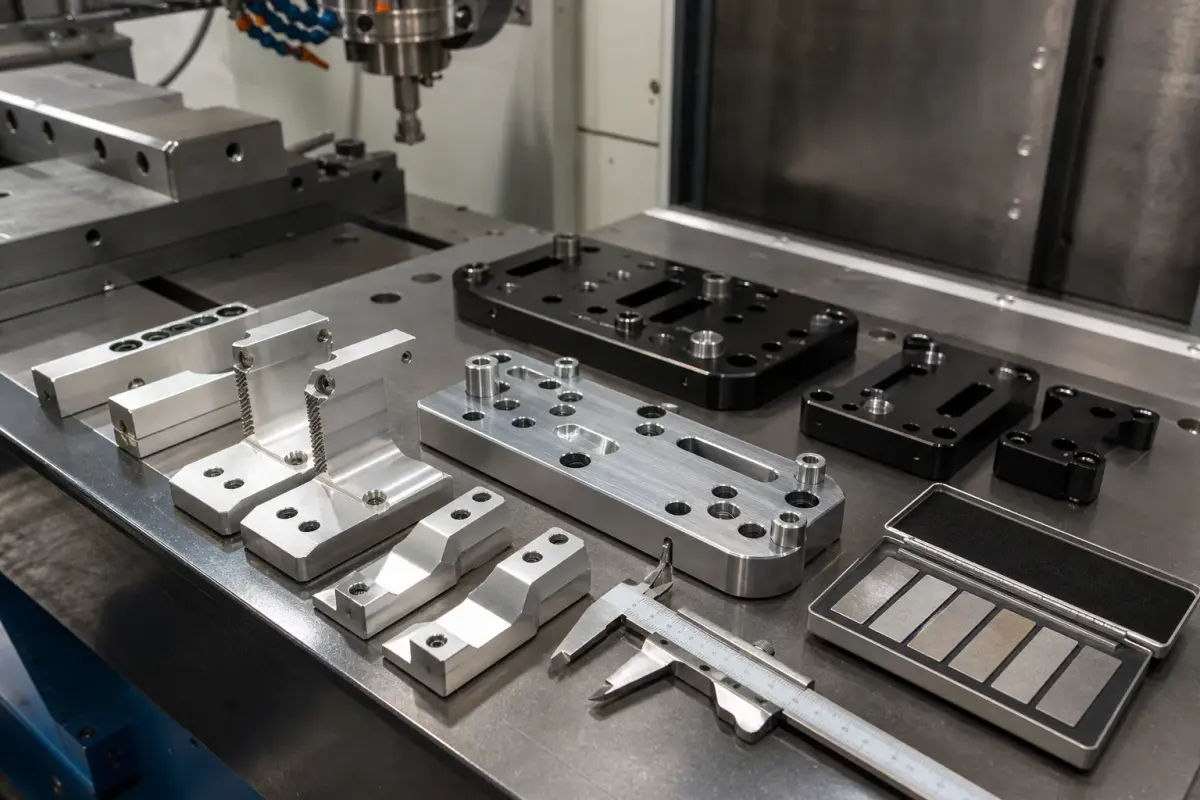
EOAT gripper jaw CNC machining is where small details become production problems. A jaw can look correct on the table, but if the grip surface is uneven, the dowel hole is off, or the edges are too sharp, the robot starts dropping parts or damaging product.
This guide is written from a CNC factory point of view. For the broader service scope, see our industrial robot parts CNC machining page.
Key Takeaways
- EOAT jaws need stable grip geometry more than decorative machining.
- Dowel holes and jaw spacing control repeatability.
- Lightweighting helps robot speed, but thin sections can flex.
- Edge break must protect product without changing datum surfaces.
- Surface finish should match the gripped material.
What Are EOAT Gripper Jaws?
EOAT gripper jaws are custom end-of-arm tooling parts that contact, locate, or clamp a workpiece during robotic handling. They are often CNC machined from aluminum, stainless steel, POM, PEEK, or urethane-supported assemblies. Their job is simple: hold the part consistently without damage.
The Grip Face Is a Functional Surface
When I machine gripper jaws, I look at the grip face first. Is it flat? Serrated? Rubber-lined? Contoured? Does it touch a finished product surface or raw stock? That answer changes the toolpath, corner break, and inspection method.
| Grip situation | Practical machining choice | Risk if ignored |
|---|---|---|
| Smooth cosmetic part | Broad, even contact face | Denting or scratches |
| Raw casting or forging | Serrated or pocketed grip | Part slip |
| Small cylindrical part | V-groove or radius pocket | Poor centering |
| Plastic or soft material | Larger contact area | Crushing |
| High-speed pick place | Lightweight pockets | Robot inertia penalty |
Dowel Holes Beat Slot Guesswork
Slots are useful for adjustment, but dowel holes are what give repeatability. If a robot jaw must come off for cleaning or replacement, dowel location helps the operator put it back without teaching the robot again.
For many EOAT plates and jaws, I like this pattern:
- Two dowel holes for location.
- Bolts for clamping force.
- Slots only where adjustment is intentional.
- Chamfered entries so assembly does not raise burrs.
Material Choice From a CNC Shop View
6061 aluminum is the workhorse for EOAT because it is light, economical, and quick to machine. 7075 is stronger when the jaw must stay compact. Stainless steel is used when wear, washdown, or heat is involved. POM and PEEK are useful when the jaw touches delicate parts or needs low friction.
Machinist note: For gripper jaws, “stronger” is not always better. Sometimes a replaceable plastic insert saves the product, the robot wrist, and the expensive aluminum body.
Edge Control Is Not Cosmetic
EOAT parts often run near wires, hoses, belts, and finished product surfaces. A sharp machined edge can cut a cable tie or scratch a customer-facing part. But too much manual deburring can roll a locating edge and change the fit.
Good drawings call out where edges are protected and where they are controlled. A general 0.2-0.5 mm edge break works for many parts, but grip faces and datum shoulders may need separate notes.
Practical RFQ Checklist
- Send the robot model, payload, cycle rate, and workpiece material.
- Mark grip faces, dowel holes, and replacement interfaces.
- Define whether the jaw contacts a cosmetic surface.
- State if weight reduction is required.
- Confirm finish: raw aluminum, anodize, hard anodize, nickel, or plastic insert.
FAQ
What tolerance is needed for EOAT gripper jaws?
Most jaw bodies do not need tight tolerance everywhere. The important controls are jaw spacing, dowel holes, grip face geometry, and mounting surfaces. Critical features often sit around +/-0.02 mm to +/-0.05 mm, depending on the robot and workpiece.
Is aluminum good for robot gripper jaws?
Aluminum is excellent for many EOAT jaws because it is lightweight and easy to machine. Use 6061 for general tooling and 7075 when the jaw needs higher strength. Add hard anodize or replaceable inserts when wear is expected.
How can CNC machining reduce EOAT weight?
Weight can be reduced with pocketing, ribbed structures, thinner non-load walls, and material selection. The load path must be preserved. Removing material near bolts, dowels, or grip contact areas can create flex and repeatability issues.
Conclusion
EOAT gripper jaw CNC machining is about repeatable contact. Control the grip face, dowel location, weight, and edge condition before worrying about cosmetic details. For custom grippers, adapters, shafts, and robot hardware, use our industrial robot parts machining service as the starting point.