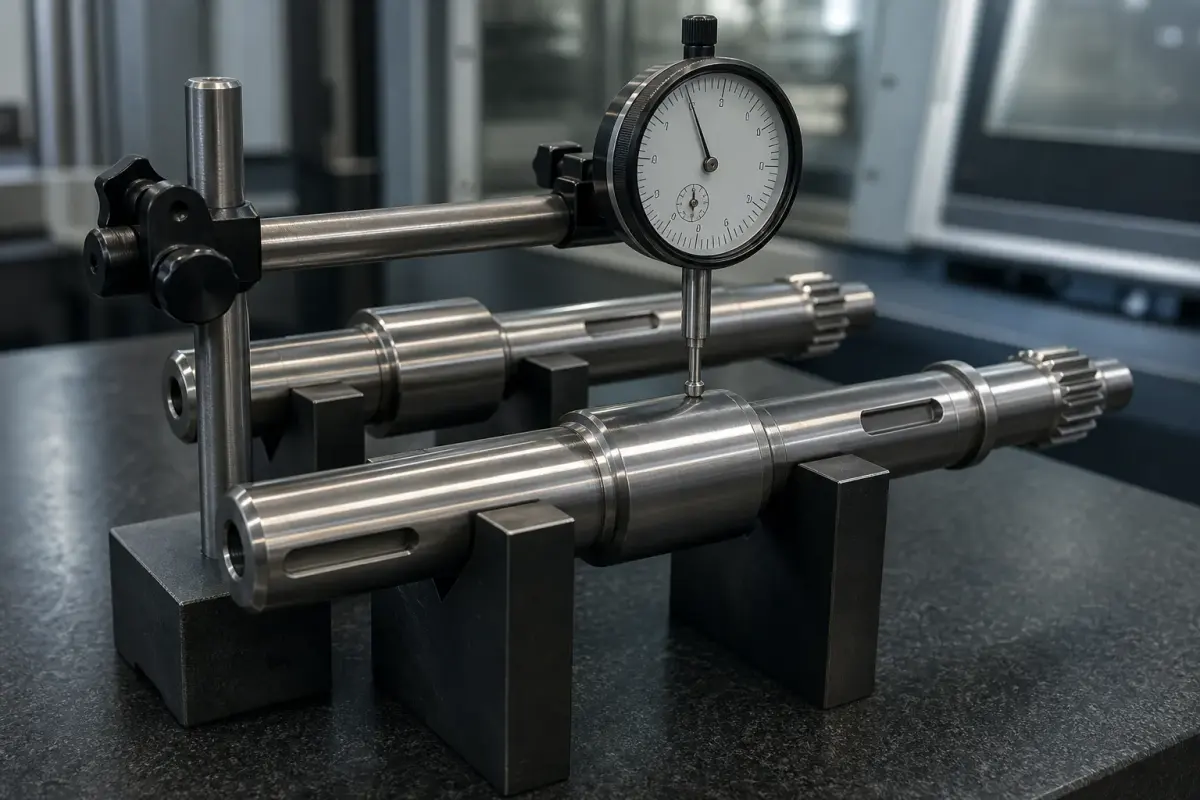
Robot shaft runout is one of those problems that does not care how pretty the part looks. A turned shaft can shine under the light and still fail when the dial indicator touches the journal. In industrial robot parts, shaft runout affects vibration, seal life, bearing load, encoder stability, and repeatable positioning.
This article covers CNC turning lessons for robot shafts. For our full manufacturing scope, visit industrial robot parts CNC machining.
Key Takeaways
- Measure runout from the functional datums, not from a convenient surface.
- Finish bearing journals after roughing and heat-heavy operations.
- Long slender shafts need support, sharp tooling, and conservative pressure.
- Threads and keyways can distort or mark a finished shaft if sequenced badly.
- Inspection should include diameter, runout, surface finish, and thread quality.
What Is Shaft Runout?
Shaft runout is the amount a rotating surface deviates from a true axis when the shaft turns. For robot drive shafts, excessive runout can create vibration, uneven bearing load, seal wear, noise, and positioning errors. Runout is usually checked with a dial indicator or CMM from specified datums.
Why Robot Shafts Are Different From General Turned Parts
A robot shaft is often part of a motion chain. One end may locate a bearing, another may carry a pulley or gear, and a thread or keyway may lock the assembly. If these features do not share the same axis, the robot feels it.
| Feature | What I check | Typical tool |
|---|---|---|
| Bearing journal | Diameter and runout | Micrometer, dial indicator |
| Shoulder face | Squareness | Indicator or CMM |
| Thread | Fit and burrs | Thread gauge |
| Keyway or flat | Position and burrs | CMM, gauge, visual |
| Seal area | Surface finish | Roughness tester |
Turning Sequence That Reduces Trouble
On a shaft with tight runout, I do not want to finish everything too early. Rough the main profile, leave stock on journals, complete stress-heavy features where practical, then finish the bearing diameters from a stable setup.
For longer parts, a center, steady rest, or sub-spindle support may be needed. Tool pressure matters. A heavy finishing pass can push a slender shaft away and create a tapered journal that looks fine at one end and fails at the other.
Material Notes
304 and 316 stainless resist corrosion but can work harden. 17-4 PH gives strength and good stability when heat treated correctly. 4140 or 42CrMo are useful for stronger shafts, but surface protection may be needed. Aluminum shafts are light, but they are not always suitable for wear or bearing contact without sleeves or surface treatment.
Machinist note: If a drawing asks for low runout but does not show the datum, I ask before cutting. Otherwise two people can measure the same shaft and argue with two correct indicators.
Common Causes of Bad Runout
- Weak chucking or inconsistent jaw pressure.
- Finishing journals before keyways, flats, or heat-heavy features.
- Measuring from the wrong datum.
- Too much tool pressure on a slender shaft.
- Burrs or raised material near shoulders and threads.
Practical Shaft RFQ Checklist
- Mark bearing journals, seal diameters, and datum axis.
- Define total runout or circular runout clearly.
- State material condition and heat treatment.
- Confirm surface finish on journals and seal areas, such as Ra 0.8-1.6 um.
- Include thread class, keyway standard, and any plating or black oxide requirements.
FAQ
What is acceptable runout for robot shafts?
It depends on bearing size, speed, load, and assembly design. Many robot shaft journals need tighter control than general turned parts, often in the 0.01-0.03 mm range on critical features after drawing review.
Should robot shafts be ground after CNC turning?
Grinding is useful for very tight diameter, roundness, or surface finish requirements. CNC turning can handle many robot shafts, but high-speed bearing journals or seal surfaces may need grinding or a controlled finishing process.
Why do keyways cause shaft problems?
Keyway cutting can raise burrs, change balance, or introduce stress near a functional diameter. Sequence and deburring matter. Critical journals should be protected, and keyway edges must be cleaned without damaging adjacent fits.
Conclusion
Robot shaft runout is controlled by process discipline: datum clarity, support, tool pressure, sequencing, and inspection. For shafts, sleeves, housings, EOAT plates, and other industrial robot parts, send the drawing with the functional axis marked clearly.