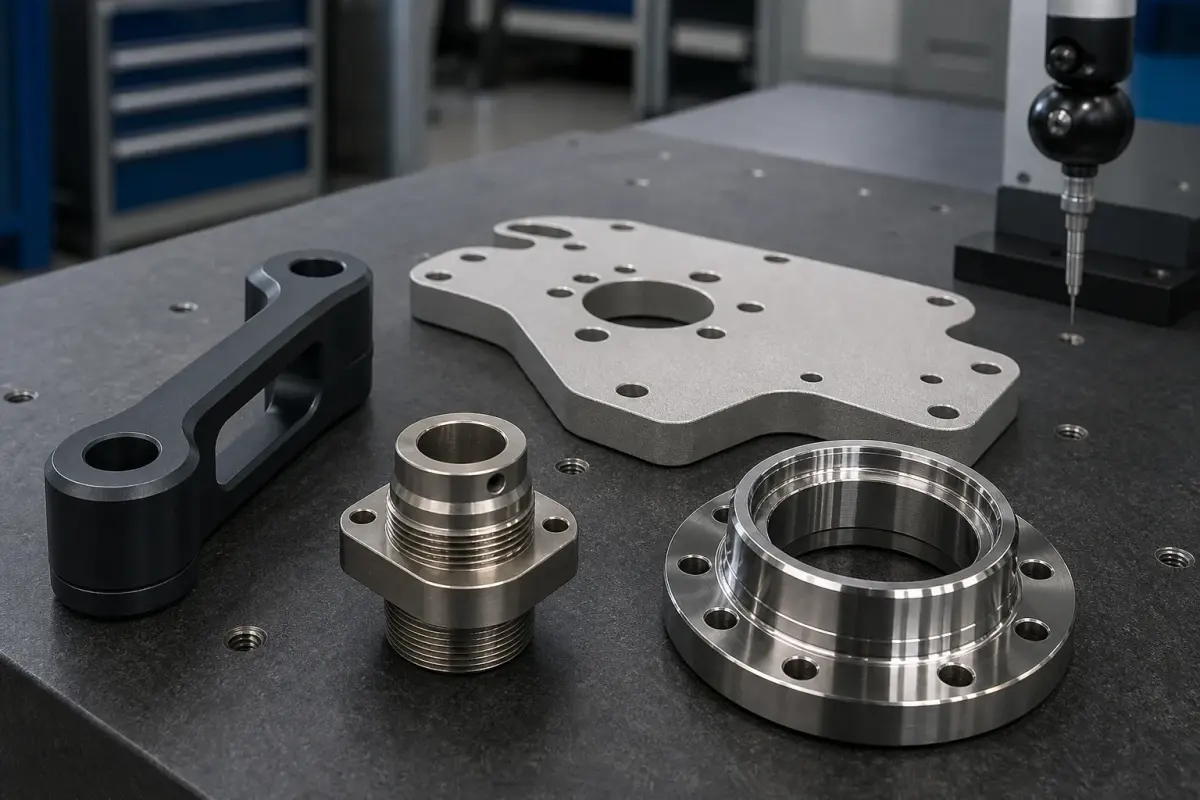
Surface finishes for industrial robot parts are not just about color. A finish can change a bore size, protect a shaft, reduce wear, improve corrosion resistance, or create assembly trouble if it is chosen too late. From the CNC side, finishing must be planned before the final cut.
For the complete robot component service page, see industrial robot parts CNC machining.
Key Takeaways
- Hard anodizing improves wear resistance but changes dimensions.
- Electroless nickel is useful when corrosion resistance and uniform coating matter.
- Black oxide protects steel lightly but is not a heavy corrosion barrier.
- Passivation is common for stainless steel robot hardware.
- Masking and pre-finish allowance must be defined before machining.
What Is a Surface Finish for Robot Parts?
A surface finish for robot parts is the final surface condition after machining, coating, blasting, plating, polishing, or chemical treatment. It affects wear, corrosion resistance, friction, appearance, electrical behavior, and assembly fit. For CNC parts, the finish must match the function of each surface.
Finish Comparison for CNC Robot Parts
| Finish | Common material | Why it is used | Machining concern |
|---|---|---|---|
| Hard anodize | Aluminum | Wear and corrosion resistance | Thickness changes bores and threads |
| Electroless nickel | Steel, aluminum, brass | Uniform corrosion protection | Mask precision fits when needed |
| Black oxide | Alloy steel | Light protection and dark appearance | Oil retention and rust risk |
| Passivation | Stainless steel | Improves corrosion resistance | Surface must be clean |
| Bead blasting | Aluminum, stainless | Uniform matte appearance | Can soften sharp visual edges |
| Polishing | Bearing or cosmetic faces | Lower roughness and shine | Avoid rounding datum shoulders |
Hard Anodizing Is Powerful but Not Magic
Hard anodize is popular for aluminum EOAT frames, gripper jaws, and lightweight robot links. It can improve wear resistance and durability. But it grows into and out of the surface, so a finished bore can become tight after coating.
When a robot part has a bearing bore, dowel hole, or sliding fit, the drawing should state whether the final dimension is before or after anodize. If the fit must stay metal-to-metal, masking may be better.
Electroless Nickel for Uniform Coverage
Electroless nickel is useful for complex robot adapters, brackets, and steel components because it coats more uniformly than some electroplated finishes. It can help with corrosion and wear, especially when parts have pockets or internal features.
The shop still needs to know which features are functional. A few microns can matter on a press fit, dowel hole, or bearing seat.
Finish Planning From the Machinist’s Side
My rule is simple: if a surface locates, rotates, seals, slides, or holds a bearing, it gets special finish discussion. If it is only cosmetic, it gets a practical tolerance and a finish that does not drive unnecessary cost.
Machinist note: A beautiful black part that no longer accepts the bearing is not a finished part. It is a lesson in missing coating allowance.
Drawing Notes That Prevent Problems
- Mark surfaces to mask before anodize or plating.
- Define final dimensions as before-finish or after-finish.
- Add surface roughness values where needed, such as Ra 0.8 um or Ra 1.6 um.
- Separate cosmetic blasting from functional bearing seats.
- Confirm if threaded holes need plug protection.
FAQ
What is the best finish for aluminum robot parts?
Hard anodize is often the best choice for wear resistance. Standard anodize can be enough for corrosion and appearance. Raw aluminum may be acceptable for prototypes or internal fixtures. The right choice depends on wear, fit, environment, color, and cost.
Does anodizing change CNC part dimensions?
Yes. Anodizing creates an oxide layer that changes surface dimensions. Hard anodize especially can affect bores, threads, dowel holes, and sliding fits. Critical features should be masked or machined with coating allowance.
What finish is best for stainless robot brackets?
Passivation is common for stainless steel brackets because it improves corrosion resistance without adding a thick coating. For wear or appearance, polishing, bead blasting, or electropolishing may also be considered depending on function.
Conclusion
Surface finish selection for robot parts should happen before machining, not after inspection. Protect the fits, define the masks, and choose the finish around motion, wear, corrosion, and assembly. For finishing-aware CNC work, start with our industrial robot parts machining page.