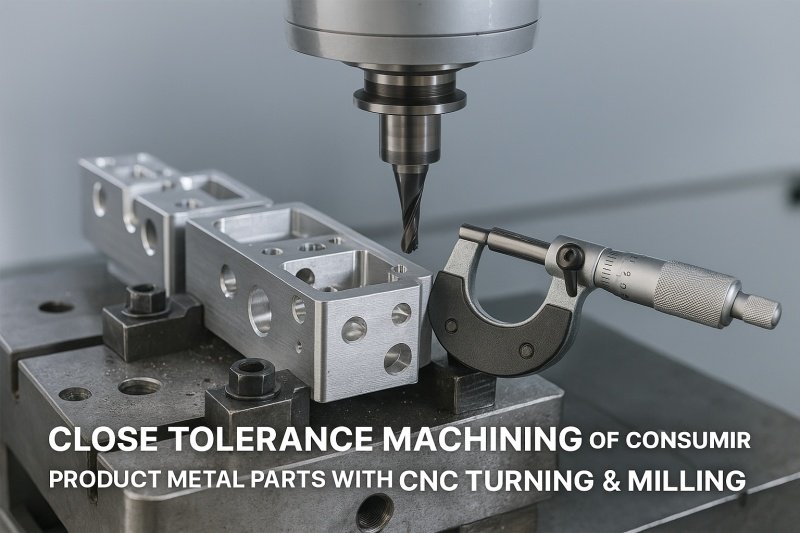
Control Functional Fit And Cosmetic Consistency Together
For consumer product metal parts, engineering quality has two dimensions: functional features must assemble repeatedly, while visible surfaces must keep a consistent texture and color from one batch to the next. This guide explains how to control both without applying the tightest tolerance to every surface. It focuses on datum planning, process stability, finishing variation and inspection evidence for housings, bezels, knobs, brackets and other appearance-sensitive parts.
What “Close Tolerance” Means in Practice
Tight numbers on a drawing are only the beginning. Holding close tolerance requires stable fixturing, thermal control, controlled tool wear, hygienic chip evacuation, and metrology built into the routine. We focus the tightest tolerance where it changes function: sealing faces, bearing fits, locating datums, and positional patterns that govern alignment. On non-functional surfaces we recommend pragmatic limits so cost remains under control. This balance lets you hit the performance spec without over-engineering the rest of the part.
For consumer product metal parts, the requirement is two-fold: parts must interchange dimensionally across batches and present a consistent visual standard on the shelf. We validate both. Functional features are measured against GD&T callouts, while cosmetic areas are qualified against controlled surface prep and finishing panels under consistent lighting. The result is high first-pass yield and predictable cost at launch.
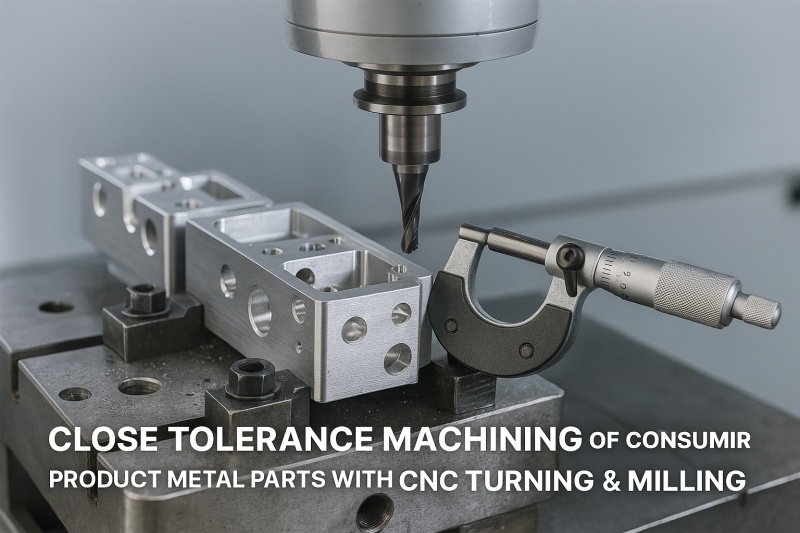
CNC Milling and Turning—One Controlled Flow
Our cells combine 3–5-axis milling with mill-turn capability to reduce setups and stack-up error. We use in-process probing to pick up datums, verify tool offsets, and maintain positional accuracy on hole patterns and pocket arrays. For thin-wall housings and covers we apply balanced toolpaths and adaptive step-downs to protect geometry without over-clamping. Coaxiality for shafts and hubs, perpendicularity on stepped housings, and true-position on multi-hole features are checked during machining, not just at final inspection, so drift is corrected before it becomes scrap.
When a part moves from prototype to small-batch, we lock the proven recipe: fixtures, cutters, coolant strategy, speeds and feeds, and inspection frequency. That is how we keep the first-article behavior consistent as volume grows and how we avoid the hard reset that often happens when processes are re-created from memory.
Materials & Finishes for Consumer Product Metal Parts
We routinely machine aluminum (6061/6063/6082/7075), stainless steels (304/316/17-4PH), carbon and tool steels, brass and copper alloys, and titanium for weight-critical components. Finishes include precision bead-blast, linear brushing, Type II/III anodizing including hard coat, passivation, electroless nickel, decorative nickel/chrome, and powder coating. Each route is tuned to your brand’s cosmetic target and wear environment—pocketable devices need different textures than kitchen hardware or audio frames. Color consistency is managed through sample panels and process control, not just a single good prototype.
Where thermal performance matters, we control surface roughness and flatness on interface planes so TIMs wet correctly and heat spreaders sit flush. Where EM shielding matters, we specify compatible base alloys and plating sequences. Where touch and hygiene matter, we combine edge breaks with controlled Ra to eliminate sharpness while keeping the finish crisp and repeatable after anodizing.
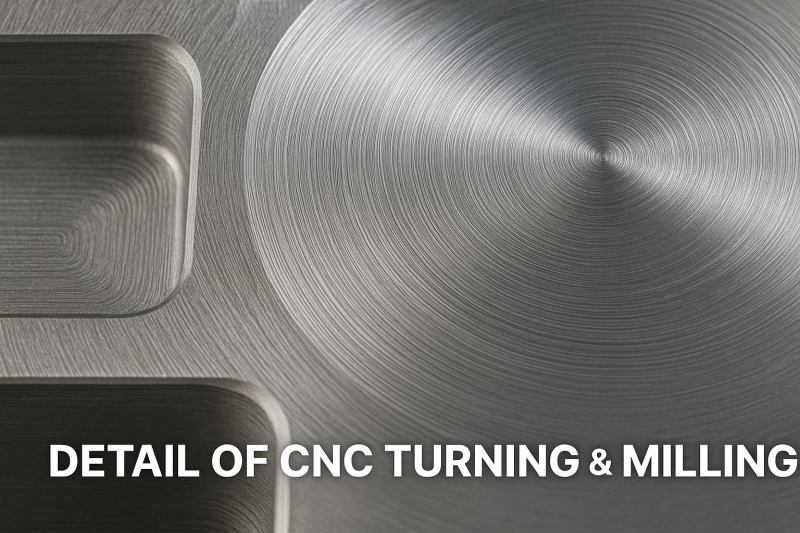
Tolerances, Metrology & Documentation
Critical features can be held to ±0.01 mm depending on material, span, and geometry. We verify with CMM routines, height-gauge and gauge blocks, pin/plug gauges, and surface roughness checks. When requested, we deliver FAIR/FAI, capability studies, and full inspection reports mapped to the drawing. Sampling plans are aligned with incoming inspection on your side, and for sealing or pressure features we can run leak tests and function checks before shipment.
Documentation is not paperwork—it is how tolerance becomes durable. We keep controlled process sheets, revisioned NC programs, tool lists, and fixture drawings. That way, when you reorder or revise, we are not guessing at what made the earlier batch successful; we are rerunning a documented recipe and scaling it responsibly.
Design Guidance to Hold Tight Specs
Good drawings make good parts. Define clear primary/secondary/tertiary datums and apply GD&T where alignment and fit matter most. Avoid blanket ±0.01 mm on non-functional faces—tighten where the mechanism demands it and relax elsewhere to preserve cost and schedule. Add reliefs at pocket intersections to remove cutter dwell marks, keep thin walls practical for the alloy and finish, and specify cosmetic zones separately from function so finishing can be tuned without arguing over dimensional intent. Share early prototypes for DFM—one loop of feedback can remove hours of future setup time.
Applications
We produce device frames and bezels, hinge components, precision knobs and dials, audio and camera housings, strap and buckle hardware, heat-spreader plates, and structural inserts that must carry load without print-through. KPIs include dimensional interchangeability across builds, low cosmetic defect rates at retail inspection levels, and consistent color/texture when parts meet on the final assembly. Whether your next release is an accessory with a premium finish or a performance module that lives behind a gasket, our close tolerance machining ensures reliability and perceived quality for high-precision consumer product metal parts.
What to Include in a Consumer Metal-Part RFQ
Include the critical datum scheme, functional tolerances, cosmetic zones, finish sample or visual standard, material and condition, batch quantity, inspection report requirements and the intended assembly interfaces. A supplier can then propose the machining, finishing and sampling plan around the actual product risk. For production sourcing after the engineering requirements are defined, review the tight-tolerance CNC machining service.
Need to release a consumer metal part with controlled fit and appearance? Send the drawing, CAD model, finish requirement and quantity through the engineering RFQ.