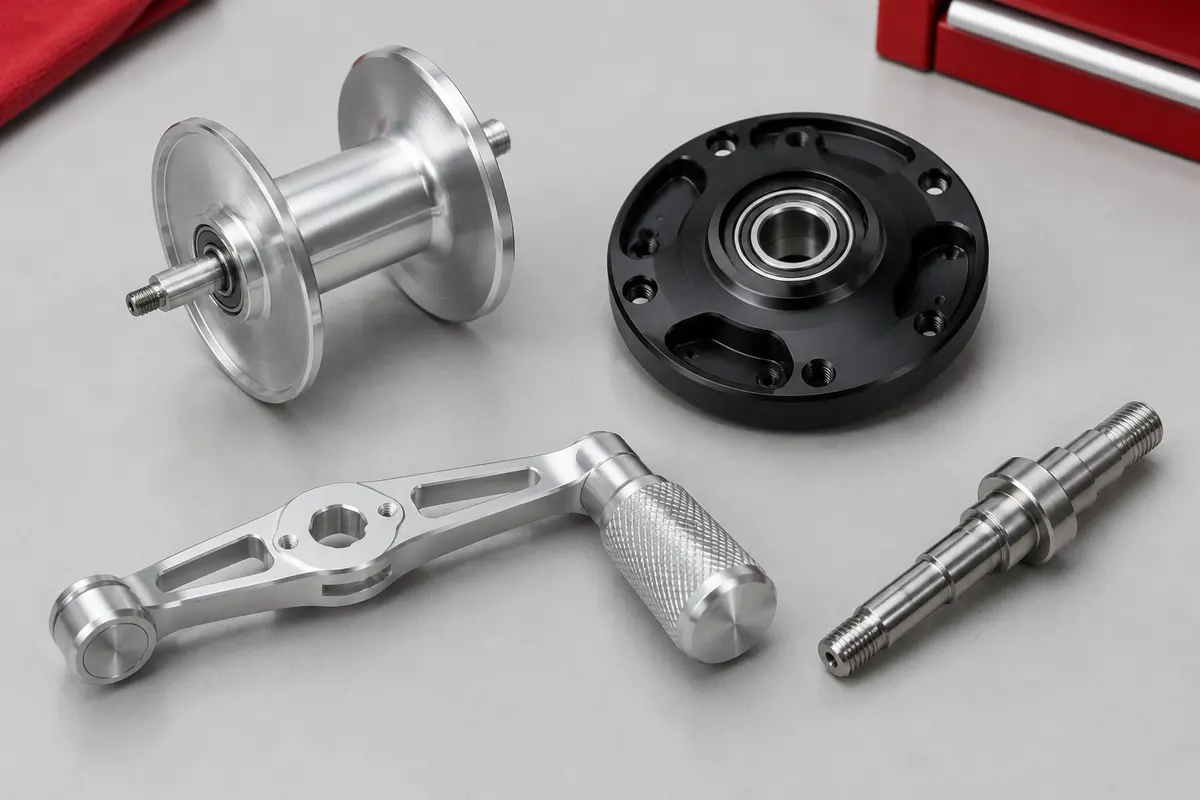
Two fishing reels can look similar on a shelf yet feel different when the handle turns. Part of that difference comes from how the spool, shaft, bearings and housing fit together. Surface finish, edge quality and assembly alignment also matter, especially on components that touch fishing line or the user’s hand.
CNC machined fishing reel parts are custom metal components produced by turning and milling to a controlled drawing. Huade can review spools, side plates, frames, handles, knobs, shafts and spacers for prototype and repeat-batch manufacturing. We supply drawing-based machining services, not off-the-shelf branded replacement reels.
The cover is an AI-generated concept illustration of machining applications, not a photograph of a delivered customer project.
What parts of a fishing reel can be CNC machined?
A reel combines rotational components with structural parts. CNC turning suits circular features; milling creates pockets, mounting patterns, arms and multi-face interfaces. The process route depends on the drawing, rather than whether the finished product is described as a spinning, baitcasting or conventional reel.
| Custom component | Typical machining scope | Features to define on the drawing |
|---|---|---|
| Aluminum spool | Turning the arbor, flanges and bearing interfaces; milling weight-reduction features | Axial datums, runout, wall thickness, line-contact edges and final finished dimensions |
| Frame and side plate | Milling pockets, bearing seats, fastener holes and locating faces | Bearing alignment, hole positions, mating datums and assembly clearances |
| Handle arm and knob | Milling the arm profile; turning or milling the grip and mounting interfaces | Drive interface, knob bearing fit, threads and comfortable edge breaks |
| Shaft, sleeve and spacer | Turning stepped diameters, shoulders and threads | Fit limits, datum axis, shoulder position and surface texture |
| Custom connector or bushing | Turning bores, diameters and threads, with secondary features as needed | Exact material, mating interfaces and finish allowance |
Gears, drag elements, seals and bearings need their own specifications and production routes. Do not assume that quoting a reel housing includes gear cutting, heat treatment, purchased components or complete reel assembly.
Four ways CNC machining supports a better reel component
1. Controlled interfaces for rotating assemblies
A bearing seat is more than a diameter. Its relationship to another bearing, a shaft shoulder or a housing datum can determine whether an assembly fits as intended. Specify the size limits and geometric controls separately, with a clear inspection method.
For a spool, identify the functional axis before assigning runout requirements. For a side plate, relate the bearing bore to the surfaces that locate it in the frame. Read our tight-tolerance CNC machining service guide when preparing these callouts.
2. Weight reduction where the design allows it
Milling can add pockets and reliefs to a frame or handle; turning can establish a thin spool section. But removing more material is not automatically better. Thin flanges, long unsupported sections and heavily pocketed parts need a review of workholding, distortion risk and inspection access.
Provide the target geometry and functional requirements. Structural performance, spool balance and casting behavior must be evaluated on the finished design; CNC machining alone does not establish those outcomes.
3. Finished surfaces people and fishing line can touch
Line-contact edges, grip surfaces and visible faces deserve separate drawing notes. Identify where burrs, tool marks or abrupt edge transitions are unacceptable. Agree the edge break and surface texture rather than asking for every surface to be polished.
For anodized components, define cosmetic areas, color references and masking boundaries. Bearing fits and threads may need dimensions specified after finishing. An approved sample helps make repeat orders more consistent than a color name alone.
4. Custom geometry without committing to a mold first
Drawing-based CNC machining lets a brand evaluate a new knob shape, handle interface or frame layout before committing to dedicated production tooling. The same approach can support small batches where design flexibility matters.
CNC is not the only route to a quality reel. Casting, forging and other processes can also be appropriate, sometimes followed by machining of critical interfaces. Compare routes against geometry, material, quantity and acceptance requirements instead of treating a process label as a performance guarantee.
Aluminum, stainless steel or brass: which material fits the part?
Start with the product designer’s approved grade and condition. A material name such as “aluminum” or “marine metal” is not a complete purchasing specification.
| Material option | Components to discuss | Procurement questions |
|---|---|---|
| 6061 aluminum | Spools, side plates, frames and handles | Which temper, wall thickness, finish and after-finish dimensions are required? |
| 7075 aluminum | Parts where the design calls for its strength properties | Is the grade justified by the design, and are exposure and finishing requirements defined? |
| Specified stainless steel | Shafts, sleeves and hardware | Which grade and condition meet the wear, corrosion and machining requirements? |
| Specified brass | Bushings, adapters and other drawing-defined turned parts | What alloy, mating materials, wear conditions and finish are approved? |
Our aluminum machining page covers alloy and finishing decisions. For small rotational components, see custom brass turned parts and CNC turning services.
For saltwater use, assess the complete assembly: material combinations, surface treatments, fasteners, water retention, seals and maintenance requirements. Do not describe a machined component as saltwater-proof solely because it is anodized or made from stainless steel. Specify any corrosion testing and acceptance criteria separately.
Technical specifications for a custom reel-parts RFQ
There is no universal spool size, handle interface or bearing fit that suits every reel. Send a part-specific package instead of relying on a generic product specification table.
| RFQ item | What to provide |
|---|---|
| Product scope | Individual parts, matched pairs or an assembly; identify any supplied bearings and hardware |
| Files | STEP model and revision-controlled 2D drawing |
| Material | Alloy, temper or condition, and permitted substitutions |
| Fit-critical features | Bearing fits, shaft shoulders, runout, locating datums, threads and mating drawings |
| Appearance | Visible surfaces, color reference, logo artwork and approved sample if available |
| Finish | Treatment specification, masked areas and final dimensional requirements |
| Quantity | Prototype quantity, batch quantity and likely repeat demand |
| Inspection | Critical-feature report, material records, sampling and any separate functional tests |
| Delivery | Requested date, packing protection and delivery location |
Huade confirms tolerances, minimum practical order quantity and lead time after reviewing these requirements. A universal tolerance or delivery promise would conceal the differences between a simple knob and a thin-walled precision spool.
From CAD to custom fishing reel components
- Review the part and mating interfaces. Establish what must locate, rotate, clamp or clear another component. Resolve drawing and model differences before programming.
- Choose the machining sequence. Plan turning, milling, secondary features and workholding around the functional datums.
- Control edges and finishes. Deburr the specified areas, protect contact surfaces and coordinate anodizing, plating or marking where required.
- Inspect against the agreed drawing. Verify the identified features in the agreed measurement state, including after finishing where necessary.
- Approve the prototype before repeat batches. Record fit and finish feedback against the revision. Reel-level drag, durability, balance and corrosion validation need a separately agreed test plan.
Frequently asked questions
Can Huade make custom fishing reel parts for an OEM brand?
Yes. Send the controlled drawings for spools, frames, side plates, handles or turned hardware. Huade reviews the machining, finish and inspection scope for prototypes and repeat orders. Complete reel design and assembly are not included by default.
Can you copy a replacement spool from a reel model name?
A model name alone does not define its interfaces. Supply authorized drawings or discuss a sample-based engineering review, including mating parts and acceptance criteria. Compatibility must be verified; we do not claim universal fit across brands.
Can I add custom anodized colors and a logo?
Custom color finishing and marking can be reviewed with the part files. Provide artwork, marking location, finish specification, masking areas and an appearance reference. Confirm the effect of finishing on functional fits before approving production.
Can CNC machining guarantee a smoother reel?
No single machining process guarantees complete-reel performance. Accurate parts support the assembly, but bearings, gears, lubrication, alignment, design and validation also matter. Specify component acceptance separately from reel-level testing.
What changes the price of a CNC machined spool or handle?
Material, removed volume, thin sections, setup count, tight features, finish and inspection requirements all influence the route. Quote prototype and repeat quantities separately, and avoid tight tolerances on surfaces that do not control function.
Request a quote for CNC fishing reel parts
Developing a custom spool, handle or reel frame? Upload your CAD files and drawings with the material, quantity, finish and critical interfaces. Huade will review the manufacturing requirements and confirm the proposed machining and inspection scope before quoting.