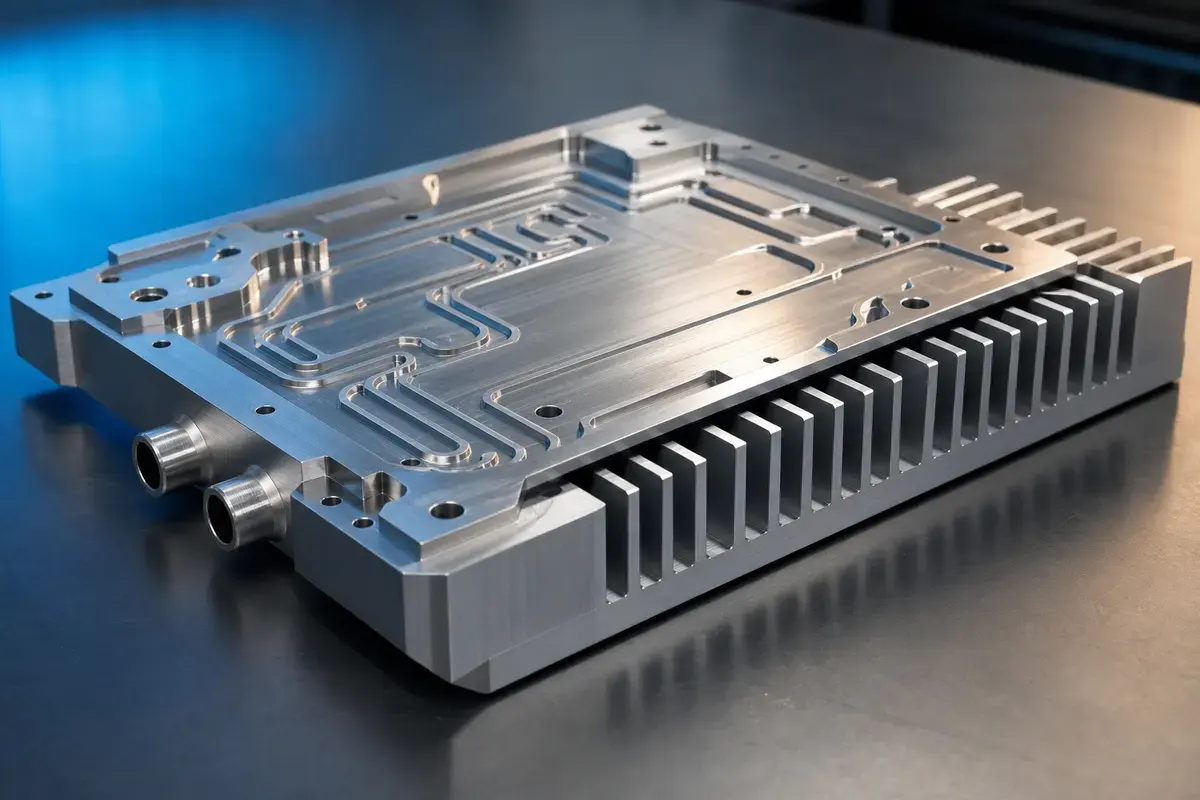
An AI server cooling assembly needs more than a machined channel. Its cold plate must fit the mounting stack, its manifold must connect to the specified ports, and its wetted surfaces must meet the cooling system’s material and cleanliness requirements.
Huade offers drawing-based CNC machining for custom cold-plate components, distribution blocks, connector bodies and mounting hardware. We review aluminum, copper and other specified materials against your CAD model, drawing and inspection requirements, from prototypes through repeat batches. Finished cooling assemblies, joining operations and system tests require a separately agreed scope.
This guide covers what to specify before requesting a machining quote. The cover is a general thermal-component illustration, not evidence of a delivered AI server project.
Which AI server components can be CNC machined?
Start by separating parts that contact coolant from the surrounding mechanical hardware. They may share an assembly, but they do not share every material, finish or acceptance requirement.
| Component | Features to review for machining | Information needed before quotation |
|---|---|---|
| Cold-plate bases and covers | Contact faces, accessible channels, seal grooves and mounting holes | Interface drawing, channel geometry, cover joining method and critical dimensions |
| Distribution manifolds | Intersecting bores, port locations, threaded connections and plug seats | Port standard, passage drawing, sealing method and internal access |
| Custom fitting and connector bodies | Turned diameters, threads, shoulders and seal lands | Mating component specification, thread gauges and seal requirements |
| Sensor housings and adapters | Probe bores, locating faces and mounting threads | Sensor interface, material and wetted-surface requirements |
| Mounting brackets and support plates | Hole patterns, pockets, datums and assembly clearances | Assembly model, mounting loads and finish requirements |
Huade’s CNC milling services support prismatic parts and multi-face features. CNC turning suits rotational bodies, sleeves and threaded adapters. A machined coupling body is not, by itself, a qualified quick-disconnect assembly; valves, seals, mating compatibility and qualification remain separate requirements.
Cold plates: define the interfaces before the toolpath
For a cold-plate RFQ, identify the heat-source contact face, mounting datums, channel geometry and lid interface on the drawing. Specify flatness and surface texture where they matter to the assembly. A general dimensional tolerance does not define either requirement.
Ask for a manufacturability review of deep pockets, narrow channels, thin walls and inaccessible corners. Tool access and inspection access need to be considered together. Do not assume every microchannel or enclosed passage can be produced by conventional milling.
The cover attachment also belongs in the initial review. A bolted cover, a brazed joint and a welded assembly require different process plans. Joining can change final geometry, so agree whether inspection is required before joining, after joining or at both stages. Huade confirms joining availability and responsibility during quotation rather than treating it as part of every machining order.
Manifolds and fittings: make hidden features inspectable
An external drawing can conceal the hardest manufacturing decisions. For a distribution block, include sections showing intersecting passages, blind ends, cross-drilled closures and sealing interfaces.
- Name the thread standard and size, not just a nominal diameter.
- Identify whether sealing occurs on a face, an O-ring interface or a specified threaded connection.
- Mark internal intersections that require deburring and describe how cleanliness will be accepted.
- Provide mating connector drawings or controlled interface specifications.
- Separate assembly access clearances from machining dimensions.
Multi-face access may justify 5-axis machining, but it is not automatically needed for a simple manifold. The review should select a process around the features and quantity, not a machine label.
Material selection starts with the complete cooling loop
Use the system designer’s approved material list for wetted parts. Do not choose a cold-plate alloy solely from a thermal-conductivity comparison or substitute a familiar machining grade without approval.
| Material route | Potential component scope | What to confirm |
|---|---|---|
| Aluminum, including specified 6061 grades | Plates, housings, brackets and approved wetted components | Exact alloy and temper, coolant compatibility, surface treatment and mating materials |
| Specified copper grades | Cold-plate bases and thermal interfaces | Grade, stock condition, channel geometry, finish and handling requirements |
| Specified stainless steel grades | Fitting bodies, sensor adapters and hardware | Wetted compatibility, required surface condition and thread inspection |
Review coatings, seals, coolant chemistry and dissimilar-metal contacts as an assembly. A finish selected for appearance is not automatically suitable inside a liquid circuit. Identify areas that must remain uncoated and define dimensions after finishing where assembly fit depends on them.
See our aluminum CNC machining capabilities and copper machining services for drawing-based material and process review.
What inspection belongs in the purchase specification?
Define acceptance requirements before comparing quotes. Dimensional inspection, cleanliness verification and functional testing answer different questions.
| Requirement | What to agree with the supplier |
|---|---|
| Material identity | Required certificates, batch identification and traceability records |
| Dimensions and geometry | Drawing revision, datums, critical features, inspection method and sampling |
| Surface condition | Roughness requirements, burr acceptance, protected sealing faces and cosmetic limits |
| Cleanliness | Applicable procedure, acceptance criteria, verification method and packaging |
| Leak and pressure tests | Responsible party, test medium, pressure, duration, leak criterion and reporting |
| Thermal and flow validation | Assembly configuration, coolant conditions, operating points and system test owner |
Huade provides dimensional inspection planning, including CMM review for accessible features. A dimensional report does not establish leak tightness, flow performance or thermal performance. Pressure, leak, particle-cleanliness and thermal tests must be requested and their availability confirmed in writing. Do not assume they are included in a standard CNC quotation.
For the machining controls behind a sealing interface, our waterproof aluminum enclosure case study provides a related example. It is an enclosure project, not qualification evidence for a server liquid-cooling assembly.
From prototype machining to repeat orders
Use the prototype stage to resolve mating interfaces, machining access and the inspection plan. Give the supplier a controlled drawing revision and distinguish dimensions needed for an early fit check from requirements that must already match the final assembly.
Before repeat production, freeze the approved material, finish, drawing, inspection criteria and packaging requirements. If a design change affects a channel, sealing interface or joining process, ask whether the change also requires renewed assembly testing.
The main quotation variables include stock material, removed volume, channel accessibility, setup count, critical geometry, finishing and inspection scope. Give separate prototype and forecast quantities so the machining route can be reviewed for each stage. A firm price or lead time requires the actual part files.
RFQ checklist for AI server cooling components
Send the following through our custom CNC quote form:
- STEP or equivalent 3D models plus dimensioned 2D drawings with revision identifiers.
- Exact material grade, temper or condition, and permitted substitutions if any.
- Prototype quantity, anticipated repeat quantity and required delivery date.
- Critical datums, flatness, surface texture, threads and seal-interface details.
- Wetted-part identification, coolant compatibility requirements and finish or masking instructions.
- Cover joining, assembly and supplied-component responsibilities.
- Required inspection reports, cleanliness criteria, packaging and separately specified functional tests.
Huade reviews the machining scope, identifies features that need clarification and confirms the proposed process and deliverables in the quotation. For broader mechanical requirements, include the bracket, housing and connector drawings in the same package.
Frequently asked questions
Can Huade manufacture a complete liquid-cooling system?
This service is for custom machined components. System design, joining, assembly and functional qualification are not included by default. Send the full requirement so we can confirm the available scope and identify work that needs a separate specialist.
Is aluminum or copper better for a cold plate?
That decision belongs to the thermal and materials design of the complete assembly. Specify the approved grade after considering the thermal path, coolant, mating materials, finish, weight and manufacturing route. Huade can review the selected material for machining feasibility.
Does a tighter machining tolerance guarantee a leak-free part?
No. Seal geometry, surface condition, joining, assembly and operating conditions also need acceptance criteria. Assign tolerances to functional features and specify the required assembly leak test separately.
Can you quote prototypes and small batches?
Yes. Huade supports drawing-based prototypes, small batches and repeat production. Share the models, drawings, quantities and acceptance requirements so we can confirm feasibility, price and schedule.