Drone arm CNC mounts are small parts with a large effect on UAV reliability. They connect the arm to the center frame, hold the propulsion geometry, transfer vibration into the main structure, and often decide whether a prototype feels rigid or unstable during flight testing.
For professional UAVs used in inspection, mapping, agriculture, logistics, or payload development, an arm mount is not just a bracket. It is a structural interface that needs controlled hole position, stable datums, predictable weight, clean edges, and a finish that does not compromise assembly.
What Are Drone Arm CNC Mounts?
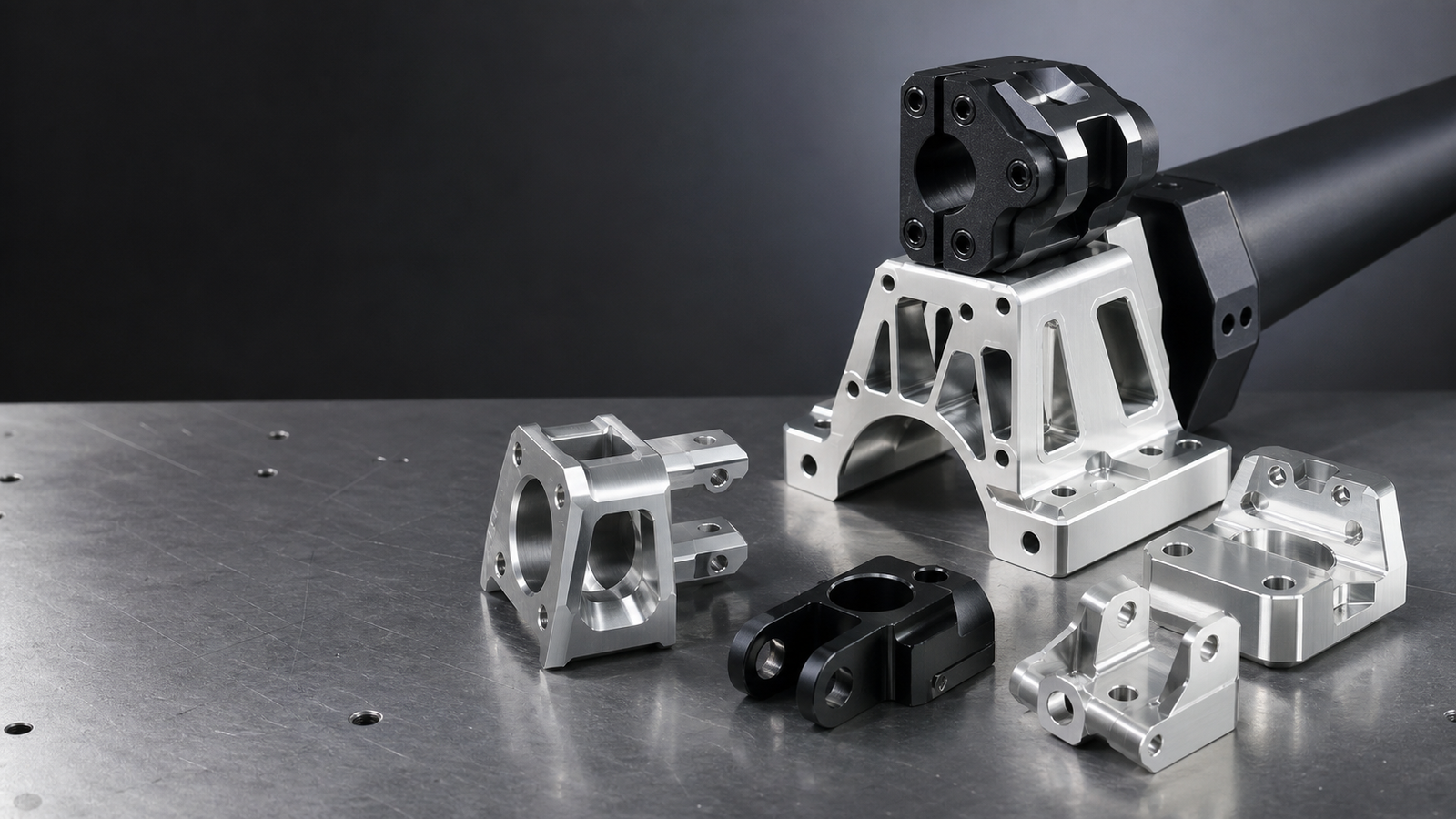
Drone arm CNC mounts are machined connector parts used to attach UAV arms to the main frame, center plate, folding hinge block, or motor-side structure. They may appear as clamp blocks, fork brackets, hinge supports, split collars, reinforcement plates, or custom arm-to-frame adapters.
Common applications include:
- fixed arm mounts for inspection drones
- folding arm connector blocks for portable UAV platforms
- aluminum clamps for carbon tube or aluminum tube arm assemblies
- reinforcement blocks around motor-arm junctions
- left/right matched brackets for symmetrical airframes
The key point is repeatability. If the left and right arm mounts do not hold the same geometry, the aircraft can require extra shimming, tuning, or manual adjustment during assembly.
Why CNC Machining Fits UAV Arm Interfaces
Arm mounts often require features that are difficult to hold consistently with simple fabrication methods. CNC machining allows the manufacturer to control the geometry of each functional surface instead of relying only on external shape.
Important machined features often include:
- tight bolt-hole location for arm and frame alignment
- flat mounting faces for consistent load transfer
- pocketing to remove mass without weakening key load paths
- chamfered and deburred cable-adjacent edges
- bearing or pin seats for folding-arm mechanisms
- matched datum strategy for mirrored parts
For UAV developers, these details reduce assembly variation and make flight-test feedback more meaningful. When the hardware is repeatable, the engineering team can separate structural problems from tuning or control-system problems.
Material Choices for Drone Arm Mounts
Most custom UAV arm mounts are machined from aluminum because it offers a practical balance between strength, weight, machinability, and surface finishing.
6061-T6 Aluminum
6061-T6 is commonly used for general UAV brackets, clamps, and connector blocks. It machines cleanly, anodizes well, and is suitable for many prototypes and low-volume production programs.
7075-T6 Aluminum
7075-T6 is often selected when the arm interface carries higher load or when the design needs more stiffness without a large increase in section size. It is a strong fit for high-performance UAV structures, folding arm supports, and compact reinforcement blocks.
Stainless Steel Inserts or Pins
Stainless steel is usually not the main material for an arm mount because of weight. It is useful for selected pins, shafts, threaded inserts, wear interfaces, and locking hardware where aluminum may wear too quickly.
Design Details That Affect Flight Stability
An arm mount can look simple in CAD, but a few details have direct consequences in flight.
Hole Position and Bolt Pattern Control
Motor thrust alignment depends on the relationship between the center frame, arm, and motor-side interface. If bolt holes drift, the arm angle can change slightly. That error may show up as vibration, trim compensation, or uneven motor loading.
Datum Surfaces
The drawing should identify which faces or bores locate the mount in the assembly. Without clear datums, inspection can pass individual dimensions while the part still assembles inconsistently.
Weight Reduction Pockets
Lightweight pockets help reduce mass, but pocket depth and corner radius should respect the load path. Removing material around a clamp screw, hinge pin, or highly loaded corner can create a failure point.
Edge Quality
Drone frames often route wires, antennas, straps, and sensor cables near structural hardware. Burrs and sharp edges can damage these items over time, especially under vibration.
Folding Arm Mounts Need Extra Attention
Folding UAV arms add more constraints than fixed arms. The mount must be stiff during flight, smooth during folding, repeatable after many cycles, and compact enough for transport.
For folding-arm mounts, the RFQ should call out:
- hinge pin diameter and fit
- clearance targets for rotation
- locked and folded positions
- wear surfaces that may need better finish
- thread strength around repeated fastener use
- inspection requirements for left/right matched parts
These details should be clear before machining starts. A folding arm that feels acceptable on the bench can still develop play after repeated field use if the pin-to-bore relationship is not controlled.
Surface Finishing for UAV Arm Mounts
Anodizing is common for aluminum drone arm mounts. It improves corrosion resistance and can provide a stable cosmetic finish for exposed parts.
Typical options include:
- clear anodizing for clean aluminum appearance
- black anodizing for low-reflection UAV hardware
- hard anodizing for wear-prone interfaces
- bead blasting before anodizing for a uniform matte surface
Functional holes, bearing seats, and precision faces may need masking or post-finish tolerance planning. The finish should be treated as part of the manufacturing plan, not an afterthought.
RFQ Checklist for Drone Arm CNC Mounts
When requesting a quote, include more than a 3D model. A good RFQ for custom UAV machined parts should include:
- STEP or X_T file
- 2D drawing for critical dimensions
- material grade, such as 6061-T6 or 7075-T6
- quantity for prototype and expected production batch
- finish requirement and color
- marked datums and functional holes
- weight target or maximum allowable mass
- notes for left/right matched parts
- assembly context, such as tube size, frame plate thickness, and fastener type
This helps the CNC supplier quote the part around its real function instead of treating it as a generic aluminum bracket.
How Drone Arm Mounts Connect to the Larger UAV System
Arm mounts work together with center plates, motor mounts, gimbal brackets, landing structures, and precision fasteners. If you are building a UAV part family, review our broader guide to CNC machined drone components and the industry page for CNC UAV drone parts.
For related purchasing intent, also see our article on CNC machined structural drone parts.
FAQ: Drone Arm CNC Mounts
What tolerance is needed for drone arm CNC mounts?
It depends on the assembly, but hole position, flatness, and pin-to-bore fit are often more important than a blanket tight tolerance on every dimension. Critical interfaces should be called out on a 2D drawing.
Is 6061 or 7075 better for UAV arm mounts?
6061 is practical for many brackets and prototypes. 7075 is preferred when the arm mount needs higher strength or stiffness in a compact geometry.
Can drone arm mounts be anodized?
Yes. Clear, black, and hard anodizing are common for aluminum UAV mounts. Critical holes and mating faces should be reviewed before finishing.
Do you machine carbon fiber drone arms?
This article focuses on metal CNC machined arm mounts, brackets, inserts, and interfaces. Carbon fiber machining is not presented here as a production service.
CNC Drone Arm Mounts from HDProto
HDProto machines custom aluminum UAV arm mounts, folding-arm connector blocks, motor-side brackets, center plate interfaces, and precision fastening hardware for prototype and low-volume production. Send your CAD files, drawings, material requirements, finish notes, and target quantity, and our team can review the manufacturability of your drone arm mount before production.