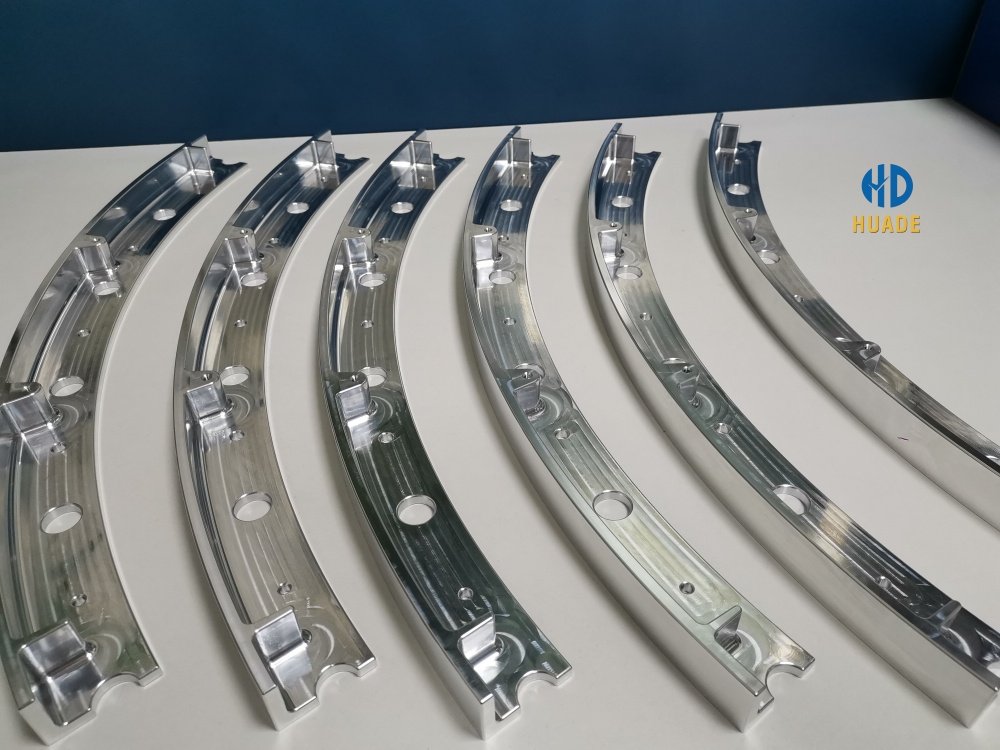
High-volume CNC machining is repeat production built around a stable drawing revision, proven workholding, controlled tool life and an inspection plan. The quantity alone does not make a process ready for volume: the approved first article and the method used to reproduce it matter more.
Unlike low-volume and small-batch CNC machining, high-volume CNC machining places more weight on cycle-time stability, tool-change rules, in-process sampling and revision control. A design should move into repeat production only after its critical interfaces and acceptance method are clear.
Companies choose this manufacturing method when they need:
- Stable critical features tied to functional datums and a defined inspection method.
- Repeatable setups using controlled workholding, offsets and tool-life rules.
- Material and cycle planning that accounts for stock condition, chip control and finishing capacity.
- Release discipline that prevents an unapproved model change from entering the next batch.
HDProto reviews repeat-production projects from the drawing outward: quantity, material, geometry, critical dimensions, finish, inspection evidence and delivery releases all affect whether CNC is the right volume process.
Boosting Efficiency with Advanced CNC Machining Techniques
To succeed in high-volume manufacturing, process optimization and automation are key. At our facility, we integrate state-of-the-art CNC technologies to streamline production cycles and reduce lead times.
1. Multi-Axis CNC Milling and Turning
Using 3-axis, 4-axis, and 5-axis CNC machines, we manufacture highly complex components in fewer setups, minimizing production time and improving part accuracy.
2. Toolpath Optimization
By applying intelligent toolpath programming, we reduce tool wear and cutting time, allowing faster turnaround while maintaining precision.
3. Automated Quality Control
Inline inspections combined with CMM (Coordinate Measuring Machines) ensure every part meets exact specifications before shipment, reducing rework and waste.
The result? A more reliable, scalable, and cost-effective production workflow for high volume production machining, perfectly suited for customers requiring thousands of consistent components.

Choosing the Best Aluminum for Machining High-Precision Parts
Aluminum remains one of the most popular materials for high-volume CNC production due to its light weight, corrosion resistance, and excellent machinability. However, selecting the best aluminum for machining can make a significant difference in performance and cost efficiency.
Common Aluminum Grades for CNC Machining
- 6061 Aluminum: Versatile, affordable, and widely used for structural components.
- 7075 Aluminum: Superior strength, ideal for aerospace and robotics applications.
- 2024 Aluminum: Excellent fatigue resistance, suitable for automotive and defense industries.
Why Material Selection Matters
Choosing the right aluminum grade ensures:
- Higher cutting speeds for improved productivity.
- Better surface finishes requiring minimal post-processing.
- Optimized strength-to-weight ratios for demanding applications.
For customers seeking large-scale production runs, we recommend 6061 and 7075 aluminum as the best aluminum for machining when balancing performance and efficiency. For detailed aluminum material properties, see MatWeb Aluminum Database.
Titanium Milling: Overcoming Challenges in Complex Component Manufacturing
While aluminum dominates many applications, industries like aerospace, medical, and energy sectors increasingly require titanium due to its exceptional strength and corrosion resistance. However, titanium milling presents unique challenges:
Key Challenges
- High Cutting Forces: Titanium’s toughness increases tool wear.
- Heat Generation: Poor thermal conductivity demands optimized cooling systems.
- Tool Life Management: Specialized coatings and cutting strategies are essential.
Solutions for Precision Titanium Machining
- High-speed carbide tools to minimize heat buildup.
- Flood coolant systems for temperature control.
- Real-time monitoring to ensure dimensional stability.
By combining advanced CNC strategies with titanium-specific tooling, we deliver precision parts for aerospace structures, surgical implants, and high-performance automotive components.
For a comprehensive reference on titanium material specifications, visit AZoM Titanium Standards.
High Volume Production Machining vs Low Volume Prototyping
Aspect
High Volume Production Machining
Low Volume Prototyping
Purpose
Large-scale production of final parts
Testing and validating designs
Batch Size
Hundreds to thousands of components
1 to 50 components
Lead Time
Optimized for speed and automation
Flexible but slower
Cost Efficiency
Lower cost per unit
Higher cost per unit
Industries
Automotive, aerospace, robotics, medical
Product development, R&D
For businesses scaling up, high volume production machining offers clear advantages: reduced per-unit costs, faster time-to-market, and seamless integration with automated assembly lines.
How Process Control and Inspection Support Consistency
In repeat production, the inspection plan should follow feature risk rather than treating every dimension the same. A practical control plan can include:
- First-article approval: Confirming the released drawing before the batch continues.
- In-process sampling: Monitoring critical dimensions and tool-wear trends at defined intervals.
- Tool-life rules: Replacing or correcting tools before drift reaches the acceptance limit.
- Final inspection records: Providing the agreed evidence for fit-critical features.
This combination reduces variation risk across repeat lots without making unsupported claims that every feature needs continuous monitoring or CMM inspection.
Partner with Experts for Reliable High Volume Production Machining
Scaling a CNC program requires more than adding machines. The supplier needs a controlled revision, stable workholding, defined tool-life rules, finishing capacity and an inspection plan that remains practical at the quoted quantity.
If the design is still changing, begin with prototype CNC machining or a controlled small batch. When the revision is stable, review our custom CNC machining services and send the expected annual quantity and delivery-release pattern with the RFQ.
Get Your CNC Quote Now
Send the 3D model, controlled drawing, material, finish, current quantity, expected repeat demand and inspection requirements through the RFQ form, or email sales@hdproto.com.
Dongguan Huade Precision Manufacturing Co., Ltd.
Address: No. 168, Shijie Industrial Zone, Dongguan City, Guangdong, China
Email: sales@hdproto.com
Website: https://hdproto.com