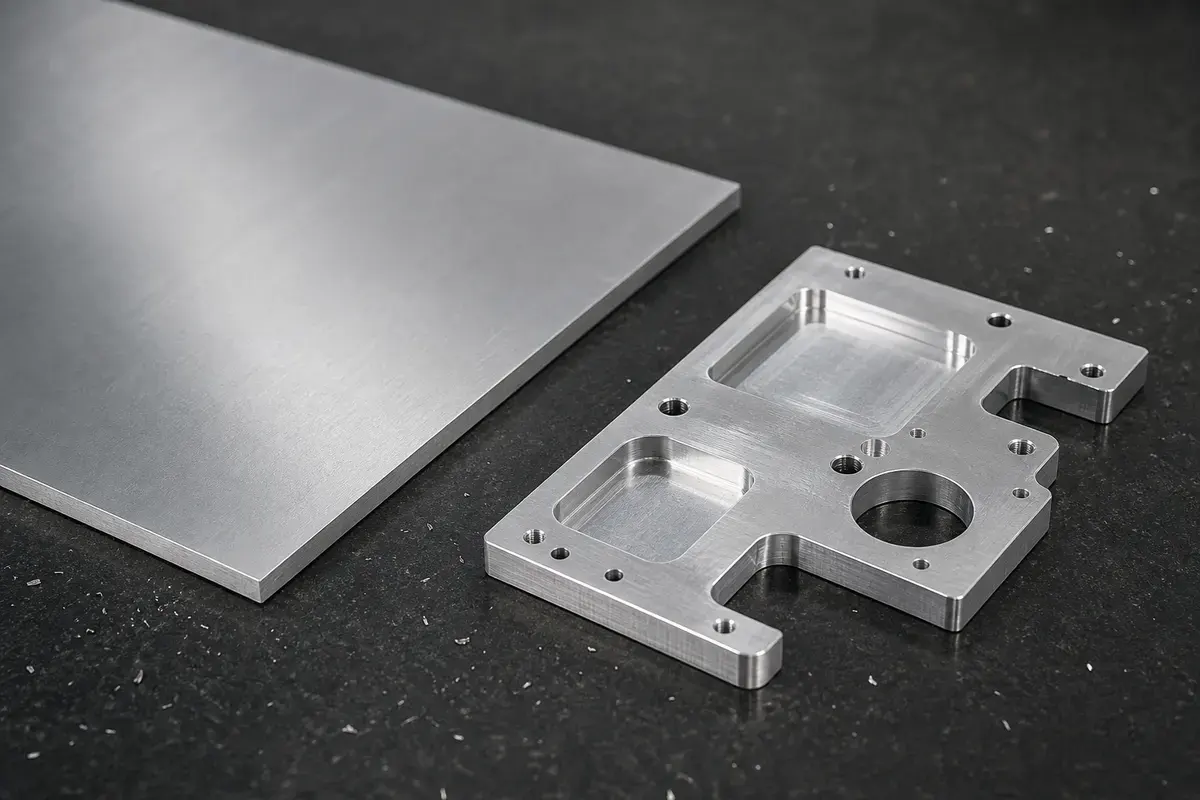
The best way to cut 1/8-inch aluminum sheet depends on what the finished part must do. A saw or router can produce a simple blank. Laser and waterjet cutting are efficient for flat profiles. CNC milling becomes valuable when the part also needs accurate pockets, counterbores, threads, edge datums, or a controlled relationship between features.
That distinction matters because 1/8 inch equals 0.125 in, or 3.175 mm. At that thickness the workpiece is stiff enough for many covers and brackets, but still easy to bow if it is clamped poorly or machined with an unbalanced toolpath.
Quick decision guide
| Requirement | Usually the best starting process |
|---|---|
| Straight cut or one-off shop blank | Carbide saw |
| Simple 2D production profile | Laser or waterjet |
| Low-cost panel with bends | Sheet-metal cutting and forming |
| Close-tolerance holes, pockets, threads, or datums | CNC milling |
| Finished housing plate with cosmetic surfaces | CNC milling plus controlled finishing |
The part should drive the process. Paying for full CNC milling is unnecessary when the drawing only defines a loose outside profile. Conversely, starting with a rough cutting method can create extra setups when the same part later needs precise holes and machined sealing surfaces.
What changes when CNC machining is required?
CNC milling locates features from a controlled work coordinate system. That helps when hole position, bore size, pocket depth, perpendicular edges, or flatness affects assembly. It also permits spot-facing, countersinking, engraving, and threaded features in the same routing.
Thin stock introduces its own risks. Excessive clamping force can distort the sheet before cutting. Aggressive pocketing can release residual stress. A small unsupported feature may vibrate and leave a poor edge. Practical process planning may use a fixture plate, vacuum workholding, sacrificial tabs, soft jaws, or a rough-and-finish sequence depending on geometry and volume.
For a panel that remains mostly flat and receives bends later, compare our sheet metal fabrication service before specifying a billet-machined solution. For plates, brackets, and housings with precision features, our aluminum CNC machining service is the more relevant route.
Alloy and temper affect the result
Do not specify only “aluminum sheet.” The grade and temper affect strength, forming behavior, chip control, anodized appearance, and procurement.
- 5052-H32 is common for bent sheet-metal parts because it forms well and has useful corrosion resistance.
- 6061-T6 is a versatile choice for machined plates and brackets, but tight bends require more care than with 5052.
- 7075-T6 offers higher strength but is usually selected for strength-driven machined parts rather than general formed panels.
If the design can use either 5052 sheet or 6061 plate, define whether bending performance or machined-feature accuracy is the priority. Our 6061 vs 7075 engineering comparison covers the separate decision between common machining alloys.
Tolerance, burrs, and finish
Cut-edge tolerance is only one part of acceptance. A useful drawing also defines hole location, flatness where it matters, edge breaks, cosmetic faces, grain direction for brushing, and any post-machining finish. Avoid placing a general tight tolerance on every dimension; identify the few features that control fit.
Every cutting route can leave a characteristic edge. Sawing may leave tooth marks. Laser cutting can produce a heat-affected edge depending on alloy and process. Waterjet cutting can leave taper or striation. Milling can leave burrs if the tool is worn or exit geometry is unsupported. Our guide to deburring CNC-machined aluminum explains how edge requirements should be communicated.
Anodizing also adds a finish-stage constraint. Cosmetic zones, electrical contact pads, threaded holes, and critical fits may need masking or post-finish allowance. Review the aluminum anodizing service before freezing finished dimensions.
A better RFQ for an aluminum sheet part
Send the 3D model and a 2D drawing that states:
- Alloy and temper.
- Finished thickness and any flatness requirement.
- Critical hole positions, threads, countersinks, and pocket depths.
- Edge-break and burr acceptance.
- Surface finish, color, masking, and cosmetic zones.
- Prototype and production quantities.
Huade supports 3-axis, 4-axis, and 5-axis milling, turning, sheet-metal coordination, finishing, and dimensional inspection. A tolerance such as ±0.005 mm is feature- and process-dependent, so it should be applied only after geometry and inspection access are reviewed. If your 1/8-inch sheet has precision features, send the drawing for a manufacturing review.
Frequently asked questions
Can a CNC router cut 1/8-inch aluminum?
Yes, a rigid router with suitable tooling, chip evacuation, lubrication, and workholding can cut aluminum sheet. It is not automatically equivalent to a machining center for bore quality, toolholding rigidity, probing, or multi-operation positional control.
Is waterjet better than laser for aluminum sheet?
Neither is universally better. Waterjet avoids a thermal cutting zone and handles thicker material well; laser is fast for many production profiles. Machine availability, alloy, edge requirement, tolerance, and secondary operations determine the economical route.
Should holes be cut or drilled after profiling?
Loose clearance holes can be included in a profile-cutting operation. Precision bores, dowel holes, tapped holes, and sealing features are commonly machined afterward so their size and position can be controlled.
Technical sources
- The Aluminum Association: The Aluminum Advantage — industry background on aluminum properties and applications.
- AZoM: Aluminium—Specifications, Properties, Classifications and Classes — material-property and processing overview.
- Aluminum Anodizers Council: Anodizing Design — anodic-finish design considerations.