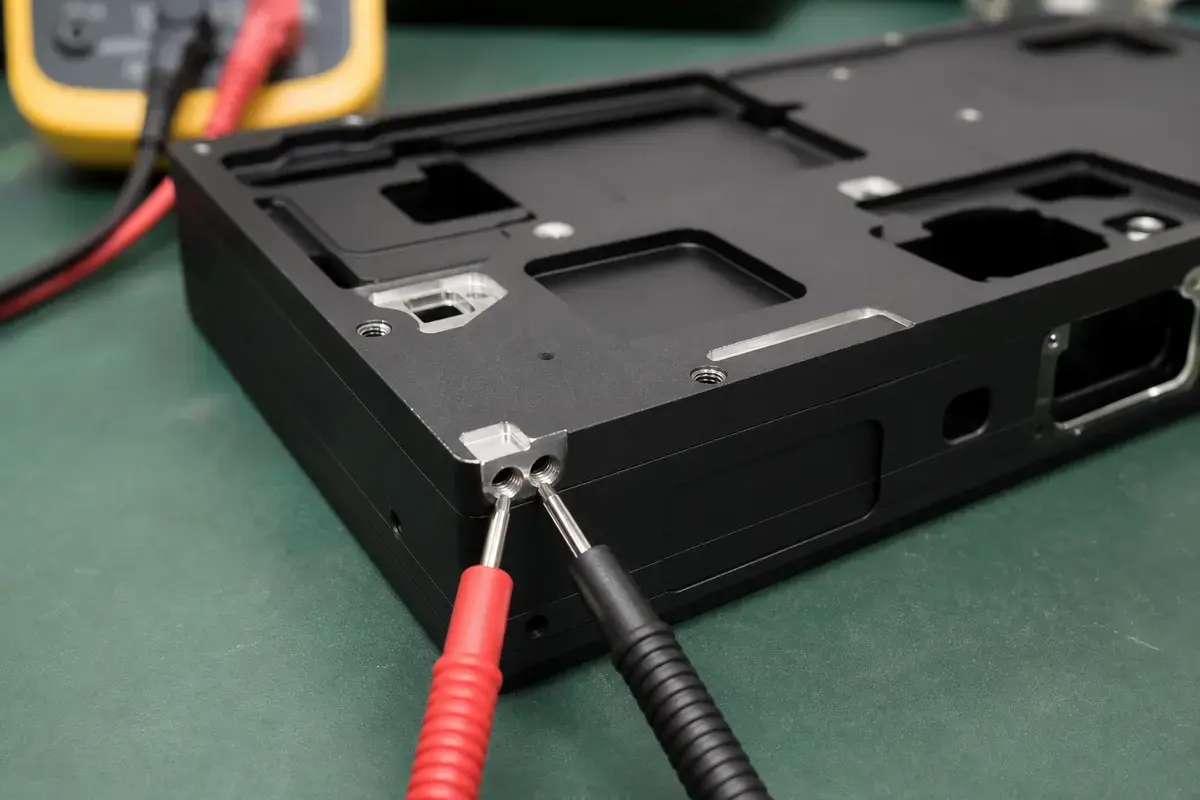
Bulk aluminum is electrically conductive; aluminum oxide is an electrical insulator. Anodizing deliberately thickens the naturally occurring oxide at the surface, so an anodized aluminum part may not provide reliable electrical contact through the coated area. Conductive interfaces normally require controlled bare-metal pads, masking, mechanical penetration, inserts, or post-finish machining designed into the part.
This distinction affects grounding, EMI bonding, sensors, threaded joints, heat sinks, battery hardware, and electronics enclosures.
Aluminum metal vs aluminum oxide
| Material or surface | Electrical behavior | CNC design implication |
|---|---|---|
| Bare aluminum alloy | Conductive | Protect contact surface from uncontrolled oxide and contamination |
| Natural oxide film | Thin and insulating | Contact resistance can vary with pressure and surface condition |
| Anodized surface | Deliberately thickened oxide; insulating | Do not assume a coated face is a dependable ground |
| Masked or post-machined pad | Exposed conductive aluminum | Control location, corrosion protection, and final dimensions |
| Conductive insert or plated contact | Depends on material and stack | Specify interface, installation, and compatibility |
AZoM describes alumina, Al2O3, as having high volume resistivity and dielectric strength, making it useful as an electrical insulator. The Aluminum Association separately notes aluminum’s major role in electrical transmission. Both statements can be true because the metal and its oxide layer behave differently.
What anodizing does to a CNC part
The Aluminum Anodizers Council describes anodizing as a controlled electrochemical process that thickens and toughens the naturally occurring protective oxide. The coating is integral with the metal rather than a paint film sitting only on top.
The process can improve wear, corrosion behavior, and appearance, but it changes functional interfaces. Depending on specification, process, alloy, and geometry, anodizing affects:
- Electrical contact and grounding.
- Hole and bore dimensions.
- Threads and insert fits.
- Surface texture and cosmetic consistency.
- Sealing and wear surfaces.
- Thermal contact resistance.
For finish options and RFQ requirements, see Huade’s aluminum anodizing service and broader aluminum CNC machining capability.
Design grounding pads before machining
A grounding pad should not be improvised after the enclosure is finished. Define its location, minimum area, flatness or roughness if relevant, masking boundary, corrosion protection, contact hardware, and inspection method.
Common approaches include:
- Masking the pad during anodizing.
- Machining the pad after anodizing.
- Using a conductive insert, stud, or plated interface.
- Designing serrated hardware to penetrate a controlled surface layer—only when validated for the assembly.
Each approach has trade-offs. A bare aluminum pad can oxidize or corrode. Post-finish machining adds handling and dimensional risk. Aggressive tooth washers can damage a cosmetic surface and produce variable contact. Inserts introduce material compatibility and installation requirements.
Threads, bores, and tight fits
Anodizing grows partly into and partly out from the original aluminum surface. The exact dimensional effect belongs to the specified coating system and anodizer’s process control. Threads can tighten, small bores can lose clearance, and press fits can change.
State whether dimensions apply before or after finish. Identify masked threads, bearing seats, gasket lands, electrical contacts, and datum surfaces. Do not solve coating buildup by applying a blanket loose tolerance to the entire part.
For critical fits, use a drawing-based tolerance stack and inspection plan. Huade’s tight-tolerance machining service explains how geometry, material, finish, and measurement must be considered together.
Can anodized aluminum still appear conductive?
Yes, measurements can be misleading. A probe may touch a scratch, pore, thin spot, cut edge, thread crest, fastener, or exposed pad instead of measuring through intact oxide. High test voltage can also produce a different result from a low-voltage grounding check.
Define the functional test: maximum contact resistance, dielectric withstand, continuity path, probe location, contact pressure, and environmental condition. “Conductive” or “nonconductive” without a method is not an acceptance criterion.
Aluminum oxide is not the same as aluminum metal
Searches for “is aluminum oxide conductive?” sometimes mix three materials: a thin native oxide film, an engineered anodic coating, and bulk alumina ceramic. Bulk alumina is widely used as an electrical insulator. Anodic coatings share the oxide chemistry but their porosity, thickness, sealing, defects, alloy substrate, and geometry influence real part behavior.
For thermal components, the electrical requirement may compete with corrosion and heat-transfer needs. Our guide to aluminum heat sinks and cold plates covers that system-level decision.
RFQ checklist for an anodized electrical part
Send the aluminum alloy and temper, anodizing type and governing specification, color, sealed/unsealed requirement, target thickness if controlled, masked zones, pre- or post-finish dimensions, grounding-pad details, threads and fits, cosmetic acceptance, and electrical test method.
Huade supports clear, black, and hard-anodized aluminum projects along with machining and inspection coordination. Final coating performance must be tied to the drawing and test requirement. Send your enclosure or conductive-interface design for DFM review.
Technical sources
- Aluminum Anodizers Council: Anodizing Design — anodic coating formation, process types, alloy, temper, and design considerations.
- Aluminum Anodizers Council: Anodizing Advantages — protective oxide and finish characteristics.
- The Aluminum Association: Electrical Applications — electrical uses and conductivity-to-weight context for aluminum metal.
- AZoM: Alumina—Aluminium Oxide — dielectric strength, volume resistivity, and alumina applications.