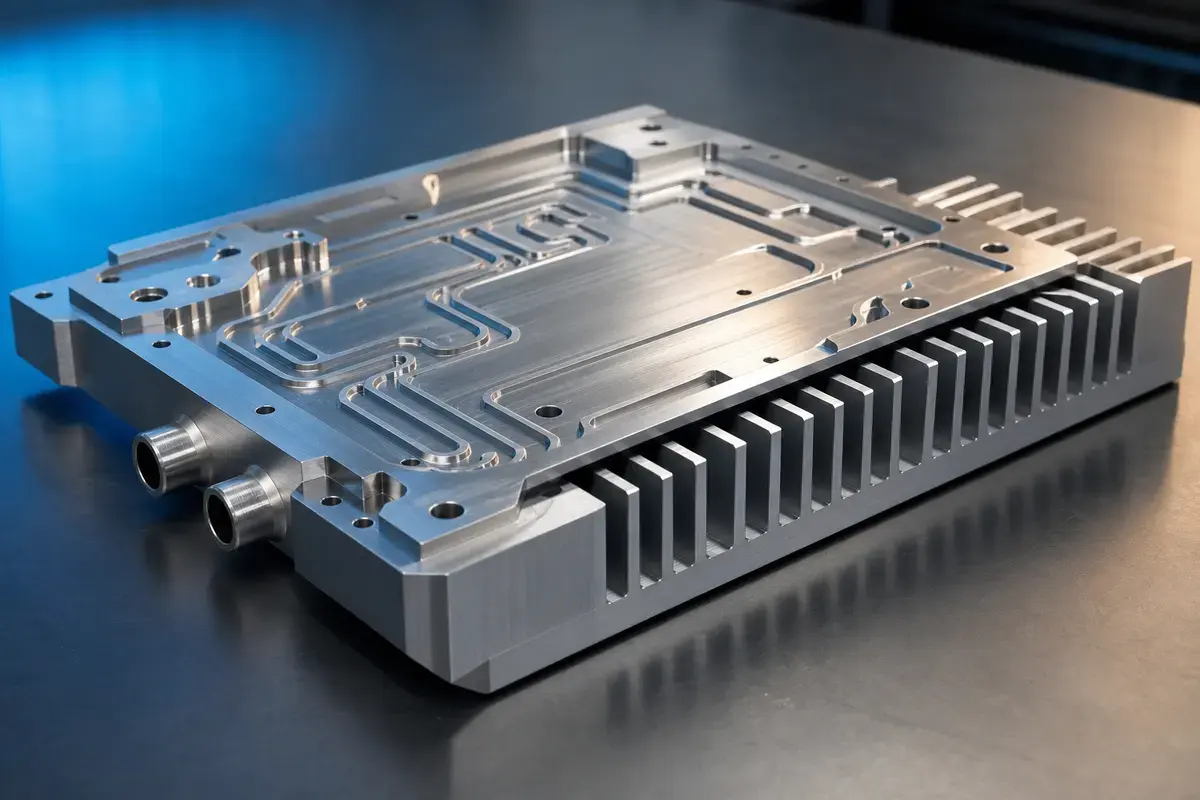
Yes. Aluminum conducts heat well, which is why it is widely used for heat sinks, cold plates, electronics housings, LED fixtures, battery components, and heat exchangers. But choosing aluminum does not guarantee good thermal performance. Alloy, section thickness, fin geometry, contact flatness, interface material, airflow or coolant, and surface finish determine how the complete thermal path behaves.
AZoM reports that aluminum’s thermal conductivity is roughly three times that of steel as a broad material comparison. Grade-specific design values should still come from a controlled material-data source at the actual operating temperature.
Thermal performance is a system
Heat travels from the source through several resistances:
- Component-to-interface contact.
- Thermal interface material.
- Aluminum base or spreader.
- Fins, channels, or enclosure walls.
- Air, coolant, or another heat sink.
A highly conductive aluminum base cannot compensate for a warped mounting face, trapped air, insufficient interface pressure, stagnant airflow, or poorly distributed channels. Engineers should model and test the assembly, not treat conductivity as the only input.
Alloy selection for CNC thermal parts
Pure aluminum conducts heat better than many strengthened alloys, but thermal parts also need stiffness, machinability, corrosion resistance, finish compatibility, and supply stability.
| Alloy | Why it is considered | Design caution |
|---|---|---|
| 6061 | Common, machinable, strong enough for many housings and cold plates | Use grade-specific conductivity and corrosion data |
| 6063 | Common in extruded heat-sink profiles and cosmetic products | Strength and available form may constrain design |
| 5052 | Useful corrosion resistance and forming behavior for sheet-metal thermal structures | Less common than 6061 for heavily milled blocks |
| 7075 | High strength for compact structural parts | Usually not selected primarily for thermal conductivity or corrosion |
If thermal performance and structure pull in different directions, a hybrid design may use an extruded or machined 6063/6061 thermal body with separate high-strength inserts or brackets. For general alloy trade-offs, see 6061 vs 7075 for CNC machining.
CNC design rules for heat sinks
Thin fins increase surface area but create machining and handling risks. Deep narrow channels need tool access and chip evacuation. Small internal corner radii require smaller tools and longer cycle time. A heat-sink design should balance thermal surface area with a stable manufacturing route.
Useful drawing controls include:
- Flatness of the component mounting face.
- Surface roughness where a thermal interface material contacts the part.
- Fin thickness, spacing, height, and permitted damage.
- Hole position and thread engagement for clamping pressure.
- Cosmetic zones and airflow direction.
Avoid specifying an extremely smooth surface without confirming that the thermal interface material benefits from it. Contact performance depends on both surfaces, pressure, and the selected pad, paste, or gap filler.
Huade supports aluminum plates, housings, heat sinks, and manifold-like parts through custom aluminum CNC machining and CNC milling. Published tolerance capability down to ±0.005 mm applies only where feature geometry, fixturing, thermal stability, and measurement method support it.
CNC design rules for cold plates
Liquid cold plates add sealing and pressure requirements. Channel layout, wall thickness, cover attachment, gasket grooves, ports, cleanliness, and leak testing become as important as bulk conductivity.
Identify:
- Coolant chemistry and operating temperature.
- Pressure, proof-test, and leak-rate requirements.
- Channel surface and cleanliness expectations.
- O-ring material, groove standard, and compression target.
- Port threads and fitting loads.
- Corrosion risks from mixed metals in the loop.
If stainless fittings contact an aluminum cold plate in a wet environment, review galvanic corrosion prevention before finalizing the stack.
Does anodizing reduce heat transfer?
Anodizing converts the surface into an aluminum-oxide layer. That layer is far less electrically conductive than the underlying metal and has different thermal properties. In many air-cooled heat sinks, dark anodizing can improve radiative behavior while the thin oxide adds little to the dominant convection path; at a precision contact interface, however, the coating can affect contact resistance and dimensions.
Mask or post-machine thermal contact faces only when the thermal, corrosion, electrical, and dimensional requirements justify it. Do not assume black color alone makes a heat sink effective. See does anodized aluminum conduct electricity? for the related electrical-contact issue.
RFQ checklist for a thermal part
Send the alloy, heat load and boundary conditions, model and controlled drawing, mounting-face flatness and roughness, interface material, airflow or coolant data, channel and leak requirements, finish and masking, cleanliness, quantity, and inspection plan.
Huade can review manufacturability and measurement access; thermal simulation and final performance validation remain the product owner’s responsibility. Submit the thermal-part drawing for DFM and quotation.
Technical sources
- The Aluminum Association: Electrical Applications — aluminum conductivity-to-weight and electrical application context.
- AZoM: Aluminium—Specifications, Properties, Classifications and Classes — thermal conductivity, density, strength, corrosion, and alloy overview.
- Aluminum Anodizers Council: Anodizing Design — anodic-layer and design considerations.