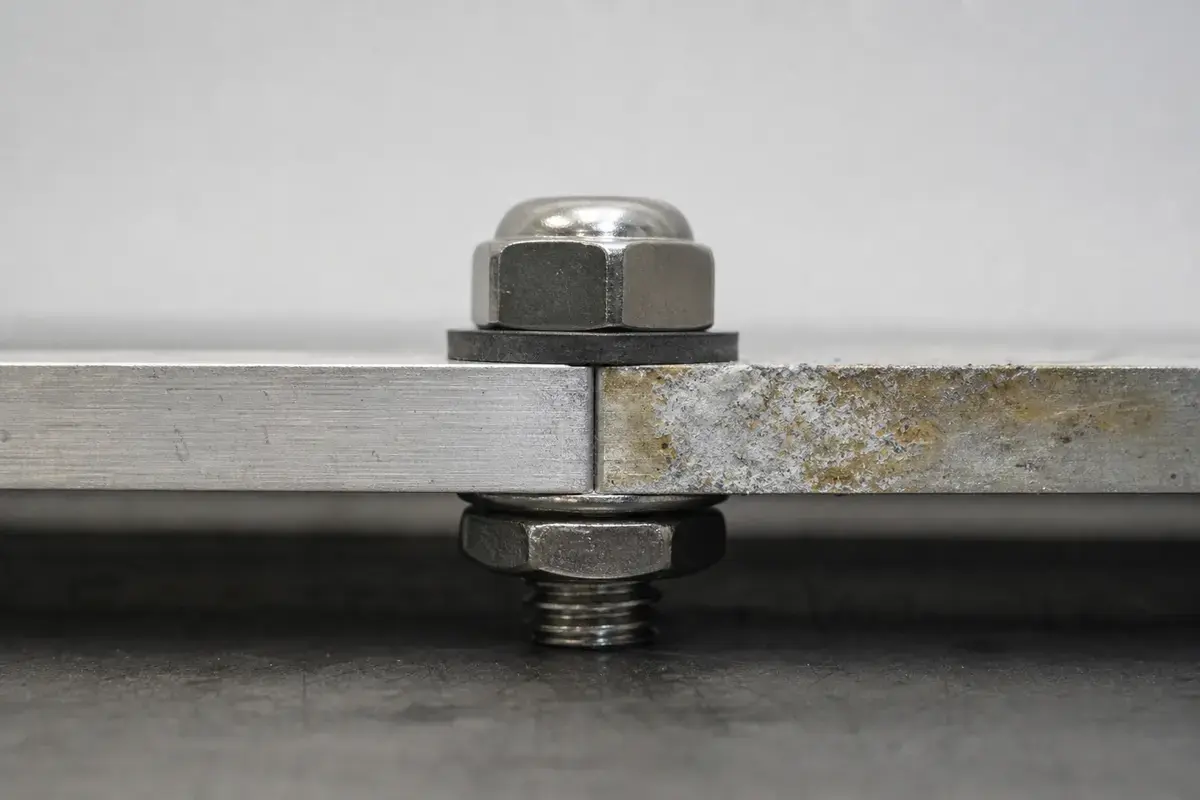
Prevent galvanic corrosion between aluminum and stainless steel by breaking at least one part of the corrosion circuit: keep the metals from direct electrical contact, keep electrolyte away from the joint, or redesign the material and area relationship. In practice, durable assemblies often combine isolation washers or sleeves, sealed interfaces, drainage, compatible finishes, and inspection access.
This is not a theoretical edge case. Stainless fasteners are frequently used with CNC aluminum housings, brackets, heat sinks, marine hardware, and outdoor equipment.
The three conditions galvanic corrosion needs
The Specialty Steel Industry of North America identifies three requirements:
- Metals with different corrosion potentials.
- Direct electrical contact between those metals.
- A conductive electrolyte, such as rain, condensation, saltwater, or process fluid, connecting them.
Remove any one condition and the galvanic cell cannot operate. The difficulty is keeping the protection intact through assembly, vibration, cleaning, scratches, and years of exposure.
Why aluminum is at risk beside stainless steel
In many common environments, passive stainless steel is more noble than aluminum. When they are electrically connected and wet, aluminum becomes the anodic member and can corrode faster near the joint. The exact rate depends on alloy, electrolyte, temperature, exposure cycle, surface films, geometry, and cathode-to-anode area ratio.
A small aluminum feature coupled to a large stainless surface can be particularly unfavorable because galvanic current is concentrated on the smaller anodic area. Do not assess fastener material without considering the areas of both metals exposed to the electrolyte.
Six practical design controls
1. Electrically isolate the joint
Use nonconductive washers, shoulder washers, sleeves, bushings, gaskets, or barrier films so the stainless fastener does not create direct metal-to-metal contact. Isolation must cover the shank, head, countersink, and any edge where coatings can be damaged during torqueing.
2. Keep moisture out—and let it escape
Sealants can exclude electrolyte, but trapped moisture can be worse than an open, drainable joint. Add drainage and ventilation where the assembly will see condensation, washdown, or temperature cycling. Avoid narrow crevices that retain salts.
3. Specify finishes as a system
Anodizing can improve the aluminum surface, while suitable coatings and sealants can add barriers. A coating that is scratched at one small point can concentrate attack there, especially when the opposing cathodic area remains large. Define masking, touch-up, edge coverage, and post-assembly damage limits.
Our aluminum anodizing service is relevant when an RFQ includes color, wear, corrosion, masking, or grounding requirements. The stainless passivation process addresses free-iron contamination on stainless; it does not electrically isolate the stainless from aluminum.
4. Control the area ratio
Avoid a small exposed aluminum anode connected to a large stainless cathode. If the material combination cannot change, reduce exposed cathodic area, improve aluminum protection, and keep electrolyte away from the couple.
5. Select fasteners and assembly details deliberately
Stainless fasteners may still be the correct choice for strength and general corrosion resistance. Design the isolation around them. Use sleeves or inserts where needed, prevent coating damage during installation, and define torque so the joint does not crush the barrier.
6. Design for inspection and maintenance
Outdoor, marine, energy, and washdown assemblies should permit visual inspection and replacement of seals or isolation hardware. A hidden joint with no drainage and no maintenance path creates avoidable lifecycle risk.
What to show on the drawing
A corrosion-sensitive drawing or assembly specification should state:
- Aluminum alloy and temper.
- Stainless grade and condition.
- Anodizing, passivation, coating, and sealing requirements.
- Isolation washer, sleeve, gasket, or insert material.
- Masked contact and grounding zones.
- Sealant type and application region.
- Drainage direction and prohibited fluid traps.
- Salt-fog or other validation requirements, when genuinely relevant.
Do not rely on a note that says only “prevent galvanic corrosion.” The manufacturer needs a buildable stack-up. If the interface includes machined counterbores, inserts, sealing grooves, or controlled datums, our aluminum CNC machining service and stainless steel CNC capability provide the two material routes.
Example: a sealed CNC aluminum enclosure
Consider a machined 6061 enclosure using stainless cover screws. A robust design may combine sealed anodizing, masked grounding pads only where intentionally required, nonconductive isolation under fastener heads, a gasket outside the fastener pattern, and drainage that prevents condensation from sitting around the joint.
The actual stack depends on ingress protection, EMI grounding, torque, temperature, and service chemistry. Grounding and galvanic isolation can conflict, so the electrical and mechanical requirements must be reviewed together. Our IP67 extruded aluminum enclosure case study shows how sealing grooves, cable interfaces, and machining controls fit into a real enclosure program.
Frequently asked questions
Will anodizing alone stop galvanic corrosion?
Anodizing can provide a useful barrier, but it should not be treated as an indestructible electrical isolator. Fastener installation, scratches, cut edges, masked zones, and wear can expose conductive paths. Use a system-level design.
Can stainless steel screws be used in aluminum?
Yes, and they commonly are. Evaluate moisture, salt, isolation, finish damage, and area ratio. Dry indoor equipment has a different risk from marine or outdoor assemblies.
Does passivation protect the aluminum?
No. Passivation supports the stainless surface by removing free iron contamination. It does not coat the aluminum or interrupt electrical contact between the metals.
For a mixed-metal assembly, submit the assembly drawing, environment, finishes, and fastener stack for DFM review.
Technical sources
- Specialty Steel Industry of North America: Galvanic Corrosion — three required conditions, galvanic series, isolation, and area-ratio principles.
- IMOA, Nickel Institute, and ICDA: Practical Guidelines for the Fabrication of Austenitic Stainless Steels — galvanic corrosion and mechanical-joint considerations.
- Aluminum Anodizers Council: Anodizing Design — design and process context for anodic finishes.