Robotics in manufacturing is no longer limited to automotive welding cells. Articulated robots, SCARA systems, delta robots, gantries and collaborative robots now support assembly, machine tending, inspection, packaging and material handling. Their performance depends on more than the controller: robot joints, shafts, housings, brackets and end-of-arm tooling (EOAT) must hold alignment through repeated motion.
This guide explains the main robotics manufacturing applications and the CNC part requirements that engineers should define in a drawing or RFQ.
What Is Robotics in Manufacturing?
Robotics in manufacturing means using programmable robots and supporting equipment to perform repeatable production tasks. A complete cell usually includes the robot, controller, tooling, sensors, safety equipment, fixtures and the parts that connect everything together.
The mechanical interfaces are critical. A small error in a mounting face, bearing seat or gripper jaw can become vibration, poor repeatability or inconsistent part handling after thousands of cycles.
Types of Manufacturing Robots
Industrial robots are not a one-size-fits-all solution. Each category has unique strengths and is suited to specific production needs:
- Articulated Robots
The most common type, articulated robots feature rotating joints that mimic a human arm. They excel in welding, painting, and machine tending. - SCARA Robots
Known for their selective compliance, SCARA robots provide fast and precise horizontal movement, ideal for electronics assembly and pick-and-place tasks. - Delta Robots
Lightweight and incredibly quick, delta robots are popular in food packaging and high-speed sorting. - Cartesian (Gantry) Robots
These robots move along three linear axes (X, Y, Z) and offer exceptional accuracy, making them perfect for CNC machining and additive manufacturing support. - Collaborative Robots (Cobots)
A rapidly growing category, collaborative robots in manufacturing are designed to safely share workspaces with humans. Built-in sensors and force feedback let them stop or adjust when encountering obstacles, opening new possibilities for flexible production.
The right choice depends on payload, reach, cycle time, required repeatability and the end effector. These choices also determine the stiffness, material and inspection requirements of the machined components.
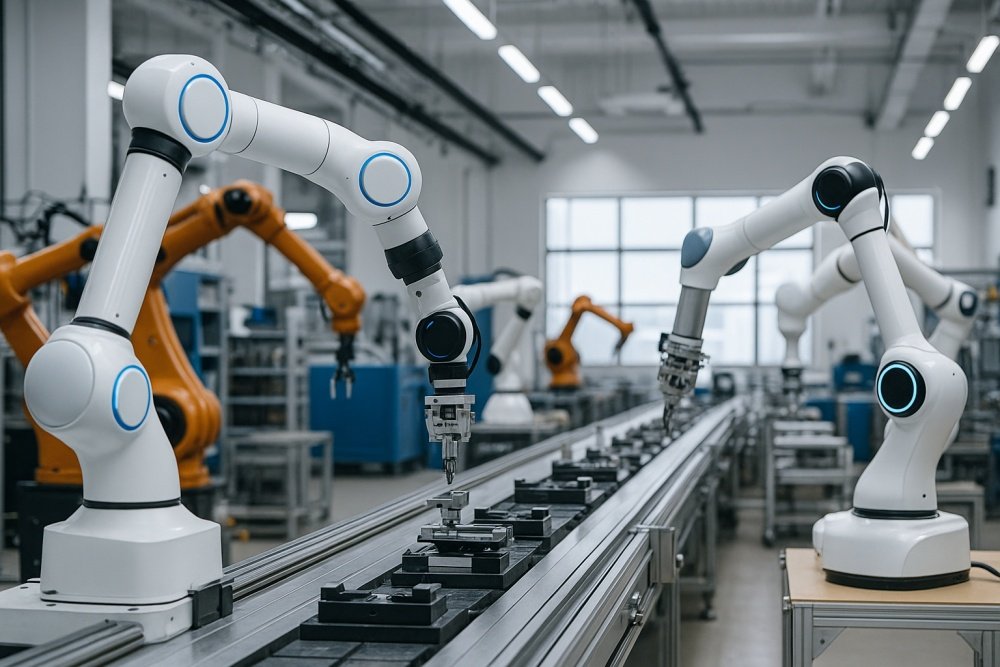
Collaborative Robots: A Manufacturing Game-Changer
Collaborative robots are designed for applications with controlled human interaction, but their safe use still depends on the complete cell, tool and risk assessment. Their compact joints and interchangeable tooling make mounting-interface accuracy, cable routing and repeatable fastening especially important.
Key benefits of cobots include:
- Ease of Deployment – Simple programming and lightweight design enable quick installation and redeployment.
- Flexibility – Cobots can switch between tasks like packaging, quality inspection, and machine loading within minutes.
- Improved Safety – Force-limiting sensors reduce risk of injury, making them ideal for small and mid-sized factories.
For gripper jaws, adapter plates and sensor-ready structures, see our industrial robot parts guide and robot-parts DFM checklist.
Robotic Arms for Manufacturing
The articulated arm remains the workhorse of industrial automation. Its mechanical parts must maintain alignment under repeated motion, payload and acceleration. For machined components, specify functional datums, bearing or shaft fits, thread requirements, finish restrictions and the inspection evidence that validates them.
Recent innovations include:
- Integrated vision and sensors require stable mounting and protected cable paths.
- Modular end effectors need repeatable locating surfaces and controlled fastener interfaces.
- High-cycle joints need realistic requirements for runout, concentricity, wear and surface finish.
These advances make robotic arms indispensable for industries ranging from automotive to aerospace.
Advanced Robotics Driving Smart Factories
Smart-factory systems add sensors, vision and data collection to the production cell. That makes part repeatability more visible: a small error in a shaft, locating face or gripper jaw can surface as vibration, inconsistent sensing or lost positioning accuracy. A clear inspection plan prevents the drawing from asking for unnecessary precision everywhere.
Challenges and Considerations
While the benefits of advanced robotics are clear, successful adoption requires careful planning:
- Interface definition — identify datums, mounting holes, cable passages and clearance zones.
- Material and finish selection — balance stiffness, mass, wear and corrosion protection.
- Inspection planning — measure the features that affect alignment, motion and assembly.
These factors highlight the importance of strong partnerships with technology providers and component manufacturers.
How to Prepare an RFQ for Robot Components
Send the supplier a STEP, IGES or native CAD file, a dimensioned drawing, material, heat treatment, finish, prototype and production quantities, critical datums, fits, inspection reports and delivery target. For production support, review our robotics and automation CNC machining capabilities and request a quote.
Frequently Asked Questions
What are the most common industrial robot components?
Joint housings, shafts, bearing carriers, adapter plates, gripper jaws, sensor brackets, covers and locating fixtures are common CNC-machined components.
Which material is best for robot parts?
There is no universal best material. Aluminum is often selected for low mass, while stainless, alloy steel or engineering plastics may be better for wear, stiffness, corrosion or friction requirements.
What should be inspected on a robot joint part?
Inspect bearing seats, datums, hole position, shaft runout, concentricity and surface finish that affects motion or sealing. The drawing should identify these functional features.
Conclusion: Preparing for a Robotic Future
Advanced robotics succeeds when the mechanical interfaces are designed for the real motion, payload and inspection constraints. For production support, review our robotics and automation machining capabilities and send the interface drawing, material, quantity, finish and critical inspection requirements with the RFQ.