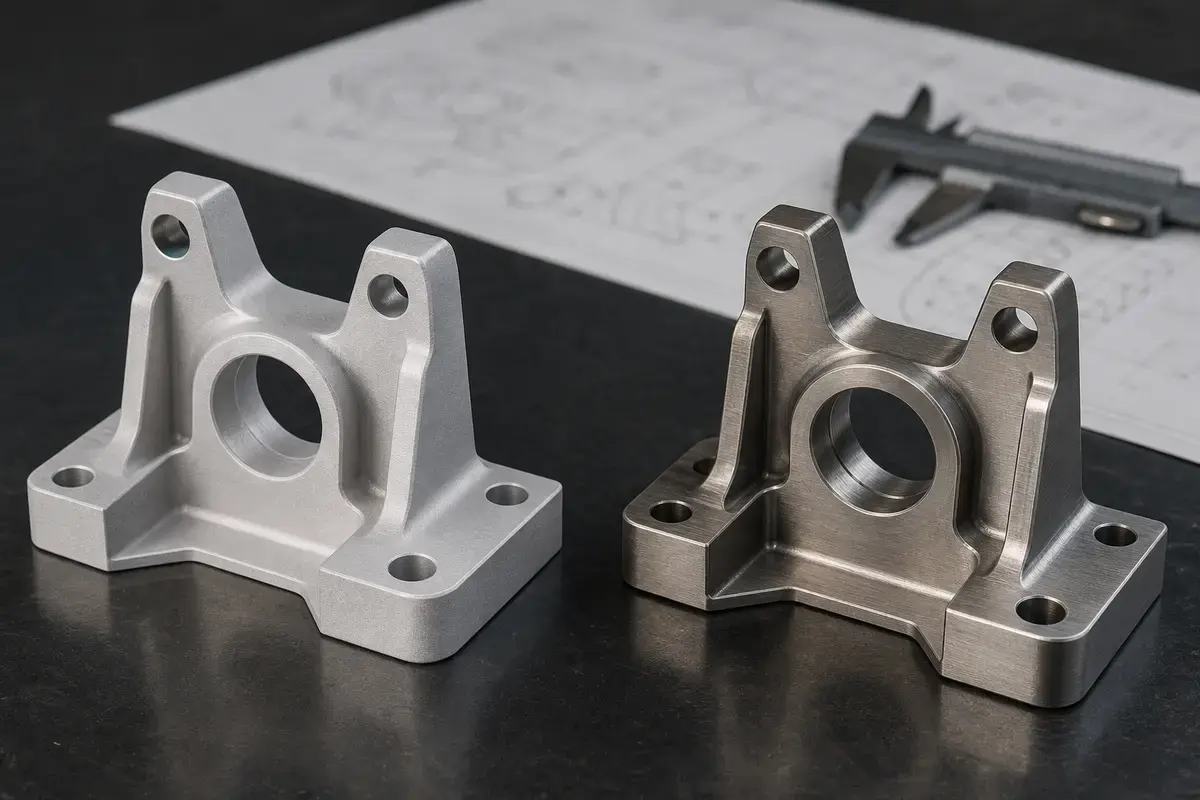
Choose aluminum when low mass, heat transfer, fast machining, and anodized appearance dominate. Choose stainless steel when stiffness, wear resistance, temperature capability, or corrosion performance in a demanding environment matters more than weight. Neither material is universally better, and comparing only raw material price usually leads to the wrong decision.
For CNC parts, the useful comparison includes alloy, geometry, finish, tolerances, production volume, and service environment.
Side-by-side engineering comparison
| Decision factor | Aluminum alloys | Stainless steels |
|---|---|---|
| Density | About one-third of steel | Roughly three times aluminum |
| Elastic modulus | Lower; deflects more at the same geometry and load | Higher; stiffer at the same geometry |
| Machining time | Usually faster | Usually slower with higher tool load |
| Thermal conductivity | High | Much lower than common aluminum alloys |
| General corrosion behavior | Protective oxide; alloy and environment matter | Chromium-rich passive film; grade and chlorides matter |
| Cosmetic options | Anodizing, bead blast, painting, plating routes | Brushing, polishing, passivation, electropolishing |
| Typical CNC grades | 6061, 7075, 5052, 6063, 2024 | 303, 304, 316/316L, 17-4 PH |
| Good fit | Housings, heat sinks, UAV parts, lightweight brackets | Shafts, washdown parts, medical/process hardware, wear-loaded components |
AZoM summarizes aluminum density as roughly one-third that of steel and notes that aluminum has substantially higher thermal conductivity. Those broad properties explain many applications, but final selection must use grade-specific data and the actual design condition.
Weight is not the same as stiffness
Replacing a stainless part with the same geometry in aluminum can reduce mass dramatically, but it also reduces stiffness. The aluminum version may need thicker walls, deeper ribs, or a larger section. That redesign can still be much lighter, but a direct one-for-one substitution is not always valid.
Strength is also grade- and condition-dependent. 7075-T6 has much higher strength than 6061-T6, while 17-4 PH strength depends strongly on heat-treatment condition. Yield strength alone does not capture fatigue, notch sensitivity, bearing stress, galling, temperature, or corrosion.
For aluminum alloy selection, start with our 6061 vs 7075 CNC comparison. For common austenitic grades, review 304 vs 316 stainless steel.
Machinability and total cost
Aluminum generally permits higher material-removal rates and produces lower cutting forces. Stainless steel conducts heat away from the cutting zone less effectively and many grades work-harden, so tools, feeds, coolant, and engagement need more control. On identical geometry, stainless machining often costs more even before finishing.
However, the lowest machining quote is not always the lowest system cost. A stainless part may remove the need for a protective coating, increase thread durability, or survive washdown and high temperatures. An aluminum design may reduce shipping mass, machine time, and moving inertia. The right comparison is finished-part cost over the required service life.
Corrosion and mixed-metal assemblies
Aluminum forms a protective oxide, and stainless steel relies on a chromium-enriched passive film. Neither is immune to corrosion. Chlorides, crevices, trapped moisture, cleaners, temperature, and finish damage all influence performance.
When aluminum and stainless steel touch in the presence of an electrolyte, galvanic corrosion can accelerate attack of the more active aluminum. Electrical isolation, drainage, coatings, sealants, and area-ratio control may be needed. See our detailed guide to preventing galvanic corrosion between aluminum and stainless steel.
Surface finish and functional interfaces
Anodizing can improve wear and corrosion behavior and provide consistent color families on aluminum, but appearance varies with alloy, temper, surface preparation, and batch. Stainless can be passivated, brushed, polished, or electropolished depending on function and geometry.
Finish must be included in the tolerance stack. Mask grounding pads, bearing seats, and thread interfaces when required. Define cosmetic zones with an approved sample or measurable standard rather than adjectives such as “perfect” or “premium.” Our surface finishing services page shows the available process categories.
Choose by application
- Electronics enclosure or heat sink: aluminum is often the first candidate because mass, machining, and heat spreading align.
- Washdown manifold or fluid hardware: 316/316L may be appropriate after checking the actual fluid, chloride level, temperature, and cleaning cycle.
- Robot arm or UAV bracket: 6061 or 7075 can reduce moving mass; validate stiffness and fatigue.
- High-strength shaft or fixture component: 17-4 PH or another steel may better control stiffness, wear, and thread life.
- Cosmetic control panel: aluminum offers anodized options; stainless offers brushed or polished surfaces.
Huade’s custom aluminum machining service covers lightweight milled and turned components, while our stainless steel machining service covers corrosion-resistant and higher-load parts. Linking to both is appropriate only after the functional comparison, because material choice should precede the RFQ.
RFQ checklist
Provide the service environment, load and stiffness needs, maximum mass, operating temperature, mating materials, critical dimensions, finish, inspection needs, and annual quantity. If substitutions are allowed, state which property limits cannot change.
For a drawing-based recommendation, send both the model and the functional requirements. Huade can review machining, finishing, and inspection implications; final material approval remains an engineering decision for the product owner.
Technical sources
- The Aluminum Association: The Aluminum Advantage — aluminum performance and application context.
- AZoM: Aluminium—Specifications, Properties, Classifications and Classes — density, strength, corrosion, thermal, and processing overview.
- IMOA, Nickel Institute, and ICDA: Practical Guidelines for the Fabrication of Austenitic Stainless Steels — stainless microstructure, fabrication, machining, and corrosion.