Gimbal bracket CNC machining is a high-intent topic because buyers are usually not looking for a generic drone accessory. They are solving a payload mounting problem: camera stability, sensor alignment, vibration isolation, weight reduction, or a custom interface that standard brackets cannot provide.
For industrial UAVs, a gimbal bracket sits between the aircraft structure and the payload system. If it is too flexible, too heavy, poorly aligned, or difficult to assemble, the issue can show up as blurred imagery, unstable sensor data, or repeated field adjustment.
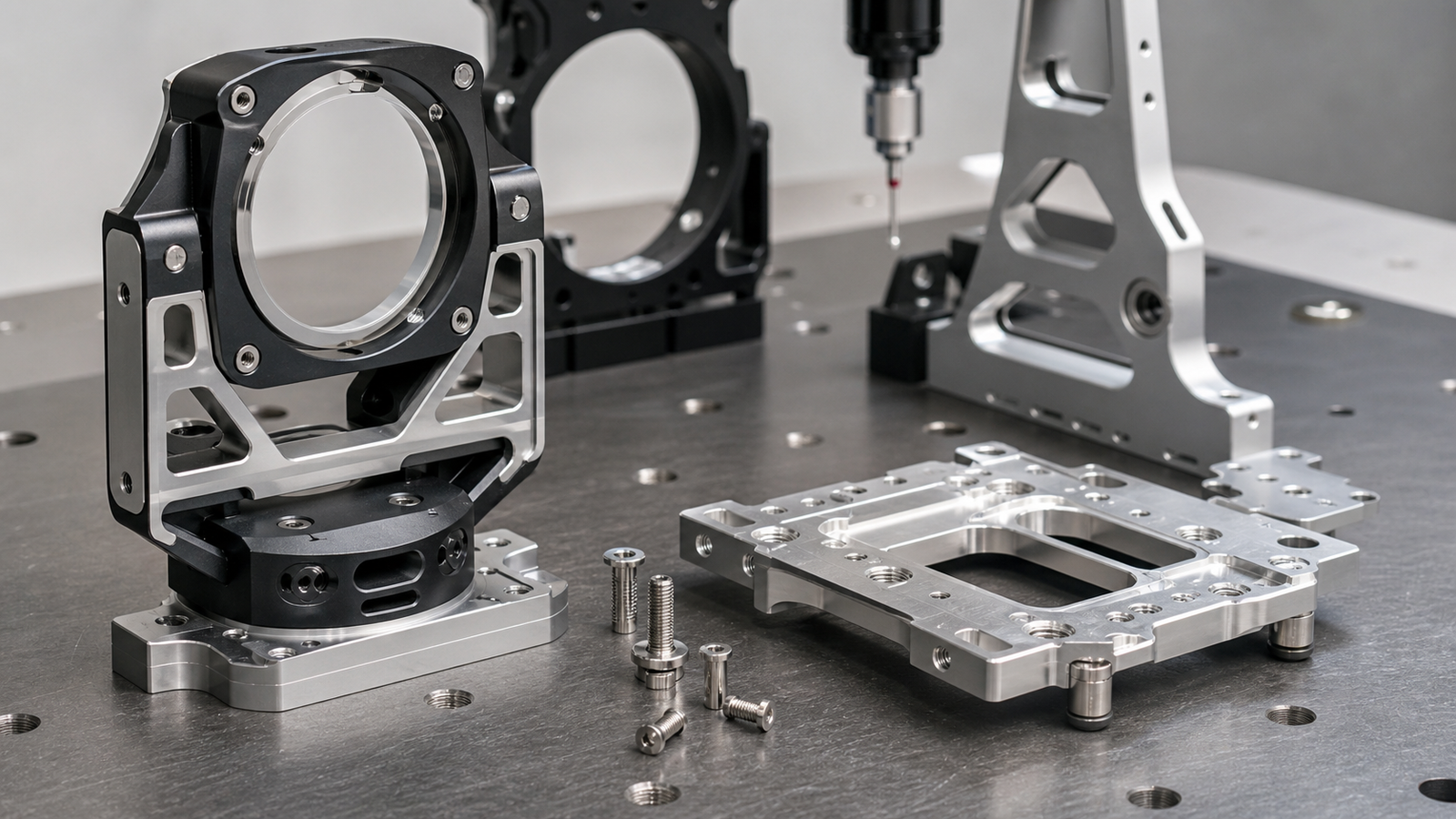
What Is a CNC Machined Gimbal Bracket?
A CNC machined gimbal bracket is a custom metal part used to locate and support camera modules, inspection sensors, LiDAR units, thermal imagers, or other UAV payload hardware. It may connect the payload to the center frame, damping plate, landing structure, or a dedicated equipment bay.
Typical forms include:
- camera mounting brackets
- payload adapter plates
- gimbal side frames
- sensor mounting bridges
- anti-vibration support blocks
- anodized aluminum interface plates
Unlike many off-the-shelf mounts, a machined bracket can be designed around the exact camera, sensor, cable route, fastener pattern, and weight limit of the UAV platform.
Why CNC Machining Matters for Gimbal Brackets
Gimbal and payload brackets often combine thin walls, lightening pockets, precision holes, cosmetic surfaces, and assembly datums. CNC machining gives engineers control over those features while keeping the design flexible during prototyping.
The main benefits are:
- accurate hole spacing for payload alignment
- flat mating surfaces for stable sensor mounting
- weight reduction through controlled pocketing
- repeatable geometry across low-volume batches
- clean edges around cable passages and service areas
- anodized or bead-blasted surfaces for corrosion and wear resistance
For camera and sensor systems, small alignment errors can matter. A bracket that is visually acceptable may still create angular misalignment if its mating surfaces are not controlled.
Material Selection for UAV Gimbal Brackets
Aluminum is the most common material for CNC machined UAV gimbal brackets because it balances weight, strength, surface finish, and cost.
6061-T6 Aluminum
6061-T6 is a strong default choice for camera brackets, payload adapters, and general UAV mounting structures. It machines efficiently and works well with anodizing.
7075-T6 Aluminum
7075-T6 is useful when the bracket must be more rigid in a smaller envelope. It is often considered for high-load payload mounts, compact gimbal side frames, or brackets exposed to repeated vibration.
Stainless Steel Hardware
Stainless steel may be used for threaded inserts, small shafts, pins, or wear-prone features. In many UAV brackets it is used locally rather than as the full bracket material because weight remains critical.
Design Factors That Affect Payload Performance
Flatness and Parallelism
Flat surfaces help the payload mount consistently. If a gimbal bracket has uneven mating faces, the camera or sensor may require manual correction after assembly.
Hole Pattern Accuracy
Camera and payload systems often use compact bolt patterns. Hole position should be controlled where the bracket locates the payload, damping system, or aircraft frame.
Vibration Path
A gimbal bracket should not amplify vibration from the airframe into the camera. Geometry, wall thickness, fastener spacing, and damping interfaces should be reviewed together.
Cable Clearance
Payload brackets often sit near signal cables, antennas, and power leads. Slots, radii, and deburred edges can prevent cable abrasion during vibration and service.
Weight Distribution
Every gram near the payload affects aircraft balance. CNC pocketing can remove weight, but material should remain around screw bosses, corner transitions, and high-stress interfaces.
Anodizing and Surface Finish Planning
Many UAV gimbal brackets are anodized after machining. Black anodizing is common for camera-related hardware because it reduces visible reflection. Clear anodizing is useful when a neutral aluminum appearance is preferred.
Surface finish planning should consider:
- whether threaded holes need masking
- whether bearing or alignment holes require post-finish control
- whether cosmetic faces need bead blasting
- whether sharp edges near cables need extra deburring
- whether serialized marking or laser engraving is required
If the bracket has close-fitting holes, the effect of anodizing thickness should be discussed before production.
Prototype vs Low-Volume Production
During prototype work, the priority is usually fast iteration and fit validation. During low-volume production, the priority shifts toward repeatability, inspection, and stable finishing.
For prototype gimbal bracket CNC machining, buyers should share:
- the payload model or envelope
- expected load direction
- available mounting space
- target weight
- cable route and connector clearance
- finish preference
For production batches, the drawing should define inspection points and cosmetic requirements more clearly.
RFQ Checklist for Gimbal Bracket CNC Machining
To get a useful quote, prepare:
- STEP or X_T files
- 2D drawing for critical holes and mating faces
- material, such as 6061-T6 or 7075-T6 aluminum
- quantity and expected repeat order volume
- finish, color, and masking notes
- payload mass and mounting orientation
- marked datum surfaces
- required inserts, fasteners, or assembly tests
This prevents the bracket from being quoted as a simple plate when it is actually a payload-critical UAV interface.
Internal Links for UAV Buyers
If your project also includes arm connectors, center plates, or motor-side hardware, review our guide to drone arm CNC mounts and the broader page for CNC UAV drone parts.
For related background, see CNC machined drone components and CNC machined structural drone parts.
FAQ: Gimbal Bracket CNC Machining
What material is best for CNC machined UAV gimbal brackets?
6061-T6 aluminum is practical for many payload brackets. 7075-T6 is better when higher stiffness or strength is needed in a compact design.
Can a gimbal bracket be black anodized?
Yes. Black anodizing is common for camera and payload hardware because it reduces reflection and improves corrosion resistance.
What features should be marked on the drawing?
Mark payload-locating holes, mating faces, datums, flatness requirements, finish-sensitive holes, cable-clearance edges, and any threaded insert locations.
Is CNC machining suitable for low-volume UAV payload brackets?
Yes. CNC machining is well suited for prototypes and low-volume batches because it allows design changes without dedicated tooling.
CNC Machined Gimbal Brackets from HDProto
HDProto manufactures aluminum UAV gimbal brackets, payload mounts, camera brackets, sensor adapter plates, and related custom UAV machined parts. Send your CAD files, drawings, material requirements, finish notes, and target quantity for an engineering review and CNC quotation.