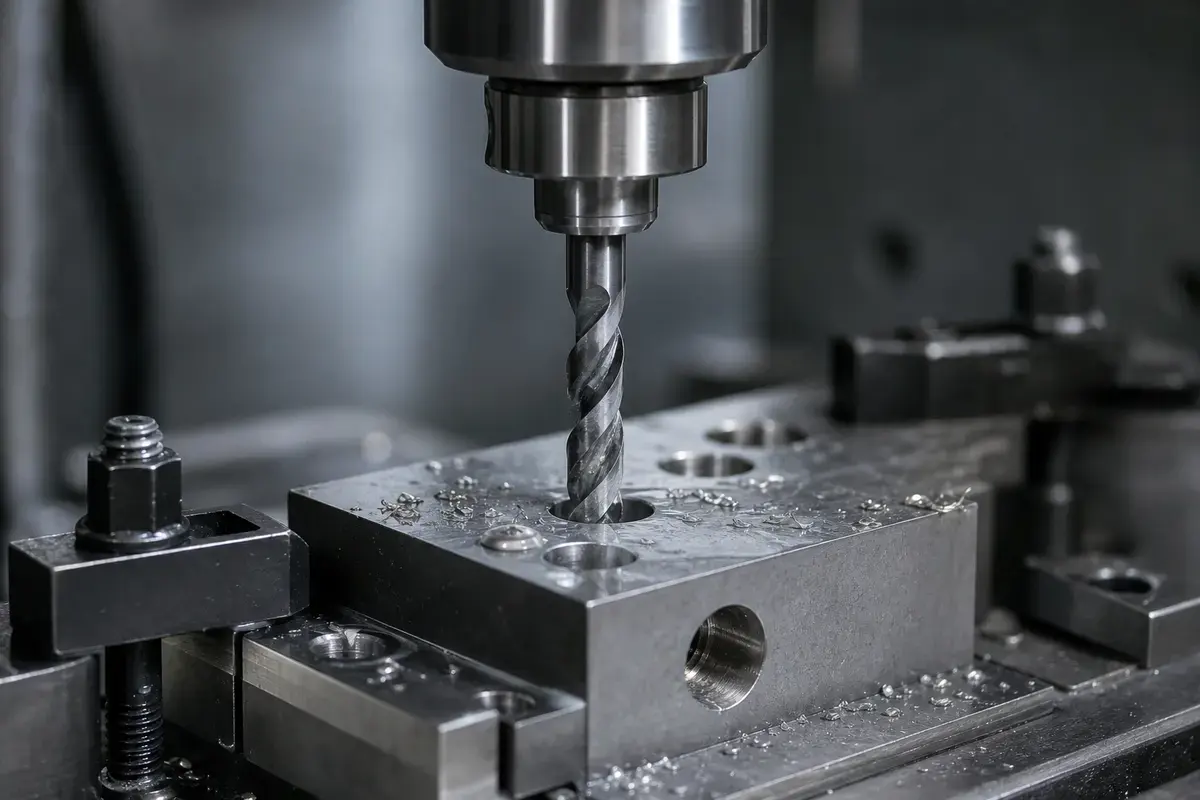
To drill stainless steel without work hardening, the cutting edge must keep shearing material instead of rubbing it. That requires a sharp tool, rigid setup, positive feed, suitable cutting speed, and enough coolant to control heat and evacuate chips. Dwelling at the bottom of the hole or repeatedly pecking with too little feed can harden the surface ahead of the drill.
Work hardening is especially relevant in austenitic grades such as 304 and 316. These grades are ductile and corrosion resistant, but deformation at the cutting zone can raise local hardness. The next tool engagement then meets a harder surface, increasing heat and wear.
Why stainless steel drilling fails
The most common failure pattern is not simply “stainless is hard.” It is a system problem involving the material, tool, holder, fixture, program, coolant, and hole design.
| Symptom | Likely cause | Process response |
|---|---|---|
| Blue or burned chips | Excessive heat or poor coolant delivery | Reduce heat generation and improve coolant access |
| Rapid corner wear | Rubbing, runout, or unsuitable geometry | Check toolholding and restore a positive cut |
| Oversize or tapered hole | Deflection, runout, or unstable entry | Improve setup and consider spot drilling |
| Drill stops penetrating | Work-hardened layer or damaged edge | Do not force a dull tool; review the full cycle |
| Burr-heavy exit | Poor support or worn cutting edge | Support the exit and plan deburring |
The 2020 fabrication guide co-published by the International Molybdenum Association, Nickel Institute, and ICDA includes dedicated guidance for machining and twist drilling austenitic stainless steels. Its broader lesson is consistent: rigid equipment, sharp tooling, steady cutting, and adequate lubrication are central to reliable machining.
Tool and program choices
Carbide drills are common in CNC production because they support higher productivity and consistent geometry when the machine and setup are rigid. Cobalt high-speed-steel drills can be useful for lower-speed work, repair, or less rigid situations. Tool material alone does not fix a poor process.
A production drilling cycle should consider:
- Drill diameter and length-to-diameter ratio.
- Through hole, blind hole, or intersecting hole.
- Coolant delivery and chip evacuation.
- Entry angle and exit support.
- Required size, cylindricity, and surface finish.
- Whether the final feature needs reaming, boring, thread milling, or tapping.
Blind holes need enough depth allowance for the drill point and chip space. Deep holes may require through-tool coolant or a deliberate peck strategy, but unnecessary retracts can waste time and permit heat to build at repeated contact points.
Grade selection still matters
Free-machining 303 often cuts more easily than 304 or 316, but its sulfur addition changes corrosion and fabrication behavior. Grade 304 is a general-purpose choice, while 316/316L is often selected for chloride-bearing or demanding process environments. The material decision should be based on service conditions before optimizing the drilling cycle.
If corrosion exposure is the question, use our 304 vs 316 stainless steel guide. If the grade is already fixed and the part has bores, cross-holes, threads, or sealing faces, review our stainless steel CNC machining capability.
Design holes for inspection and assembly
A drawing should distinguish a normal clearance hole from a precision bore. Diameter tolerance alone may not control function: position, perpendicularity, true position relative to datums, surface finish, thread class, and edge condition can matter more.
For close fits, drilling may be only the roughing operation. Reaming can improve size and finish in suitable holes. Boring can control a critical bore from a known setup. Thread milling may be preferable for some large or valuable threaded features because tool engagement and recovery differ from conventional tapping.
Huade’s published capabilities include milling and turning, CMM inspection, and feature tolerances down to ±0.005 mm where the geometry, material, process, datum plan, and measurement method support them. Do not apply that tolerance to every drilled hole by default. Our tight-tolerance CNC machining page explains why tolerance must be tied to function and inspection.
RFQ checklist for stainless holes
Include the exact grade and condition, hole depth, through/blind status, thread standard, positional tolerance, datum references, finish requirement, and whether burrs are allowed at intersecting passages. Identify sealing holes and fluid passages explicitly.
For passivated parts, state the desired specification and any masking or cleanliness requirements. Passivation removes free iron contamination and supports the stainless surface condition; it does not repair a damaged bore or replace correct alloy selection. See our stainless steel passivation service for finishing scope.
Frequently asked questions
What speed should I use to drill stainless steel?
There is no safe universal RPM. Cutting speed depends on grade, drill material and coating, diameter, rigidity, coolant, and toolmaker data. Start from the tool manufacturer’s recommendation and validate chip form, wear, heat, and hole quality in the actual setup.
Should I push harder if the drill stops cutting?
No. A drill that is rubbing or damaged can create a work-hardened surface and then fail catastrophically. Stop, inspect the tool and setup, and correct the cause before continuing.
Can 316 stainless steel be drilled accurately?
Yes. Accurate 316 holes are routine with suitable machines, tooling, fixtures, coolant, and process control. Deep, tiny, intersecting, or very tight-tolerance holes need more planning than ordinary clearance holes.
If you have a stainless part with critical holes or threads, submit the model and drawing for DFM review.
Technical sources
- IMOA, Nickel Institute, and ICDA: Practical Guidelines for the Fabrication of Austenitic Stainless Steels, 2nd ed. — machining, drilling, metallurgy, and fabrication guidance.
- British Stainless Steel Association: Magnetic Properties of Austenitic Stainless Steels — background on austenitic structure and cold work.