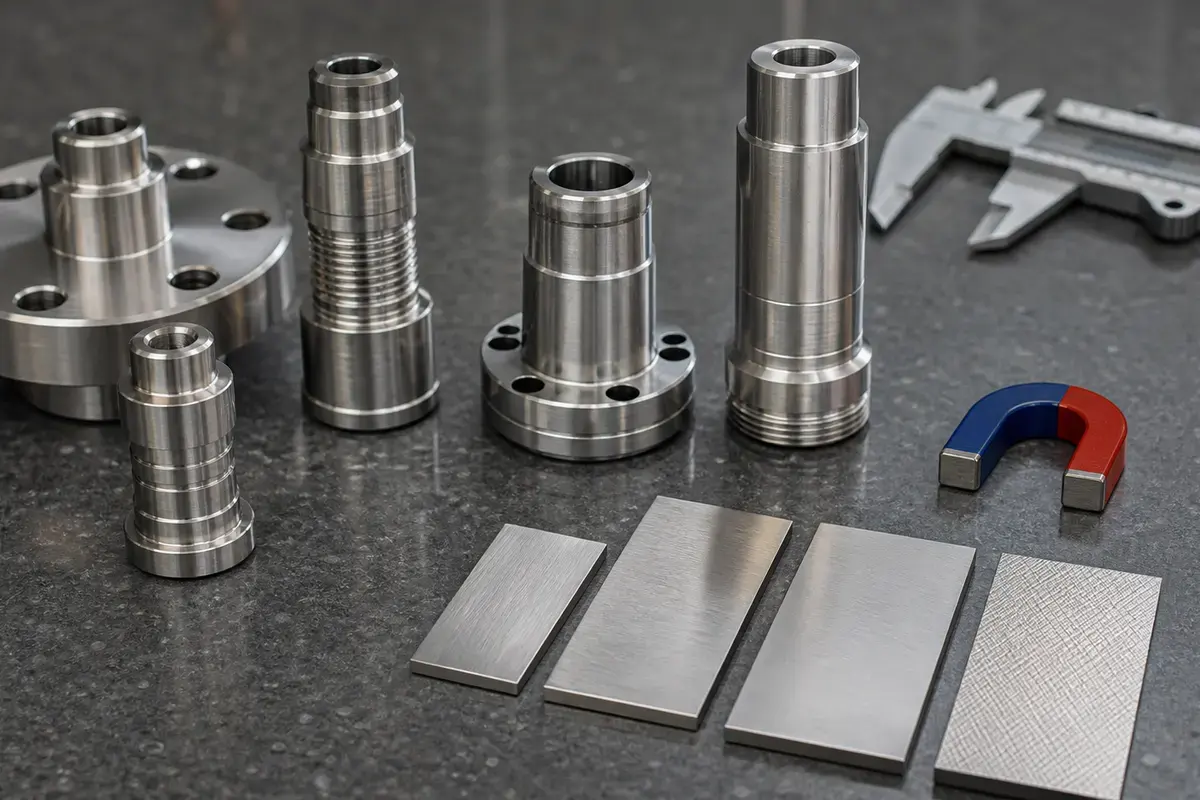
Some stainless steels are strongly magnetic and others are weakly magnetic or nearly non-magnetic. The answer depends primarily on crystal structure, not on whether the material is “real stainless.” Ferritic, martensitic, duplex, and many precipitation-hardening grades attract a magnet. Fully austenitic stainless steels are generally non-magnetic, but cold work and processing can create a measurable response.
That is why a simple magnet test is useful for screening, but not reliable enough to certify grade or performance.
Common grades at a glance
| Grade or family | Typical magnetic response | CNC design context |
|---|---|---|
| 303 | Usually low in annealed condition; processing can change response | Improved machinability, general precision parts |
| 304 / 304L | Usually low; cold work may increase attraction | General industrial, food-equipment, and housing parts |
| 316 / 316L | Usually low; not guaranteed magnet-free | Chloride-exposed, medical/lab, and process components |
| 430 | Magnetic | Ferritic sheet and corrosion-resistant components |
| 410 / 416 | Magnetic | Martensitic family; strength, wear, shafts, and hardware |
| 17-4 PH | Magnetic | High-strength precision parts and aerospace/industrial hardware |
| Duplex stainless | Magnetic | Strength and chloride stress-corrosion resistance |
The fabrication guide from IMOA, Nickel Institute, and ICDA explains that austenitic grades tend to be non-magnetic, ferritic grades are ferromagnetic, and duplex grades show attraction in proportion to their ferrite content. It also notes that standard wrought austenitic grades can contain small amounts of ferrite.
Why can 304 or 316 become magnetic?
Austenite has a face-centered cubic structure and is normally associated with low magnetic permeability. Cold deformation can transform some metastable austenite into martensite, increasing magnetic response. Forming, drawing, swaging, aggressive grinding, and local deformation can therefore make one area respond more strongly than another.
Machining does not automatically turn an entire 304 or 316 part magnetic, but it creates localized strain and heat. The response depends on composition, starting condition, deformation, and subsequent processing. Welds can also contain ferrite and respond differently from the base metal.
The practical conclusion is important: “316 stainless” is not the same specification as “non-magnetic under a defined test.” If permeability affects a sensor, solenoid, compass, MRI-adjacent device, or precision instrument, state a measurable acceptance requirement and test method.
A magnet cannot identify the alloy
A magnet may help separate a strongly magnetic 430 or 17-4 component from an annealed austenitic sample, but it cannot prove chemical composition, heat treatment, corrosion resistance, or traceability. Two parts with similar attraction may be different grades. Two parts from the same nominal grade may respond differently after fabrication.
For grade verification, use purchasing controls and appropriate evidence: material certificates, positive material identification when required, hardness or heat-treatment records, and controlled lot traceability. The inspection plan should match the consequence of a material mix-up.
If your decision is primarily corrosion-driven, compare 304 and 316 for CNC-machined parts. For high-strength precipitation-hardening parts, define the 17-4 condition, such as H900 or H1150, because heat treatment changes mechanical properties even though the grade remains magnetic.
What this changes on a CNC drawing
Write the exact alloy, applicable specification, condition, and any allowed substitution. Add a permeability or magnetic-response requirement only when it is functional. Avoid vague notes such as “non-magnetic stainless” without a test limit.
For precision parts, also identify:
- Critical datums, bores, threads, and mating faces.
- Whether heat treatment occurs before or after finish machining.
- Passivation, electropolishing, or cosmetic finish.
- Material traceability and inspection reports.
- Any contamination-control requirement.
Huade machines stainless grades including 303, 304, 316/316L, and 17-4 PH for custom components. Our stainless steel CNC machining page covers the material and manufacturing scope, while the stainless steel machined-parts service focuses on RFQ-ready component requirements.
Frequently asked questions
Is 316 stainless steel magnetic?
Annealed 316 is normally weakly magnetic or effectively non-magnetic for many applications, but it is not guaranteed to have zero magnetic response. Cold work, weld structure, composition variation, and measurement sensitivity can change the result.
Why does a magnet stick to my 304 part?
The part may contain deformation-induced martensite, residual ferrite, or a different grade than expected. Magnet attraction alone cannot distinguish among those causes; review material records and use an appropriate verification method.
Which stainless steel is magnetic and corrosion resistant?
430, duplex grades, 17-4 PH, and martensitic stainless steels can combine magnetic response with corrosion resistance, but their strength, toughness, weldability, and environmental limits differ. Select by the complete functional requirement, not magnetism alone.
For a magnetic or low-permeability stainless component, send the grade, condition, test requirement, and drawing for review.
Technical sources
- IMOA, Nickel Institute, and ICDA: Practical Guidelines for the Fabrication of Austenitic Stainless Steels — stainless families, microstructure, magnetism, machining, and corrosion.
- British Stainless Steel Association: Magnetic Properties of Austenitic Stainless Steels — effect of cold work on magnetic response.