Titanium and aluminum both deliver excellent strength-to-weight performance, but they solve different design problems. A material comparison should begin with the load case, stiffness target, environment, joining method, and production volume—not with a simple strength ranking.
Start with the part function
Aluminum is often the practical choice for lightweight housings, brackets, fixtures, heat-dissipating parts, and prototypes because it machines efficiently and offers broad finishing options. Titanium is valuable where a part needs high strength in a small section, strong corrosion resistance, elevated-temperature capability, or biocompatibility.
| Requirement | Usually favors aluminum | Usually favors titanium |
|---|---|---|
| Fast, economical CNC production | Yes | No |
| Heat transfer | Yes | No |
| Highest strength in limited space | Sometimes | Yes |
| Corrosive or marine service | Alloy and finish dependent | Often yes |
| Complex thin-wall machining | Often easier | Requires careful process control |
CNC machining consequences
Aluminum clears chips readily and supports short cycle times, although thin ribs and cosmetic surfaces still need good workholding. Titanium holds heat near the cutting edge, work-hardens under rubbing, and can spring back after machining. A stable setup, sharp tooling, controlled engagement, and coolant delivery are essential. Those requirements affect lead time and cost as much as the raw material price.
For a titanium part, avoid leaving long unsupported walls, deep narrow pockets, or tight internal corners without discussing them during DFM. If the function allows it, increasing a local radius or changing a pocket depth can improve tool life and consistency. Explore our titanium machining page for application-specific RFQ guidance.
Corrosion, finish, and assembly
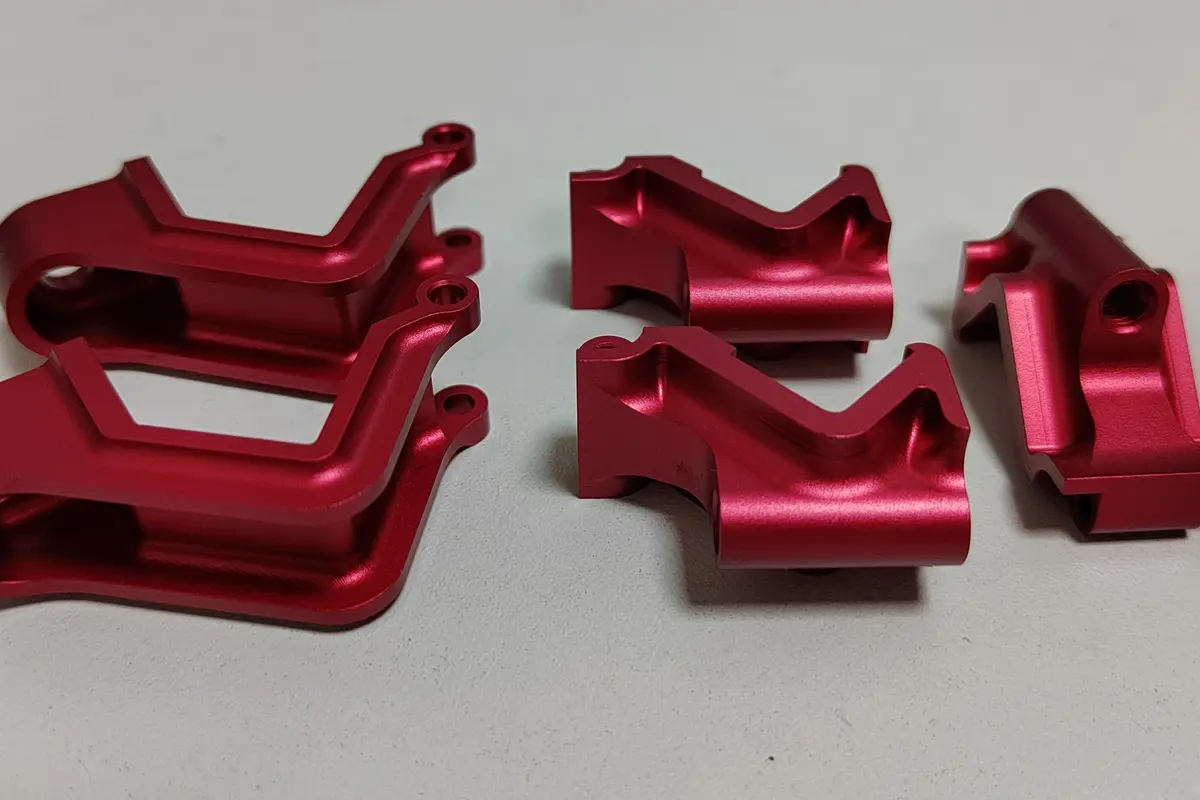
Titanium forms a stable oxide layer and performs well in many corrosive settings. Aluminum also performs well when the grade and finish suit the environment; anodizing is commonly selected for protection, wear, and appearance. Neither choice removes the need to consider galvanic corrosion. When dissimilar metals are fastened in a wet environment, specify electrical isolation or a compatible coating system.
Anodizing adds a controlled layer and should be planned with thread, press-fit, and cosmetic requirements. Titanium surface treatments depend on the purpose—cleaning, color, wear behavior, or medical validation—and should be called out by process rather than a vague “protective finish” note.
A useful decision path
Choose aluminum when thermal performance, production economy, and easy machining matter most. Move to titanium when the design cannot meet strength, corrosion, temperature, or biocompatibility requirements with an aluminum alloy and sensible geometry. For aerospace projects, material selection should be validated against the actual specification and verification plan; read our aerospace CNC machining overview.
What to include in the RFQ
Provide alloy and temper, annual volume, functional loads, critical tolerances, mating materials, required certificates, and finish. A manufacturing review before release can identify where material choice and geometry are driving unnecessary cost. Request a review through our CNC machining services.