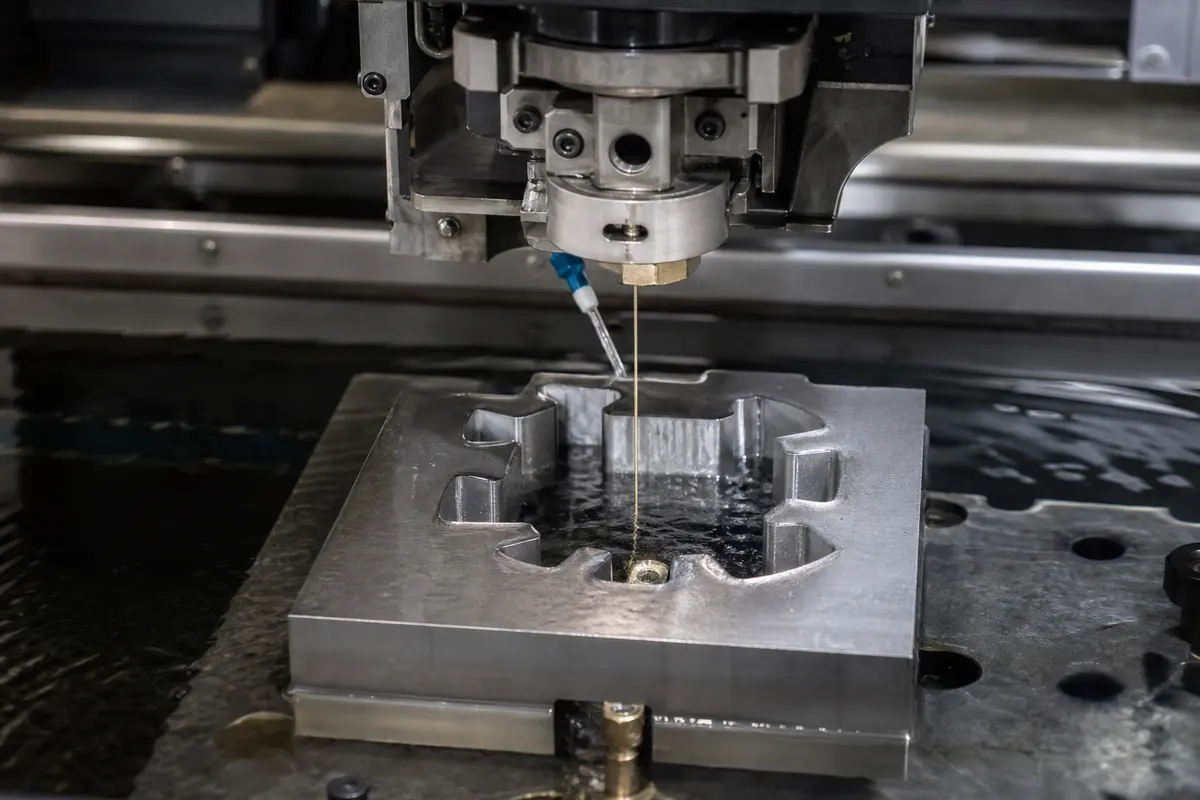
Wire EDM removes material with controlled electrical discharges between a continuously fed wire and a conductive workpiece. It is not a replacement for milling in every job. It is a specialist process for profiles and fine features where cutting force, material hardness, or corner accuracy makes conventional machining less suitable.
Best-fit applications
Wire EDM is commonly considered for hardened tool steel, carbide, titanium, and other conductive materials; punch and die profiles; narrow slots; small radii; precision fixtures; and components that cannot tolerate significant cutting force. It can achieve fine geometry without pushing a tool into the part, but it is typically slower than milling for simple open features.
Design details that decide feasibility
The wire has a diameter, so internal corners cannot be perfectly sharp. Specify the smallest acceptable corner radius rather than assuming a zero-radius corner. A through-cut generally needs access for the wire; an internal closed profile may require a start hole. Thickness, material conductivity, required surface condition, and whether the feature is through or blind all influence the process plan.
The electrical discharge can leave a recast layer. For critical fatigue, sealing, or medical applications, discuss skim cuts, surface requirements, and any post-process inspection before quoting. The required tolerance must also be tied to the part datum scheme rather than stated as a universal number.
Wire EDM versus CNC milling
Use CNC milling for fast material removal, pockets, 3D surfaces, and general-purpose production features. Consider wire EDM when the profile is difficult to mill, the material is already hardened, a very narrow slot is required, or forces from a cutting tool could distort the part. Hybrid jobs often use milling to prepare stock and EDM for the critical profile.
For a complete part, share the CAD model, material condition, thickness, feature callouts, and inspection requirements. Our CNC machining team can help determine whether EDM should be a primary operation or a finishing operation within the process route.