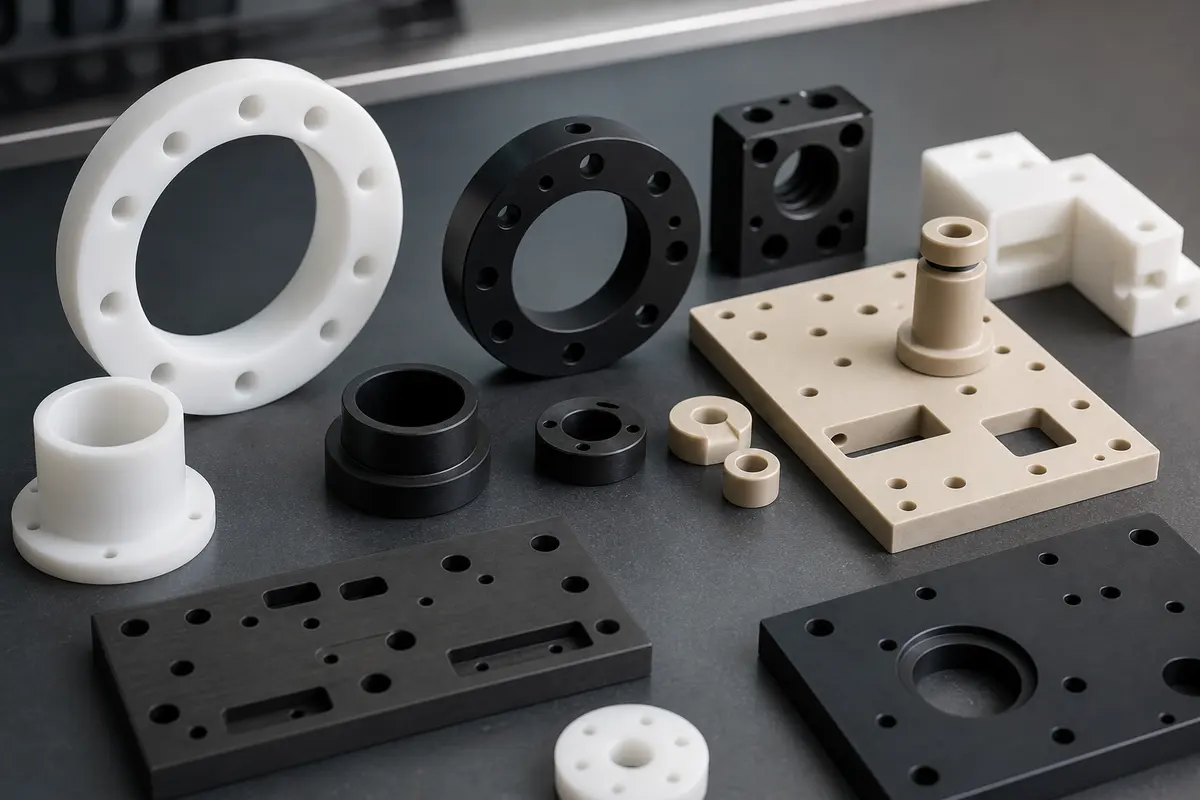
Plastic selection for CNC machining is a design decision, not a color or price decision. The same part geometry can behave very differently in ABS, acetal, nylon, PEEK, or PTFE because plastics move with heat, moisture, and machining stress.
Match the plastic to the operating condition
| Material family | Useful characteristics | Common CNC applications |
|---|---|---|
| ABS | Economical, impact resistant, easy to machine | Prototype housings, covers |
| Acetal / POM | Low friction, good dimensional stability | Gears, wear pads, fixtures |
| Nylon | Tough and wear resistant; absorbs moisture | Bushings, guides, mechanical parts |
| Polycarbonate | Impact resistant and transparent | Guards, optical covers, enclosures |
| PEEK | High temperature and chemical resistance | Semiconductor, medical, aerospace components |
| PTFE | Chemical resistance and low friction | Seals, insulators, fluid-system parts |
Tolerances need context
Do not copy a metal tolerance onto a plastic part without considering condition of use. A bore can change with humidity or operating temperature, and a thin wall can relax after release from the fixture. Identify the temperature range, media exposure, moisture exposure, and whether a dimension is measured immediately after machining or after conditioning.
For tight fits, use a material with appropriate stability, define the measurement condition, and leave enough wall thickness around critical bores. Acetal can be a strong choice for moving precision parts; PEEK may be justified when temperature or chemical demands exceed standard engineering plastics. Review individual options in our plastic CNC machining materials hub.
Design and machining notes
Sharp internal corners concentrate stress, while very thin walls can deflect under cutting forces. Add radii where function allows and use ribs instead of simply increasing a large wall. For cosmetic faces, specify whether tool marks are acceptable; some plastics polish poorly or show clamping witness marks more readily than metals.
Plastic chips can retain heat and melt if the process is not controlled. The machinist may use different tools, lower heat input, air assistance, or staged finishing to protect surface quality. These choices should be set during DFM, especially for transparent, soft, or high-performance polymers.
Avoid material-by-name substitutions
“Use an equivalent plastic” is risky when the part relies on dielectric behavior, UL requirements, chemical compatibility, or traceability. Name the resin family, grade if known, color, and any certification requirement. For a part-focused RFQ covering geometry, conditioning and inspection, see our custom plastic machined parts service. Then send the drawing, expected volume, mating-part details, and operating conditions to request a custom machining review.